Akhtar Raja
Qatar 22 seems to have thrown open another chapter in the global culture wars. This time seemingly between the current LGBTQ orthodoxy and Islamic values and norms as practised in Qatar. Without turning this into a left-right argument, it is worth reflecting on the Qatari or Islamic position in the hope that some respect prevails and the football isn’t overshadowed.
Usually what is socially acceptable is determined by what a culture regards as its values. Those values invariably include a set of morals recognised and accepted by mainstream society. Qatari citizens essentially comprise mainstream Muslims. To them, Islam is synonymous with their culture, values, and ideology.
During her tenure as the Home Secretary the Rt Hon Theresa May MP made statements defining British values. Those included, amongst other things, ‘regard for the rule of law, participation in and acceptance of democracy’.
Interestingly, the rule of law, whether British or as enunciated by the European Court of Human Rights, does not oblige any person to promote belief of something they profoundly disagree with - including, moral turpitude issues. That would be a violation of their rights. The rule of law (whether secular or faith based) is aimed at reducing friction in society, ultimately, with varying degrees of success.
Morals in a democratic society are formulated generally by what it regards as acceptable - representing its values at the time. It thereby makes allowance for or prohibits prevailing lifestyles and the associated rights and freedoms of members of society. Often morals are sanctioned by parliamentarians and translated into or reformulated as laws. Of course, some morals may remain fairly constant over time and indeed may even have been adopted from other cultures historically. But the bottom line is they are amenable to change.
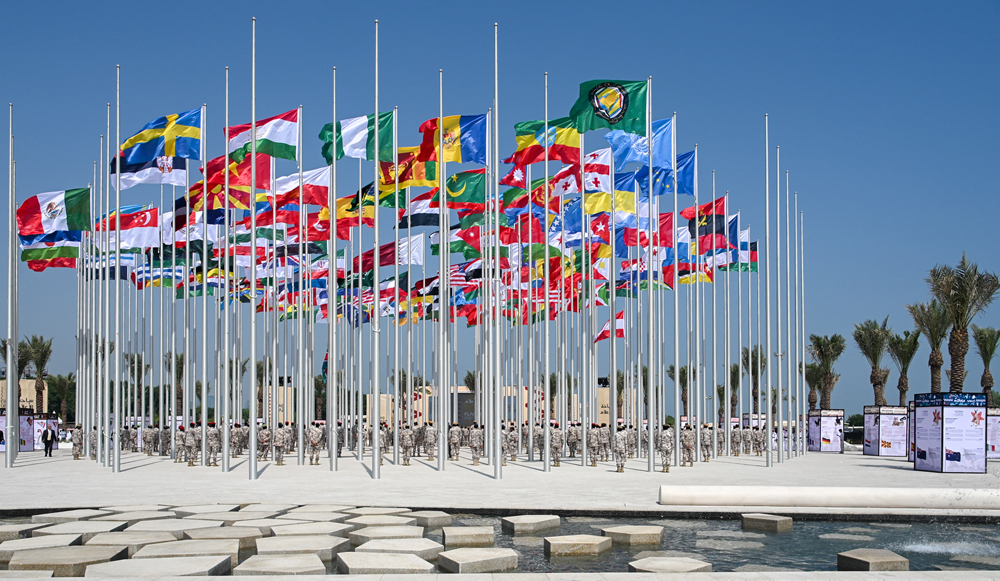
Museum of Islamic Art Flag Plaza
In Islam there is no such accommodation. Morals emanate from a unitary God - an Abrahamic God. He creates, gives life and sets out the code for adherence to a way of life. This code of values is not open to any interference or evolutionary development led by society, parliament, or monarchy. How can the two be reconciled or how can one be given preference over the other? This would entail an intellectual discourse about the ontological, cosmological, and teleological basis for the existence of God. Arguments would, by definition, need to address philosophical, historical, anthropological, and scientific positions. These debates are ongoing. Many people have arrived at a conclusion. Others have not. Regardless of this, the right to differ is an absolute right - one that not only exists in a democracy but in Islam too.
Peoples’ acceptance and rejection of the existence of God will always remain.
The focus must therefore be on how to avoid insult and clash between societies that differ.
The expectation that one should be given preference or regarded as superior over the other is a product of hubris. It exhibits little or no tolerance of ‘the other’ and creates friction.
Generally, in societies there will either be supremacy of Parliament (representing its citizens) or supremacy of God. Whichever set of values anyone follows they will, as human nature dictates, drift between moral and immoral conduct. There is of course a third category. Those who ascribe to no morals at all. In other words, they are content with amorality.
The personal lifestyles of visitors coming to Qatar are of no concern to the Qatari government. However, Qatar expects - as does any other nation - the same level of dignity and respect for its values and culture. There is no expectation that others must conform. So why must Qatar change by abandoning its values? Qatar has not detracted from extending the widest and warmest possible hospitality to all visitors and competitors alike. This is innate Arab culture. A culture bound up in religious values.To expect Qatar to transform the basis of its culture displays a profound lack of understanding. This is beginning to spurn an undercurrent of vitriol that divides and creates acrimony.
Let sport do what it does best and unite competitors and fans alike. The global adoration for this tournament should be permitted to seep and spread into a wider understanding and mutual respect for different societies - as was always the intention.