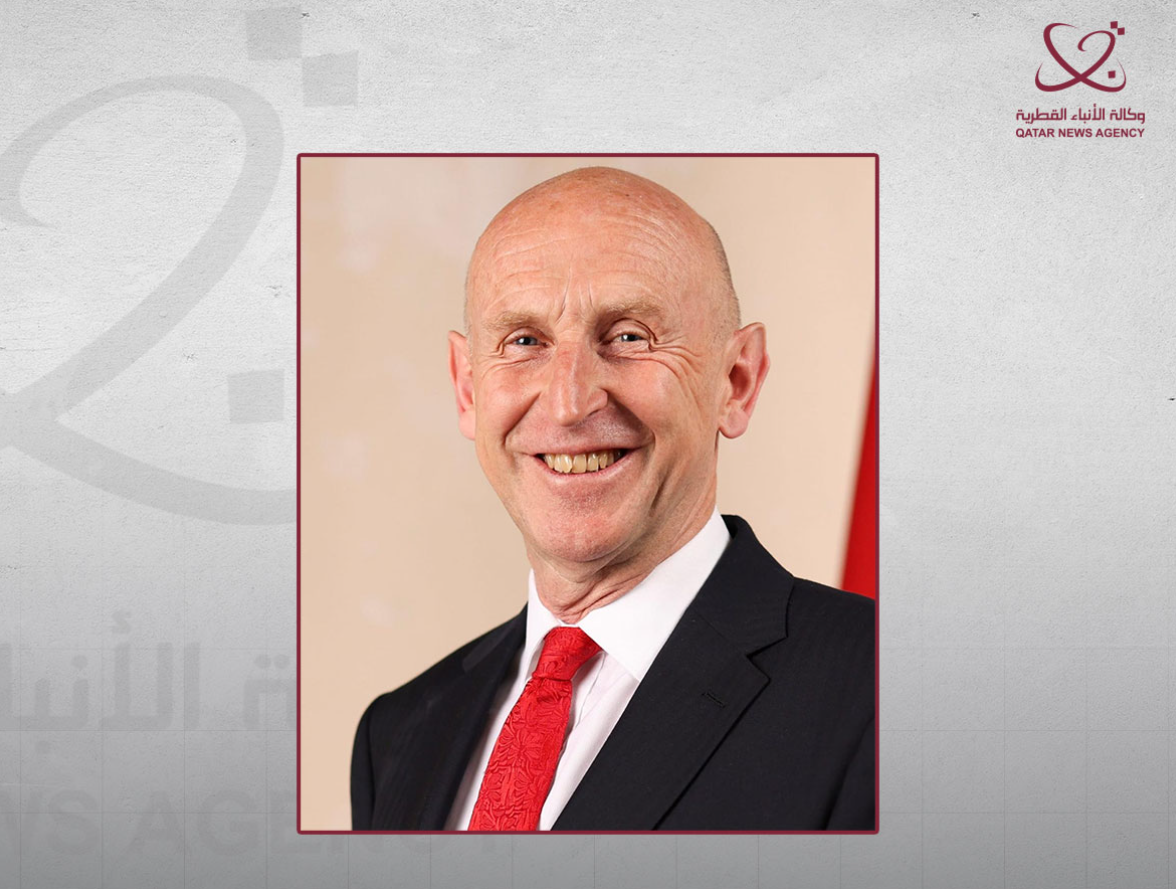
Doha, Qatar: UK Defense Secretary HE John Healey affirmed that his country stands with Qatar and its partners in the Gulf in the face of Iran’s widespread attacks on the region.
Speaking to Qatar News Agency (QNA) during his visit to Doha, he said the visit aimed to discuss the latest security developments and explore ways to further deepen cooperation.
He added that his message to Qatar and Gulf partners was that "Britain stands with you. We are not watching from a distance - we are here, shoulder to shoulder as you defend your skies from Iran's widespread attacks. I am grateful for all that Qatar is doing to support security in the region."
He noted that he had the honor of meeting HH the Amir Sheikh Tamim bin Hamad Al-Thani, the Amir of the State, as well as HE Prime Minister and Minister of Foreign Affairs Sheikh Mohammed bin Abdulrahman bin Jassim Al-Thani, HE Deputy Prime Minister and Minister of State for Defense Affairs Sheikh Saoud bin Abdulrahman bin Hassan Al Thani, and senior Qatari defence officials, where they discussed overall defence cooperation between the two countries.
HE the UK Defence Secretary stressed his country’s commitment to Gulf security, saying that "Britain's commitment to Gulf security is not just words - it is demonstrated every day by our forces flying defensive missions across this region alongside our partners, and our air defence teams and systems integrated with Gulf nations."
He described Iran’s attacks as dangerous and widespread. Iran has fired over 3,500 missiles and drones, striking civilian infrastructure, desalination plants, airports and hotels across the Gulf since the conflict began.
He added that the threat posed by Iran to regional security was being taken very seriously by the United Kingdom, noting that "the threat Iran poses to regional security is severe and real, and we take it extremely seriously. That is why the UK has been flying defensive missions alongside partners in the region from day one of this conflict, and why we continue to step up our support to Gulf partners."
He stressed that the UK has significantly strengthened its defensive military presence in the region and will continue to do whatever is necessary to protect its allies and interests. He noted that the UK has significantly enhanced its defensive military presence in the region and that it will continue to do whatever is necessary to protect its allies and British interests.
He noted that the United Kingdom had agreed with Qatar last January to deploy the joint 12Squadron, with additional aircraft deployed at the beginning of March.
He also pointed out that the United Kingdom had deployed F-35 aircraft, air defense systems, and counter-drone teams in the region before the conflict, noting that these preparations made a tangible difference from the very first day.
"We now have more jets flying in this region than at any point in the last fifteen years, with our aircrew having completed over 1,100 hours of defensive operations. We have deployed HMS Dragon to the Eastern Mediterranean, extended our Typhoon deployment in Qatar," he said.
He noted that his current visit to Doha dealt with discussing the latest security developments, the ongoing threat from Iran, and ways to enhance defense cooperation. He said: "This is a partnership that continues to grow stronger, and I am proud that the UK has been able to support Qatar."
He described the US as the UK's principal defence and security partner, noting that the two countries' commanders were in communication daily.
He noted that Britain agreed to the US request to use its bases for specific and limited defensive operations, including degrading missile sites used to attack ships in the Strait of Hormuz, in line with international law and collective self-defense for UK’s long-standing friends and allies and in accordance with international law.
He stressed that the UK has made a deliberate decision not to join offensive action.
Regarding the expected British role in protecting vital maritime routes in the Arabian Gulf, including the Strait of Hormuz, he said that "freedom of navigation is a fundamental principle of international law, and Iran's attacks on commercial shipping and its de facto closure of the Strait of Hormuz are completely unacceptable.
He stressed that the UK was working urgently with partners to develop a multilateral plan to restore navigation, noting that any plan it contributes to must be multilateral, viable, and consistent with international law.
HE the UK Defence Secretary warned of the seriousness of the current situation, highlighting them as "deeply uncertain times, and I will not minimise the seriousness of the situation. Iran has already struck over ten countries, hitting civilian infrastructure, hotels and airports. The risk of further escalation is real."
He added that the United Kingdom’s approach is based on three clear principles: defensive action only, close coordination with allies, and a firm legal basis for everything it does.
He reaffirmed that his country will not be drawn into a wider war, emphasizing that its focus remains on collective defense, urging Iran to immediately cease its attacks, and working with partners to pursue a diplomatic path forward.
His Excellency also stressed that the United Kingdom seeks to bring this conflict to an end, noting that it deliberately did not participate in the initial strikes on Iran because it believes that the best path forward for the region and the world is through diplomacy.
In concluding his interview with the Qatar News Agency (QNA), the UK Defence Secretary emphasized that the United Kingdom will continue to push strongly for a swift resolution to the conflict, in close coordination with its allies and partners, while also continuing to defend its people, support its allies, and stand by its partners in the Gulf for as long as necessary.