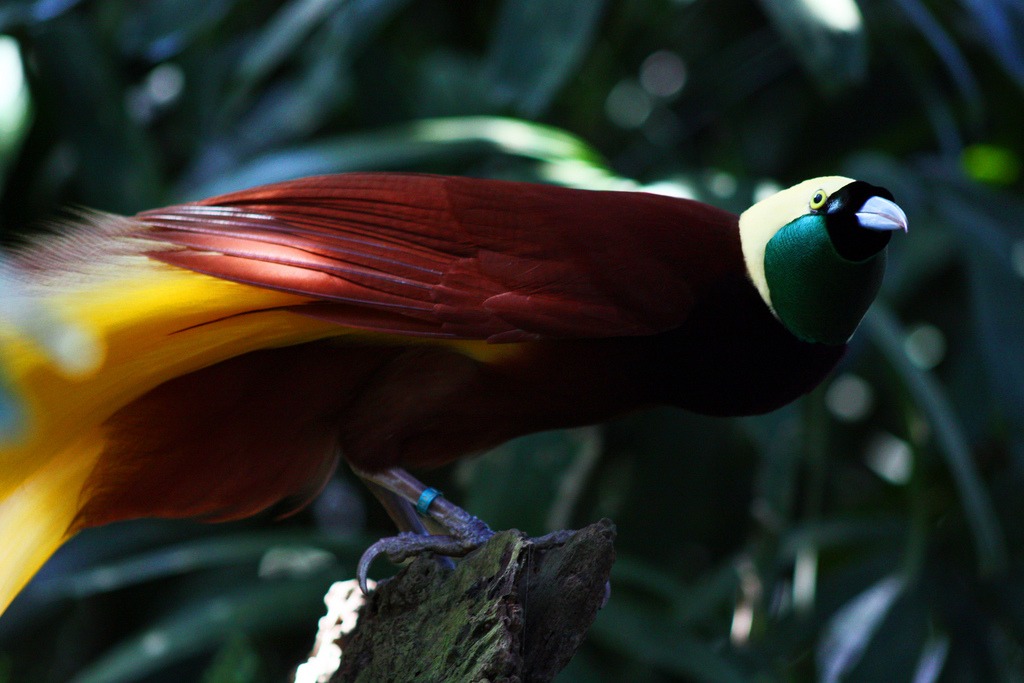
Greater Bird of Paradise by Andrea Lawardi / Wikimedia Commons / CC BY 2.0
A recent scientific discovery about birds-of-paradise living in the dense tropical forests of Oceania revealed their ability to send secret, glowy signals to other birds, offering interesting news for birders and "twitchers" (people who go to extraordinary lengths to see new bird species) worldwide.
Studies published in early 2025 in the Royal Society Open Science journal show that most birds-of-paradise are biofluorescent, meaning they can absorb sunlight and emit it as a glowing color.
This glow is invisible to human eyes, but is clearly visible to birds, which have a more advanced visual system.
What looks colourful to humans may appear even more dramatic to birds-of-paradise.
Their feathers, skin and even parts inside their mouths glow in shades of green, yellow, and pale blue when exposed to ultraviolet or blue light. Out of 45 known species, researchers found biofluorescence in 37.
How scientists made the discovery
The discovery was made by a team of scientists while studying preserved bird specimens at the American Museum of Natural History. Some of these specimens were more than 100 years old.
Using UV and blue flashlights, researchers examined the birds in dark conditions. They wore special yellow filter goggles that blocked reflected light and allowed only fluorescent light to be seen. When the feathers absorbed the high-energy light, they released it as a bright glow.
In many cases, glowing patches across the birds’ bodies were found; around 82 percent of the species examined showed strong yellowish-green fluorescence.
The glowing areas varied by species, some appeared on tails, others on the chest, belly, head, feet or around the eyes.
Almost all biofluorescent species also showed glowing patches inside their mouths, a feature often displayed by males during courtship rituals.
Why did Birds-of-paradise develop this glow?
Scientists believe biofluorescence evolved as part of the intense competition among birds-of-paradise during mating.
Males already rely on bright colours, unusual feather shapes and complex movements to attract females.
The study conveyed that glowing feathers act as an additional visual signal, making these displays even more effective.
Researchers also found that glowing areas are often located on body parts males actively show during courtship, such as the mouth, chest, head and tail.
In many species, the fluorescent feathers are surrounded by very dark or ultra-black feathers.
This contrast may help the glow stand out more clearly, especially during displays in low or filtered light.
Another clue lies in the species that do not glow. Birds-of-paradise without biofluorescence tend to be more monogamous and face less competition in finding mates. This suggests that glowing feathers evolved mainly where strong visual signals were needed.
Females also show biofluorescence, but their glow is dimmer and more mottled, supporting the idea that brighter fluorescence plays a bigger role in male courtship rather than general appearance.
A mystery still waiting to be solved
Despite these findings, researchers say many questions remain unanswered.
Birds-of-paradise live normally in dense rain-forests where sunlight is uneven and often blocked by thick vegetation. How clearly bio-fluorescence works in such conditions is still unclear.
Researchers hope that future field observations will help explain how visible these glowing patches are in the wild and how birds actually use them during real-life interactions.
What is clear, however, is that birds-of-paradise have been hiding an extraordinary feature in plain sight, reminding us once again that nature still holds many secrets waiting quietly to be discovered.
There are more than 11,000 known bird species, but only a handful of groups are known to fluoresce.
Other researchers previously described biofluorescence in auks, bustards, owls, nightjars, parrots, penguins and puffins, but little is known about how they use biofluorescent signals, the study authors reported.