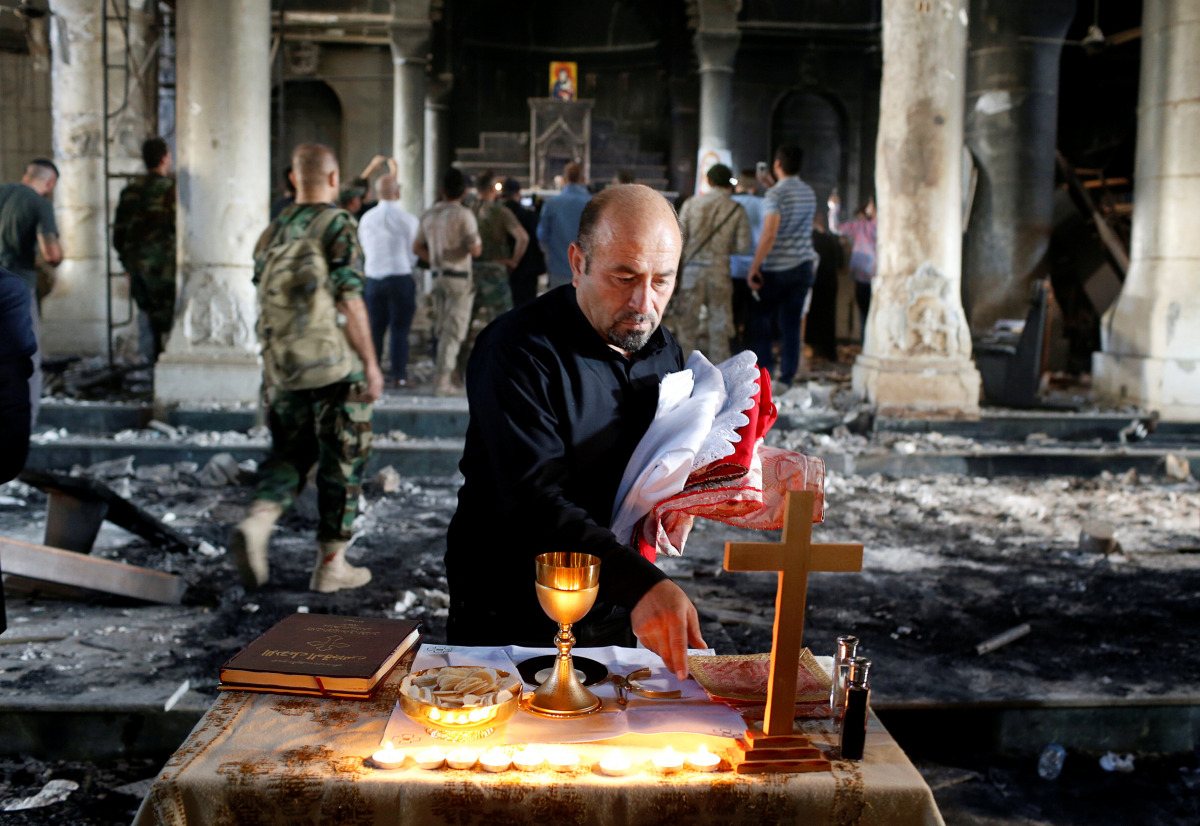
An Iraqi Christian prepares for the first Sunday mass at the Grand Immaculate Church since it was recaptured from Islamic State in Qaraqosh, near Mosul in Iraq October 30, 2016. REUTERS/Ahmed Jadallah
Qaraqosh, Iraq: A handful of faithful gathered in a burnt out church Sunday for the first mass to be celebrated in two years in Qaraqosh, which was once Iraq's main Christian town.
Iraqi forces retook Qaraqosh from the Islamic State group days earlier, as part of a massive offensive to wrest back the country's second city Mosul.
"After two years and three months in exile, I just celebrated the Eucharist in the cathedral of the Immaculate Conception the Islamic State wanted to destroy," Yohanna Petros Mouche, the Syriac Catholic Archbishop of Mosul, said.
"But in my heart it was always there," Mouche, who officiated with four priests, told AFP.
IS jihadists took over swathes of Iraq in June 2014, taking over Mosul where the prelate was based.
He moved to Qaraqosh, a town with a mostly Christian population of around 50,000 that was controlled by Kurdish forces and lies east of Mosul in the Nineveh plain.
But a second jihadist sweep towards Kurdish-controlled areas two months later forced around 120,000 Iraqi Christians and members of other minorities to leave their towns and villages.
"We had no other choice but to convert or become slaves. We fled to preserve our faith. Now we're going to need international protection," Father Majeed Hazem said.
Donning a resplendent chasuble and stole, Mouche led mass on an improvised altar in front of a modest congregation mostly made up of members of the Nineveh Plain Protection Units (NPU), a local Christian militia.
- 'Damaged but still standing' -
"I can't describe what I'm feeling. This is my land, my church," said Samer Shabaoun, a militiaman who was involved in operations to retake Qaraqosh.
"They used everything against us: they shot at us, they sent car bombs, suicide attackers. Despite all this, we're here."
Shortly before Sunday's mass, the soldiers now guarding Qaraqosh were surprised to find two elderly women in a bouse, one of them bedridden.
"We stayed the whole of the occupation by the Islamic State, from the first day. Sometimes they would bring us food," one of them said.
The bell tower of the church was damaged, statues decapitated and missals strewn across the nave floor, which is still covered in soot from the fire the jihadists lit when they retreated.
But some of the crosses have already been replaced and a new icon was laid on the main altar, where the armed militiamen took turns to light candles.
"This church is such a powerful symbol that if we hadn't found it like this, damaged but still standing, I'm not sure residents would have wanted to come back," Mouche said.