Tashkent, Uzbekistan: Speakers stressed that technology should complement rather than displace human expertise, particularly in journalism. Journalism must adapt to artificial intelligence and an increasingly complex digital information environment without surrendering its fundamental commitment to truth and objectivity, media and government figures said in Tashkent, as Uzbekistan seeks a larger role in connecting Central Asia with international audiences.
Speakers at the International Media Forum on Islamic civilization placed journalism at the centre of two rapidly unfolding transformations: the technological disruption of the media industry and the strengthening of political, economic and cultural links between Central Asia and the wider world.
Sherzod Asadov, Press Secretary to the President of Uzbekistan, said the modern information environment offered unprecedented possibilities for reaching millions of people within seconds but had simultaneously created serious risks through disinformation, manipulation, deepfakes, fake news and coordinated information attacks. Artificial intelligence was rapidly transforming journalism, he said, but should expand the professional capabilities of journalists rather than replace them. He said the contemporary journalist was increasingly becoming a multimedia professional expected to combine writing with storytelling, visualisation, infographics, filming, editing, graphic design and content production.
Despite that technological transformation, Asadov said, the underlying principles of journalism remained unchanged: truth, objectivity, professional conscience and respect for human interests.
He also raised concerns about freedom of expression and the credibility of journalism when media principles become subordinate to political considerations. Journalism based on fairness, responsibility, factual accuracy and public interest, he argued, was essential to maintaining public confidence.
He added that protecting national interests should not mean isolating a country from the outside world, but should instead depend on factual reporting, objective coverage and greater openness within society. Uzbekistan’s media landscape has expanded in recent years. According to figures cited in his address, the number of media outlets increased from 2,004 in 2022 to 2,277 in 2024, with non-state media accounting for approximately 70 percent of the sector.
Asadov said journalists were not merely transmitters of information but also played an important social role by hearing citizens’ concerns, raising significant issues and carrying the public voice to state institutions.
“That responsibility extends to explaining Uzbekistan’s history and intellectual heritage to audiences abroad.” Asadov described Islamic civilization primarily as a civilization of knowledge, enlightenment, intellectual inquiry and progress, saying the legacy of Al-Khwarizmi, Al-Biruni, Ibn Sina, Imam al-Bukhari, Imam al-Tirmidhi, Imam al-Maturidi and Ulugh Beg belonged to humanity as a whole.
The link between that intellectual history and the contemporary technological world remains visible, he noted, in the term “algorithm,” which derives from the Latinised name of Al-Khwarizmi.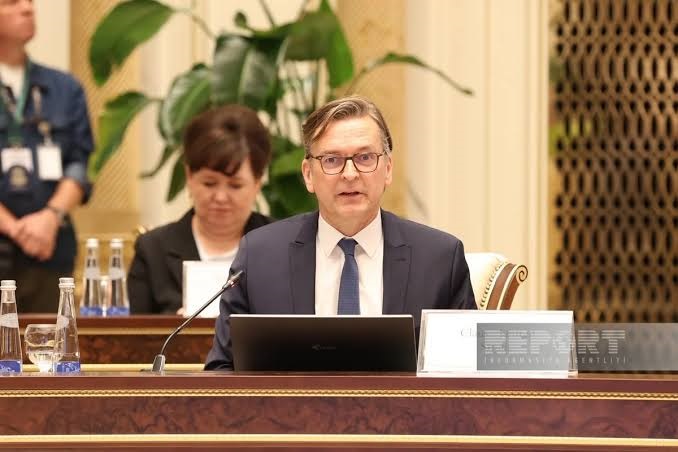 CEO and Editorial Director of Euronews Claus Strunz
He said historical heritage should not remain confined to museums and books but should be presented through modern digital formats and in language understandable to younger generations and international audiences. International journalism, he added, should build bridges rather than walls, strengthening understanding and dialogue between countries and societies.
The growing strategic importance of that bridge between Central Asia and the wider world was also emphasised by CEO and Editorial Director of Euronews Claus Strunz, who described Uzbekistan as occupying a historic crossroads between Europe, Persia, India, China and the Arab world. He argued that Europe should again look more intensively towards the East as its relationship with Central Asia enters what he described as a renaissance.
The emerging Silk Road, he said, should be viewed as far more than a network of roads and railways. “It could develop into a global network carrying high technology, algorithms, science, knowledge, languages, architecture, innovation, ideas and information.”
Information, he stressed, had always travelled along the Silk Road while news once crossed deserts and trading routes, the contemporary version moves through “bits and bytes.” Tashkent, Samarkand and Bukhara, he suggested, have the potential to become centres of the digital world, while Uzbekistan’s population, geographical position and relationships with neighbouring countries give it a significant role in closer Europe–Central Asia relations. He said the growing proximity between Europe and Central Asia represented both an opportunity and a responsibility, with political leaders required to establish the necessary framework for sustainable cooperation.
He pointed to the EU–Central Asia Summit in Samarkand and subsequent initiatives as evidence of the growing relationship, while stressing that journalists had a responsibility to examine such developments critically and determine whether commitments were being implemented seriously and sustainably.
That scrutiny, he said, formed part of the media’s broader role during major political, economic and technological transformations.
“Journalists should report what is actually happening, fight disinformation and build trust, provide platforms for exchanging opinions and ideas, communicate culture and history, bring people together and encourage innovation,” he added. The messages from the forum converged on a central challenge confronting contemporary media: technology has dramatically expanded journalism’s reach and capabilities while simultaneously increasing the speed at which false or manipulated information can circulate. For Uzbekistan and the wider Central Asian region, speakers argued, credible international journalism will therefore be increasingly important as economic, technological and cultural connections deepen.
The task facing the media is not simply to report that transformation, but to scrutinise it, explain its historical context and ensure that the expanding flow of information between Central Asia and the rest of the world strengthens understanding rather than adding to mistrust and misinformation.