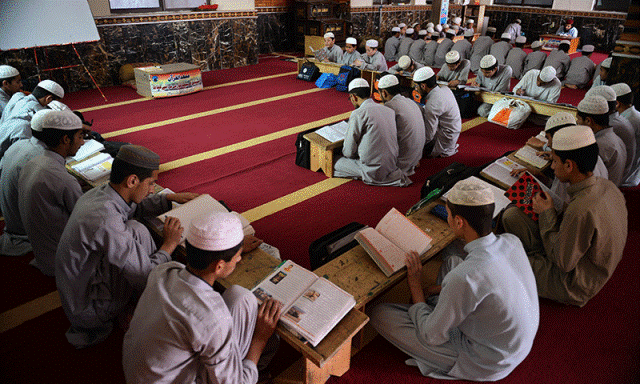
ISLAMABAD: After a much publicised and energetic start in the wake of the attack on APS Peshawar, Pakistani government’s efforts to reform religious seminaries in the country seem to have been buried under official files. This is not surprising to those who have followed the previous reform processes launched in 2004 and 2010.
When the effort was launched, as part of National Action Plan (NAP), Interior Minister Chaudhry Nisar Ali Khan was at pains to point out that his government was not painting all seminaries with the same brush; he said that “around 10pc of madaris were involved in terror activities.”
And while he may have made all the right noises to allay the fears of seminaries, it was the Ministry of Religious Affairs that initially took up the responsibility.
Later, the subject was shifted back to the interior ministry, along with the Federal Ministry for Education.
“Previously, it was decided that the Ministry of Religious Affairs would coordinate with the religious seminaries but now the interior ministry and the Ministry of Higher Education are jointly executing this task,” said Noor Zaman, a spokesman for the religious affairs ministry.
“However, the matter has been forwarded to the education and home departments of the four provinces, GB and the AJK,” he added.
In other words, the federal government is now waiting for the provincial governments to carry out the ‘reform’.
However, what this game of ping pong between federal ministries and then provincial does not reveal is that in the process, the intentions of the state have also been downgraded as an interior ministry official points out, “Initially, the government was pushing for reforms but now the matter has been reduced to getting them registered only.”
Meanwhile, the main five seminary boards are blaming the government for its lack of interest.
“We had rejected the six-page madressah registration and annual report form in the meeting jointly chaired by army chief and the prime minister in October and our point was accepted,” said Mufti Munibur Rehman, convener of the Ittehad Tanzeemate Madaris-i-Deenya (Ittehad).
The Ittehad is the joint platform of the five main madressah boards (wafaq) in the country that register madressahs, set their curricula and conduct exams.
These wafaq are - Wafaqul Madaris al Arabia (Deobandi), Tanzeemul Madaris Ahle Sunnat Pakistan (Barelvi), Wafaqul madaris al Shia, Wafaqul madaris al Salfia (Ahle Hadith) and Rabtatul Madarisul Islamia for seminaries affiliated with Jamaat-i-Islami.
Mufti Munibur Rehman said new forms had been forwarded to the government - one relates to the registration of the seminary and the other focuses on the annual data, which includes details of expenditures, income and information related to students and teachers.
“But, a month later, we have not gotten a reply,” he added.
In fact, the federal government’s decision to reinvent the wheel by holding several rounds of discussion with the board representatives for most of 2015 also annoyed the seminarians.
“After serious deliberations, we had signed an MoU in 2010 with the then interior minister, Senator Abdul Rehman Malik,” said Niaz Hussain Naqvi, of Wafaqul Madaris al Shia.
“But what happened to it?
The incumbent government continues to disregard all that hard work.”
But as the reformation process turns into a registration exercise, there is no doubt that there are several issues that are not palatable to one side or the other.
“The Wafaq leaders want to be treated like ordinary educational institutes but this is not possible,” said an official of the interior ministry.
The official said in the meeting held in April 2015, the elders of five Wafaq were told that unlike school and colleges, a large number of madressahs were built on encroached land.
This was not the only difficult issue the government brought up.
“A large number of madressahs house students from far-flung areas in inadequate hostels” but the management of the boards didn’t allow the discussion to proceed.
But the most uncomfortable issue related with madressahs was the alleged links of some seminaries with terrorism, and many of them have been raided by the law enforcement agencies.
The last raid was carried out in August when the combined teams of law enforcement agencies along with several intelligence agencies raided five in the federal capital, including Jamia Haqqania, on 8th Avenue.
In August alone, Islamabad police accompanied with intelligence officials conducted searches in 25 seminaries in Islamabad capital territory.
Incidentally, all the seminaries raided and searched in the capital belonged to the Deobandi sect.
Such was the fear and resentment that Qari Hanif Jalandhari, the general secretary Wafaqul Madaris al Arabia, the board representing seminaries of the Deobandi sect, wrote a hard-hitting article in an Urdu newspaper, warning the PML-N government that the rightwing voters would eventually withdraw their support from the party.
Though there has not been any raid on the seminaries since August, Qari Hanif Jalandhari continues to decry the government.
“The PML-N, which has been elected on Muslim votes, has imposed a tax on Zakat which is against Sharia,” he said, referring to the withholding tax on all banking transactions.
“We have written a letter to the finance minister but he has not replied. We demand that there should not be any tax on mosques and madressahs,” he added.
But when asked about alleged links of terrorism with seminaries, he said a majority of terrorists and criminals in Pakistan and the West were university graduates but that did not mean that universities should be closed down.
Internews