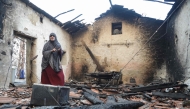
A disaster rescue personnel looks on at the site of damaged buildings in the aftermath of flash floods at Trishuli Bazar in Nepal's Nuwakot district on August 29, 2026. (Photo by MANAN VATSYAYANA / AFP)
Bidur, Nepal: Rescuers in Nepal and China on Saturday battled to locate thousands of people missing days after a deadly, tsunami-like wall of water and debris swept through the Himalayan region, engulfing entire villages.
Figures from both countries put the number of missing close to 3,000, with 682 bodies recovered -- and reports of some dead possibly swept downstream as far away as India.
In a breakthrough late Saturday, the Nepali army was able to insert a pipe into a tunnel at the Trishuli 3A hydroelectric site where workers are believed to be trapped.
"We have already started sending air through the small opening, and we will now begin excavation work and send the rescue team inside," Home Minister Sudan Gurung said in a statement.
More than 100 workers may still be alive and trapped inside such tunnels, with rescue efforts focused on the Trishuli 3A and 3B sites.
The US Geological Survey said a glacial collapse was behind the deadly torrent on Wednesday at the Nepal-Tibet border.
While the exact cause of the collapse is unclear, climate change is causing glaciers to melt worldwide, increasing the risk of such disasters.
"The sudden glacial collapse and flash flood is a devastating reminder of how fragile these mountain environments can be", UN climate chief Simon Steill said in a statement.
"We also know a warming climate, driven by humanity burning colossal amounts of coal, oil and gas, is making tragedies like this one, and so many others around the world, much more likely, frequent and severe, with vulnerable communities often hardest hit," he added.