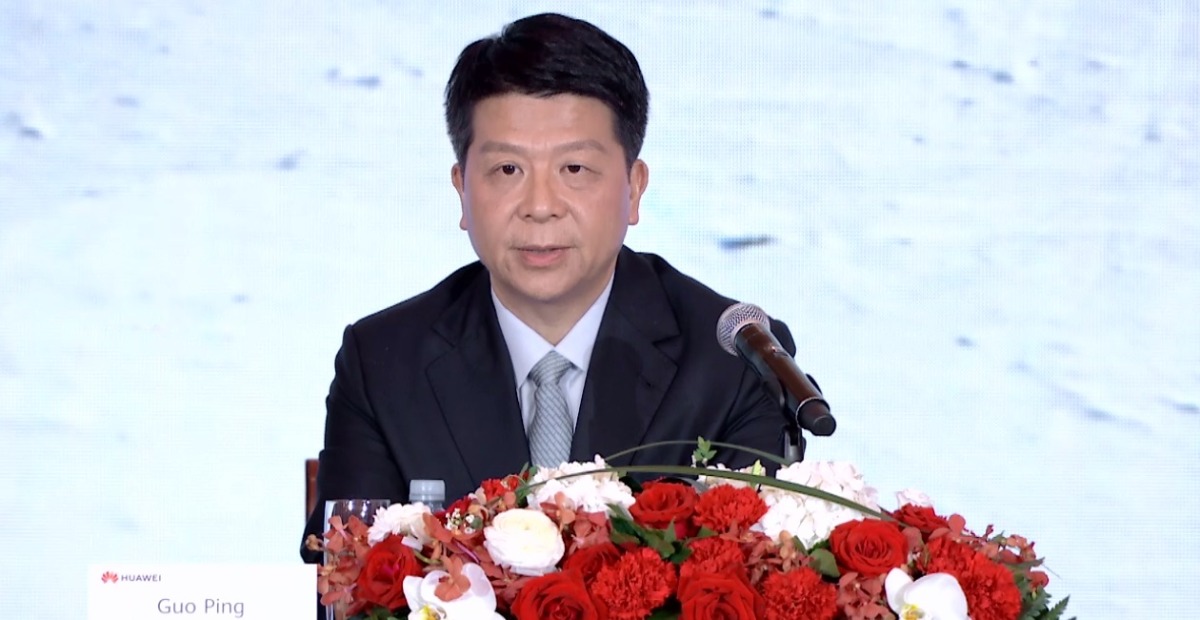
Guo Ping, Huawei’s Rotating Chairman at the Huawei Annual Report 2021 press conference
Doha: Huawei has maintained solid operations throughout the past year, revealed its 2021 Annual Report, which was released yesterday. As per the report, Huawei achieved $99.9bn in revenue in 2021, and $17.8bn in net profits, an increase of 75.9 percent year-on-year. The company’s R&D expenditure reached about $22.38bn in 2021, representing 22.4 percent of its total revenue, and bringing its total R&D expenditure over the past 10 years to over $132.5bn. Moving forward, the company also plans to continuously increase investment in R&D.
Guo Ping, Huawei’s Rotating Chairman, stated at the press conference, “Overall, our performance was in line with forecast. Our carrier business remained stable, our enterprise business experienced steady growth, and our consumer business quickly expanded into new domains. In addition, we embarked on a fast track of ecosystem development.”
Guo stressed, “Moving forward, Huawei will advance its journey of digitalization, intelligent transformation, and low carbon. Relying on talent, scientific research, and an innovative spirit, we will continuously increase investment to reshape our paradigms for fundamental theories, architecture, and software, and build our long-term competitiveness.”
Meng Wanzhou, Huawei’s CFO, also spoke at the event, “Despite a revenue decline in 2021, our ability to make a profit and generate cash flows is increasing, and we are more capable of dealing with uncertainty.” Thanks to the enhanced profitability of its major businesses, the company’s cash flow from operating activities dramatically increased in 2021, amounting to $9.3bn. Its liability ratio also dropped to 57.8 percent, and its overall financial structure has become more resilient and flexible.
In 2021, Huawei’s carrier business generated $44.1bn in revenue and helped carriers around the world deploy leading 5G networks. Third-party test results have found that 5G networks built by Huawei for customers in 13 countries, including Switzerland, Germany, Finland, the Netherlands, South Korea, and Saudi Arabia, provide the best user experience. By working with carriers and partners, Huawei has signed more than 3,000 commercial contracts for industrial 5G applications. These kinds of 5G applications are currently seeing large-scale commercial use in sectors like manufacturing, mines, iron & steel plants, ports, and hospitals.
Thanks to continuing digital transformation trends, Huawei’s enterprise business also grew rapidly, generating $16.06bn in revenue during 2021. In the past year, Huawei launched 11 scenario-based solutions for key sectors such as government, transportation, finance, energy, and manufacturing. The company also established multiple dedicated teams, including a Coal Mine Team, a Smart Road Team, and a Customs & Port Team, to combine resources in a way that more efficiently serves the needs of its customers. Over 700 cities and 267 Fortune Global 500 companies have chosen Huawei as their digital transformation partner and Huawei now works with more than 6,000 service and operation partners around the world.
Huawei’s consumer business zeroed in on consumer wants and needs, further building out the global ecosystem for a smart, all-connected era, as part of the company’s Seamless AI Life strategy for consumers around the world. This business generated $38.17bn in revenue in 2021 and continued to see steady sales growth in smart wearables, smart screens, true wireless stereo (TWS) earbuds, and Huawei Mobile Services (HMS). In particular, the smart wearable and smart screen segments both saw 30 percent+ year-on-year growth. In total, HarmonyOS was used in over 220 million Huawei devices as of 2021, becoming the world’s fastest growing mobile device operating system.
During the past year, Huawei also focused on building out its openEuler, MindSpore, and HarmonyOS ecosystems based on the principles of open collaboration and shared growth. Over eight million developers are currently using Huawei’s open platforms, open-source software, and development tools to explore new business scenarios and business models.