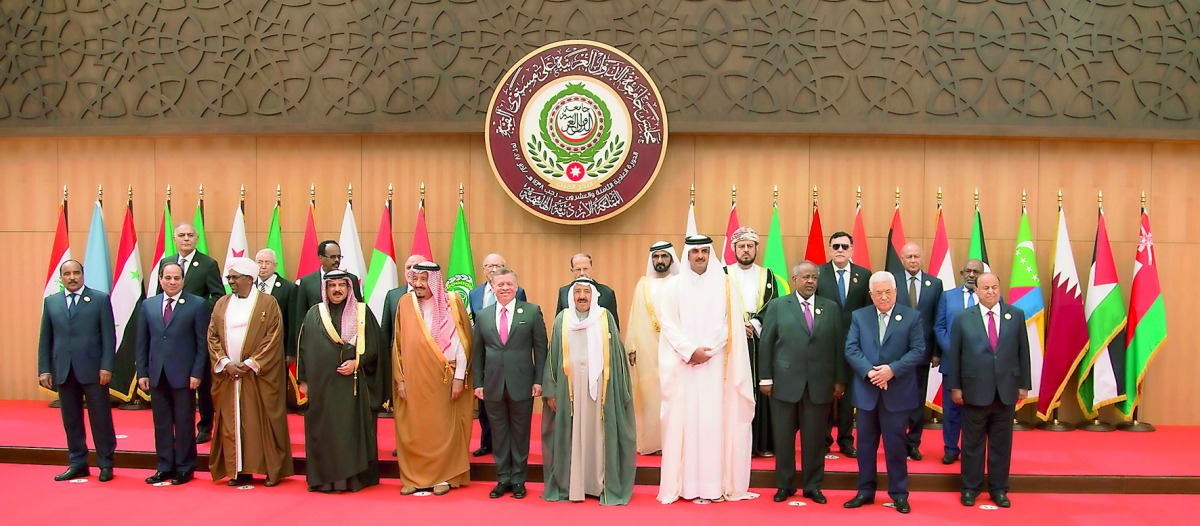
Emir H H Sheikh Tamim bin Hamad Al Thani with other Arab leaders at the 28th Ordinary Session of Arab League summit held at the King Hussein bin Talal Convention Centre in the Dead Sea area in Jordan, yesterday.
Emir H H Sheikh Tamim bin Hamad Al Thani said yesterday that Qatar will keep its pledge not to spare any effort in participating effectively in the joint Arab action to realise the security, stability and sustainable development of the Arab peoples.
Addressing the 28th Ordinary Session of the Summit-level Meeting of the Council of the Arab League at the King Hussein bin Talal Convention Centre in the Dead Sea area in Jordan yesterday, the Emir said that a genuine Arab solidarity is necessary for achieving the aspirations of the Arab people while its absence has negative effects.
The Emir said the gravity of the phase that “our pan-Arab homeland and the whole region are going through, and the obstacles on way of realising the aspirations of our peoples in development, security and stability require a lot from us in terms of realism, frankness, awareness, and conformity of words and deeds to spare our Arab Ummah the dangers.”
The Emir added that “the differences in our visions and attitudes towards some political issues facing our Ummah have led to negative effects on other non-political areas of cooperation. This indicates that the problem does not always lie in the disagreement itself, but in how to tackle it, and in the spillover of a political dispute to everything else.”
"In fact, we can unify visions and confront various challenges and surpass the current situations, since there are no intractable differences or disagreements between brothers, and even if some happened, despite all efforts, they should not impact the areas of cooperation that are of interest to our citizens and our societies,” said the Emir. The Emir stressed that the firm stance of Qatar on the Palestinian issue reflects the committed Arab stance that the peace process be based on a comprehensive, just and lasting settlement in accordance with international legitimacy and the Arab peace initiative based on the principle of a two-state solution to ensure the establishment of a Palestinian State on the borders of June 4, 1967 with East Jerusalem as its capital, and the right of return of the Palestinian refugees and ending the Israeli occupation of all Arab territories, including the Syrian Golan.
The Emir said unifying of the Palestinian ranks is an essential element in ending the occupation. There is no meaning and no point in a dispute over an authority that is devoid of sovereignty, in light of the occupation of the Palestinian territories, as no Palestinian State shall be founded without Gaza, and no State in Gaza shall be established either.
"Therefore, the State of Qatar is pursuing its efforts to end the state of division and restore unity to the national Palestinian action, in accordance with the Doha and Cairo accords.
We call on all Palestinian leaders to be endowed with wisdom and give priority to the supreme national interest by ending divisions, setting up a government of national unity to carry out the constitutional and executive tasks for restoring national unity to enable the Palestinian people achieve their legitimate aspirations for freedom and independence and to build their independent State with East Jerusalem as its capital,” said the Emir.
"While welcoming the ceasefire agreement in Syria, we stress the significance of acting to make it real and not a selective one that allows for displacements, in order to alleviate the suffering of the brotherly Syrian people, ensure the safety of civilians and speed up human aid access, since a lasting and comprehensive cease-fire represents a step towards the desired political solution”.
"We also firmly reassert that putting an end to the disaster of the brotherly Syrian people depends on adopting actions and decisions that bind the Syrian regime to implement the Geneva Conference (1) resolutions which stipulate the formation of a transitional governing body with full authorities, as well as the relevant resolutions of international legitimacy, which meet the aspirations of the Syrian people and allow them determine their future according to their choices,”
"We must not forget that the Syrian people have not been displaced by a natural disaster, but because the regime launched an all-out war against them, historically unprecedented, simply because they expressed their aspirations for freedom and dignity, turning the peaceful revolution into a civil war. Therefore, it is not possible to separate our humanitarian and political duty towards this people,” he added.
The Emir said that the Libyan brothers have no choice other than dialogue, consensus, and adherence to the outcome of the political accord signed in Skhirat, and moving forward on the path of political settlement to include all political forces in Libya without exclusion, with the rejection of chaos and reinstatement of dictatorship, which are two sides of the same coin.
"In this context, some of the brothers in Libya must refrain from using pretexts to avoid participating in the final political solution because of differences of opinion, personal interests, disputes over leadership and narcissism. These matters should not constitute an obstacle when the destiny of their country is in the balance.Building of the State and its institutions is the major challenge facing Libya. This is the mission! The national responsibility is to be measured now by contributing to this effort. Under this criterion, the attitude towards the active forces in Libya is determined,” said the Emir.
"Concerning Yemen, and as part of the Arab alliance, we reaffirm our commitment to the unity, territorial integrity and independence of Yemen, and our support for the constitutional legitimacy vested in His Excellency President Abd Rabbo Mansour Hadi. We also reaffirm our support for the mission of the United Nations Special Envoy to Yemen and the efforts to resume the political consultations to reach a political settlement according to the terms of reference of the Gulf Initiative, the Yemeni national dialogue outcomes and the resolutions of international legitimacy,” said the Emir.
The Emir said that terrorism still remains one of the most serious threats to our Arab region that targets its security and stability.
"In my view, it is necessary to point out two observations in this respect: First, if we are serious about focusing efforts on armed terrorist organisations, is it fair to make an effort to brand political movements that we disagree with as terrorist ones, although they are not. Is it a goal for us to increase the number of terrorists in this world?
"The fight against terrorism is a strategic issue with social, economic, cultural, and, of course, security dimensions. This issue is too dangerous to be subjected to differences, political interests, and a tug-of-war between the regimes.
"Second, terrorism is not confined to a particular religion or creed, there are terrorist militias from different creeds that commit crimes against civilians and civil facilities for political purposes, with the knowledge, and sometimes consent, of their governments. This is typical terrorism..
Emir H H Sheikh Tamim bin Hamad Al Thani added that radical propaganda that disguises under religious cloaks to target young people under these circumstances should not be exonerated.
"In this context, I add that we should not be silent when parties and populist forces in the west compete to incite against our Arab and Islamic civilisation and spread the poison of hate against Muslims. Some politicians may ask us to understand the circumstances of election campaigns, and that they do not mean what they said. But this is an excuse uglier than a guilt, because it makes the hatred of Muslims a popular subject."