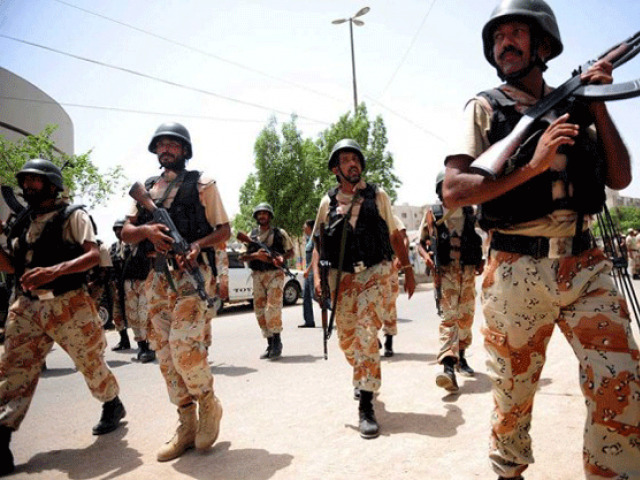
KARACHI: There was a marked improvement in the law and order situation in Pakistan’s largest city Karachi in 2015 primarily because of the intensified efforts of police and Rangers in the crackdown against criminals. However, street crimes continued to surge in the city, in addition to terrorist attacks.
Statistics by the Karachi police show a decline in all categories of crimes, the only exception being the cases of cell phone snatching.
In 2015, there were 19,983 cell phones snatching cases in comparison with 16,623 in the preceding year - a difference of 3,358.
The Karachi police managed to achieve remarkable success in decreasing vehicle crimes - . 1,949 four-wheelers were snatched or stolen in 2015 against 3,590 in 2014 - a reduction of 1,700. This success is attributed to the continuous raids by the police’s Anti-Car Lifting Cell.
In 2015, 18,000 motorcycles were snatched or stolen while the figure stood at 20,842 in the preceding year - a notable difference of 2,000 cases.
During the operation in Karachi from its start in 2013 till 2015, the law enforcement agencies seized a large number of weapons including 20 light-machine guns, 374 sub-machine guns, 16,196 pistols, revolvers and mousers, 319 rifles, and 279 repeaters and shotguns.
Some 577 explosives, nine improvised explosive devices, 17 suicide jackets, and 1,578 bomb and grenades were also seized during this period.
There was a decrease in target killing cases in 2015 - 863 people were murdered in comparison with 1,823 the previous year.
Besides, 81 policemen, seven Rangers soldiers and two Military Police personnel fell in the line of duty in 2015.
Of the policemen killed in 2015, 64 were targeted in drive-by shootings, three in blasts, nine in encounters with terrorists, two over personal enmity and two while resisting robberies.
Despite their achievements in the outgoing year, the law enforcement agencies were unable to curb the flow of weapons into Karachi - a major factor behind the law and order woes of the city.
In the late 90s during the tenure of the Pakistan People’s Party government, a viable plan for curbing the flow of illegal weapons into province was chalked out.
Weapon manufacturing companies operating in the semi-autonomous tribal area of Dara Adam Khel were identified and told to provide the details about the quantity of weapons they had, the ones they sold and the identity of their customers.
Secondly, the arms dealers in Sindh were verified and the weapons they sold were registered.
That policy had resulted in a sharp decrease in the flow of illegal weapons in Karachi and helped control the spate of violence in mid-90s.
At present, the Sindh government has once again been looking to implement that policy which, if successfully implemented, could help resolve the problem.
The frustration of the citizens of Karachi over the persistent law and order problem can be witnessed in the growing number of vigilante justice cases.
The most prominent of these cases was witnessed in May 14, 2008 when a mob had thrashed and set on fire three robbers on Nishtar Road near the Timber Market.
The three men were escaping after robbing a house in Somiya Muqaram Palace. Similar incidents have taken place over the year since then.
A senior police official said the Karachi police with the assistance of Rangers had achieved remarkable results in bringing the law and order situation in the city under control, particularly in curbing target killing cases.
During the Karachi operation, he added, the law enforcement agencies had busted many gangs of robbers, target killers and terrorists.
The official pointed out that the concept of policing in the country was 160 years old and needed to be reformed.
The Police Act of 1861 (formerly known as Indian Police Act) states that the police force in the subcontinent was basically a preventive and detective system. “But now, police have a bewildering complexity of offences which hardly would have been contemplated before,” the official noted.
“Therefore, the role of police is not only to apprehend criminals and bring them to justice but to protect lives too.”
The official said keeping in view the increase in crime and social unrest in the society, addind that the police should adopt new strategies and laws needed to be amended.
Internews