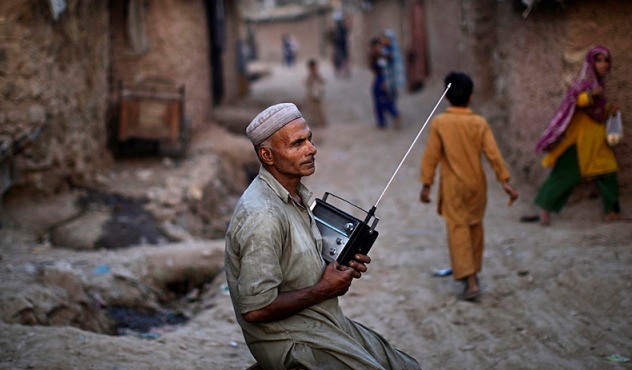
PESHAWAR: As reliable news or even some entertainment is hard to come by in Pakistan’s Federally Administered Tribal Areas (Fata), bordering Afghanistan, around 71 per cent of tribespeople are solely reliant on radio for their information.
These statistics have been revealed in a report called the Fata Development Indicator Household Survey 2013-14. The report was officially released here on Monday.
The lack of a reliable source of information has left a vacuum which people fill by listening to various stations such as Radio Dewa, Voice of America, Radio Mashal and BBC Radio stations. Worryingly, they also have access to militants-backed radio stations such as Khilafat and Da Haq Awaz.
Radio Al-Khilafat is run by Jamatul Ahrar while Da Haq Awaz is broadcast by the banned Lashkar-e-Islam, led by notorious militant Mangal Bagh.
The broadcasters obviously believe it is an effective medium to spread their ideology. The stations sponsored by the militants are mainly run from across the border in Afghanistan.
“Compared to local FM channels or Radio Pakistan, Fata residents mostly depend on Mashal or BBC as they have wider reception in the area,” says an official, requesting anonymity.
“The channels from across the border transmit programmes at prime time in the evening when people are back from work or gathered at hujras.” The militants run their campaigns and continuously push their agendas from across the border, threatening anyone opposing them.
Senior officers, requesting anonymity, say the development indicator survey 2013-14 contained data about the performance of former governor Shaukatullah.
“There is no data about development in Fata under Governor Mehtab Abbasi,” a senior officer says. Though 20 months have passed since he took charge, there has been no survey in his reign despite the fact that tribal areas are said to be comparatively safer.
According to the data that was made public, the report states unemployment rate among the youth between 15 and 24 years stands at 11.8 per cent.
In addition, literacy rate in Fata is 33 per cent. At least 0.7 per cent children between the ages of two and nine have one disability.
Alarmingly, a skilled professional is at hand for only 29.5 per cent of births. The findings further state only 38.3 per cent of Fata households have flush latrines while 6.3 per cent are equipped with underground drainage systems.
Keeping in view the mass displacement of people from many tribal agencies, there is a question mark over the authenticity of the report. No official of the secretariat was willing to speak on the issue before the official release.
Internews