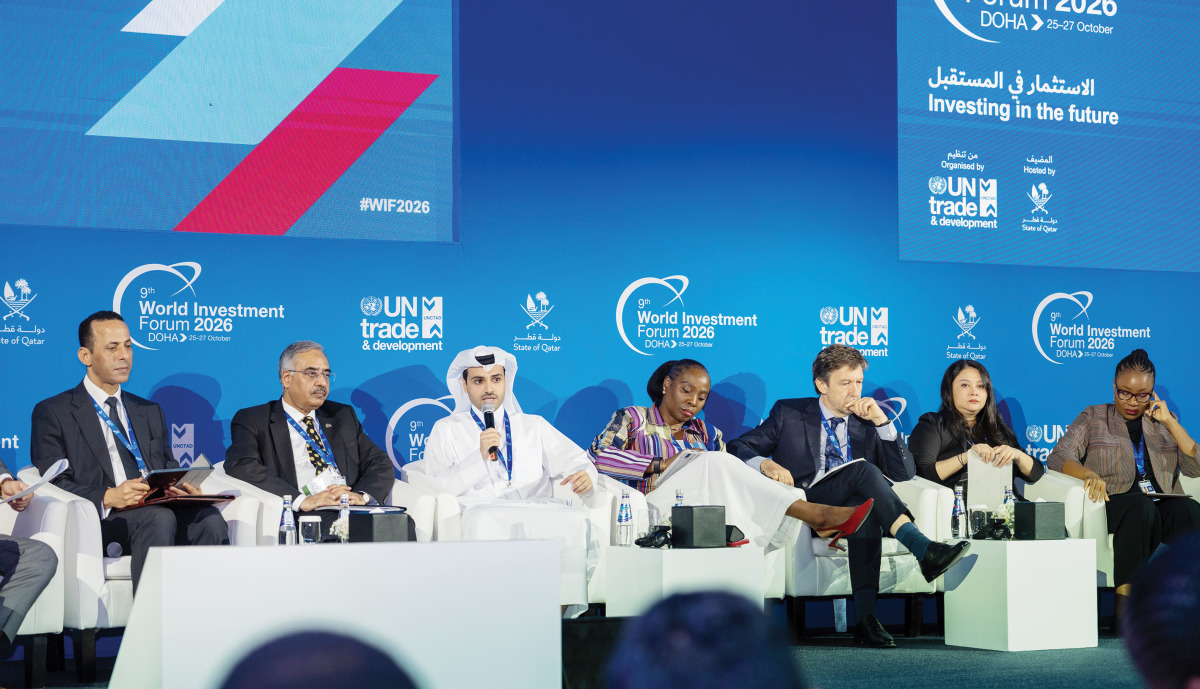
Chief Strategy Officer at Invest Qatar, Dr Hamad Rashid Al-Naimi with other speakers during a panel session at the World Investment Forum.
Doha, Qatar: Qatar’s investment promotion strategy increasingly focuses on building productive capacity, accelerating innovation and generating lasting economic benefits, rather than simply attracting capital, an official said on the sidelines of the World Investment Forum, which concluded yesterday.
Speaking to The Peninsula in an interview, Chief Strategy Officer at Invest Qatar, Dr Hamad Rashid Al-Naimi, said that Invest Qatar is focusing on attracting projects aligned with national development priorities, while strengthening institutional partnerships and sharing knowledge on the evolving role of investment promotion agencies and special economic zones.
He said, “The Forum provides an opportunity to engage directly with international investors and demonstrate what Qatar offers as a stable, connected and competitive base for long-term growth.”
The official mentioned that digitalisation is central to Qatar’s efforts to make the investment process more efficient and predictable. He highlighted the importance of providing investors with practical information, streamlined procedures and continued support after they establish operations.
Remarking on the $1bn National Incentives Programme, he said that it has supported investment projects worth more than QR2.8bn and contributed to the creation of over 900 jobs, as the country steps up efforts to attract foreign investment into high-value sectors.
Dr Al-Naimi said the programme, which offers financial support covering up to 40 percent of eligible local investment expenses over five years, was a “key part of Qatar’s economic diversification strategy.”
The programme targets advanced industries, logistics, technology and digital services, and financial services, with Invest Qatar aiming to attract investments that generate long-term economic value and support the objectives of Qatar National Vision 2030 and the Third National Development Strategy.
Through the Invest Qatar Gateway, the agency brings together sector intelligence, investment opportunities, business establishment pathways and access to relevant ecosystem partners, helping investors identify where and how to invest.
He said that digital transformation should connect the institutions involved in the investment process through integrated procedures, transparent requirements and coordinated decision-making.
“Ultimately, digital investment facilitation should be measured by outcomes, whether investors can make decisions with greater confidence, establish operations more efficiently and expand successfully,” Al-Naimi said.
He also pointed to a venture capital funding module launched with Qatar Investment Authority (QIA) in June 2026, which connects startups with more than 15 QIA-backed funds through a single platform.
Qatar’s investment priorities include advanced industries, logistics, technology and financial services, with growing interest in artificial intelligence, cloud computing, cybersecurity, data centres, semiconductors and quantum technologies.
In advanced industries, the country is targeting high-value manufacturing in areas including pharmaceuticals, chemicals, automotive and electronics. Financial services priorities include asset management, fintech, wealth management and Islamic finance.
“We are also looking closely at opportunities in life sciences, healthcare, cleantech and other innovation-led sectors where Qatar can combine capital, infrastructure, research capabilities and access to regional markets, Dr Al-Naimi said. “Our approach is to build interconnected clusters in which international companies can work alongside local businesses, the public sector and other partners.
He emphasised that WIF 2026 also provided a platform to identify further opportunities for cooperation in sustainable investment, technology, advanced industries and the energy transition.
According to Al-Naimi, Qatar attracted 373 new foreign direct investment projects in 2025, generating $3.4bn in project capital expenditure and creating more than 15,000 jobs.
“By aligning investment promotion with Qatar’s national development priorities, we aim to ensure that the benefits extend beyond individual projects and contribute to a more diversified, competitive and resilient economy,” he added.