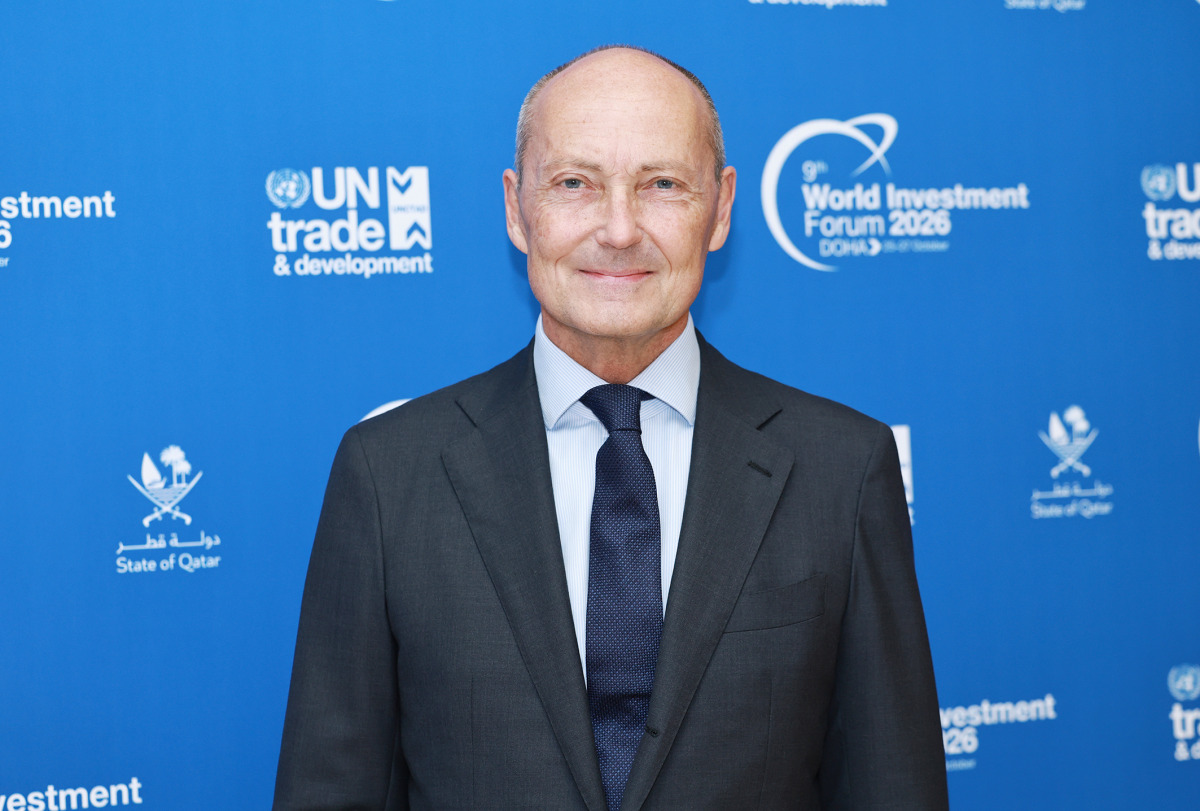
Sweden’s Chief Negotiator for Investment Treaties at the Ministry of Foreign Affairs, H E Ambassador Magnus Hartog-Holm
Doha, Qatar: Qatar and Sweden concluded a second round of negotiations on a bilateral investment treaty in Doha, marking progress in efforts to strengthen economic ties and create a more predictable environment for investors, an official has said.
In an exclusive interview with The Peninsula, Sweden’s Chief Negotiator for Investment Treaties at the Ministry of Foreign Affairs, H E Ambassador Magnus Hartog-Holm, said the negotiations had advanced during his visit to Doha and that both sides looked forward to making further progress in the coming months.
“The next step is to turn this momentum into concrete opportunities by bringing investors, companies and institutions closer together,” Ambassador Hartog-Holm said at the UN Trade and Development (UNCTAD) World Investment Forum 2026.
He noted that Sweden and Qatar had complementary strengths in industry, innovation and technology that could support deeper cooperation and long-term partnerships.
The Ambassador identified artificial intelligence, advanced manufacturing, and energy technologies as areas with potential for greater Qatari investment in Sweden.
He said Sweden’s innovation ecosystem and stable, predictable business environment could complement Qatar’s expertise in energy and its ambitions to diversify its economy.
“These areas offer potential not only for investment but also for industrial cooperation and joint development,” he said.
The official stressed that the objective should be to combine the countries’ respective strengths to generate long-term value for both economies.
Closer cooperation in technology and advanced industries could provide opportunities for companies to expand their international reach while developing new products and solutions, he said.
Beyond the bilateral negotiations, Ambassador Hartog-Holm said Sweden utilised the World Investment Forum to contribute to discussions on reforming the international investment framework.
“While these agreements remain important for protecting and promoting investment, they must also reflect the evolving responsibilities of governments,” he said.
Sweden is working to modernise its bilateral investment treaties by introducing provisions covering sustainable development, transparency, corporate social responsibility and states’ right to regulate in the public interest.
Ambassador Hartog-Holm said investor protection and governments’ ability to regulate should be treated as complementary objectives rather than competing priorities.
“Investors need legal certainty and a predictable business environment, while governments must retain the flexibility to pursue legitimate public policy objectives, including climate action, public health and sustainable development,” he said.
He stated that Sweden’s approach was shaped by its legal and policy commitments as a member of the European Union.
Ambassador Hartog-Holm added international cooperation was essential to building a more predictable, sustainable and development-oriented investment system, but stressed that governments also needed to take responsibility for reviewing their own agreements.
The Ambassador also underscored that Sweden supports reform initiatives within UNCTAD, the United Nations Commission on International Trade Law (UNCITRAL), the Organisation for Economic Co-operation and Development (OECD) and the European Union, while pursuing a long-term programme to modernise its bilateral investment treaties.
He welcomed UNCTAD’s new Guiding Principles for International Investment Agreement (IIA) Reform, describing them as useful guidance for countries seeking to reconcile investment protection with contemporary development priorities.