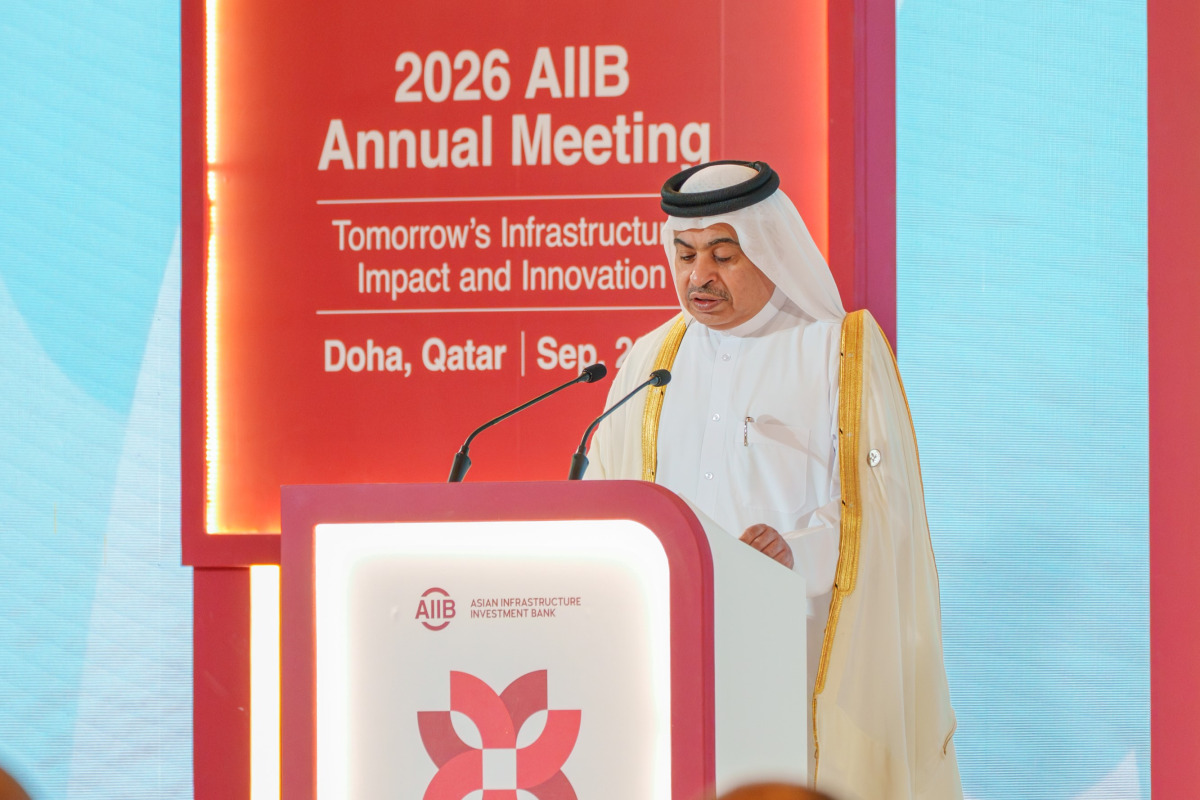
Doha: HE Minister of Finance and Chair of the Board of Governors of the Asian Infrastructure Investment Bank (AIIB) for 2026 Ali bin Ahmed Al Kuwari affirmed that the success of climate finance depends on translating political commitments into investments that generate growth and align commercial interests with environmental sustainability.
He stressed that Qatar approaches this issue as an investor and development partner, rather than merely as a host of conferences.
In remarks today during the main session held as part of the 11th Annual Meeting of the AIIB Board of Governors, HE the Minister of Finance affirmed that climate finance is most effective when governments establish the necessary foundations and policies, development institutions assume risks that the private sector cannot bear in the early stages, and banks and bond markets then connect projects with financing sources and long-term investments.
HE the Minister of Finance highlighted the critical importance of achieving this at a scale capable of meeting the needs of the coming decade. He noted a significant gap between current climate finance flows and global requirements, with global climate finance currently amounting to around USD 2 trillion annually, while the Climate Policy Initiative estimates actual needs at more than USD 6 trillion annually by 2028. He added that cross-border climate finance directed toward developing economies amounted to no more than USD 200 billion, of which the private sector accounted for only USD 40 billion. He attributed this gap to structural barriers including policy uncertainty and the debt-service burden, noting that developing countries paid around USD 1.4 trillion in external debt in 2023, constraining the fiscal space available for public investment, in addition to the high cost of capital and other factors.
HE the Minister highlighted the pivotal role of multilateral development banks, noting that their total climate finance reached a record USD 137 billion in 2024. He commended the AIIB's development of its financing instruments, particularly climate policy-based financing, which has demonstrated its effectiveness. He also cited successful projects around the world that have demonstrated the impact of these instruments on the ground.
His Excellency also addressed Qatar's efforts to support the transition toward a more sustainable economy and its investments in renewable energy, emissions reduction and sustainable finance, reviewing key domestic initiatives and overseas investments by QatarEnergy, Nebras Power, the Qatar Investment Authority, the Qatar Fund for Development and others.
HE the Minister of Finance concluded his remarks by presenting proposals to address climate challenges. These centered on reducing risks through guarantees and local-currency lending by development banks, easing debt burdens by aligning policy-based financing with International Monetary Fund programs and bringing in sovereign investment capital, and addressing program fragmentation through co-financing platforms and unified reform matrices that would enable finance ministers to work with a single action plan rather than multiple plans.
HE President of the Asian Infrastructure Investment Bank (AIIB), Zou Jiayi, said during a session that governments' climate commitments would not automatically translate into bankable projects without legislative and institutional frameworks that enable private capital to participate. She said the Climate-Focused Policy-Based Financing (CPBF), launched in 2024, serves as a bridge for building an enabling environment and sequencing structural reforms in sectors such as renewable energy and climate adaptation.
She stressed that the success of reform should not be measured by the enactment of laws and regulations alone, but by its ability to mobilize public and private financing, accelerate infrastructure development, strengthen climate resilience and improve people's lives. She cited Brazil's sustainable aviation fuel project, approved in March 2026, as well as budget and climate-planning reforms in Bangladesh and the development of carbon markets and climate-resilient health systems.
Private capital does not move simply because climate needs are large, she said, but responds to the attractiveness of the business environment. This requires removing structural barriers such as market-entry restrictions, weak tariff frameworks, fragile public utilities, procurement constraints and limitations in domestic financial markets.
She called for coordinated partnerships among development banks, governments, climate funds and the private sector that combine technical assistance, project preparation, financing and risk mitigation.
She identified four priorities for the future: strengthening the link between reforms and national investment opportunities; deepening international coordination; intensifying efforts to mobilize capital; and strengthening implementation capacity and measuring on-the-ground impact after legislation is adopted.
In this context, HE Egypt's Minister of Finance, Ahmed Kouchouk, focused during the session's discussions on his country's experience in renewable energy as a model that delivers shared benefits for the state and the private sector. He said climate ambitions exceed the capacity of any single country or institution.
Policy-based financing provides concessional financing backed by reforms and close monitoring, Kouchouk said, adding that it had provided Egypt with billions of dollars and could be replicated in sectors such as water desalination and water-resource management.
Egypt has established a coordination platform bringing together more than seven multilateral development banks and more than 50 investors to share feedback and update policies, he said.
The session, titled “Scaling Up Climate Finance for Tangible Impact: Turning Policy Reform Into Resilient Growth,” was held on the first day of the 11th Annual Meeting of the AIIB Board of Governors. It brought together HE Chairman of Islamic Development Bank (IsDB), Dr. Muhammad Al Jasser, and Nargiz Nasrullayeva, former president of the American Chamber of Commerce in Azerbaijan and a member of the AIIB's International Advisory Council.
The discussion broadly addressed the importance of making legislative changes a driver of sustainable development and attracting financing. It reviewed future priorities and the experiences of several countries, emphasizing that mobilizing capital requires reforms to the business environment and coordinated efforts by multilateral development banks.
The session also discussed how to move climate finance beyond simply mobilizing additional capital toward building a comprehensive enabling environment based on sound policies, effective regulations and efficient implementation. It noted that ambitions for climate action and sustainable infrastructure are growing across the bank's member countries, but investment is often slowed by initial barriers including policy uncertainty, weak regulatory frameworks, fragmented institutions, limited pipelines of bankable projects and inadequate risk-sharing mechanisms.
The AIIB's new Climate-Focused Policy-Based Financing instrument aims to address these barriers at their source by turning policy reform into stronger markets, more conducive investment environments, greater investor confidence and scalable, climate-resilient infrastructure.
The discussion examined three main areas: how policy-based financing can help member countries unlock climate-finance opportunities for investment in sustainable infrastructure; how policy reforms, regulatory improvements, market incentives and risk-sharing mechanisms can strengthen the enabling environment and boost investor confidence; and growing demand from clients for climate finance and support for climate-related policy and institutional reforms, as well as the role of multilateral development banks in responding to those needs.