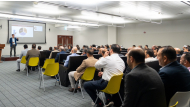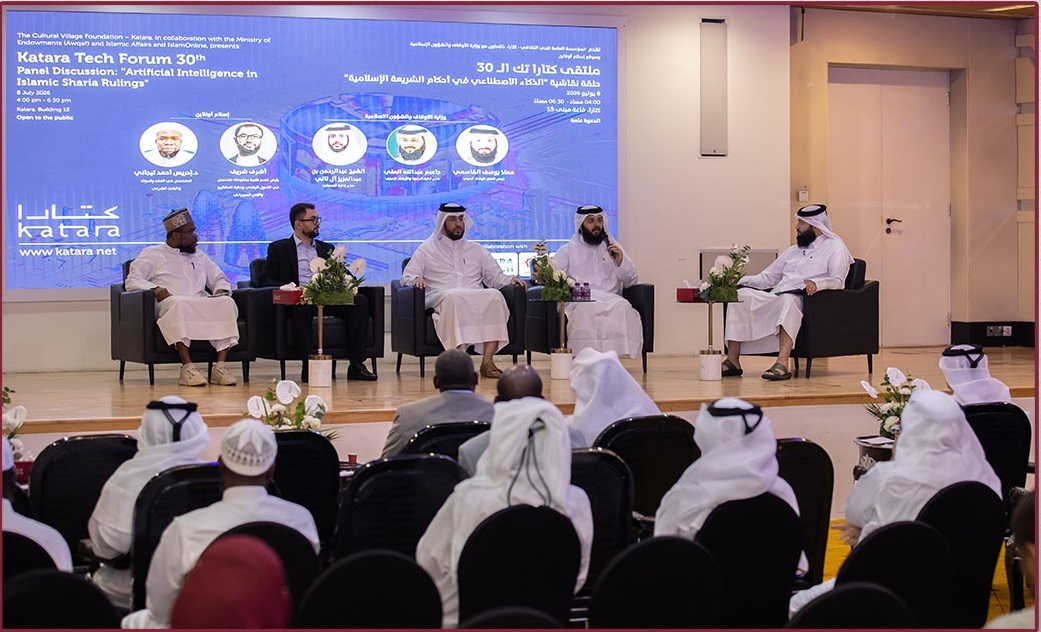
Director of the Department of Da’wah and Religious Guidance Jassem Abdullah Al Ali speaking at the event.
Doha, Qatar: The Ministry of Awqaf and Islamic Affairs is expanding its use of artificial intelligence (AI) to enhance Islamic knowledge services, improve religious guidance and provide wider access to trusted Shariah information in Qatar and abroad.
The ministry highlighted its experience during a discussion session at the 30th Katara Tech Forum, held under the theme “Artificial Intelligence in the Rulings of Islamic Shariah.” The event was organised by the Cultural Village Foundation – Katara in cooperation with the Ministry of Endowments and Islamic Affairs and IslamOnline.
Director of the Department of Da’wah and Religious Guidance Jassem Abdullah Al Ali, outlined the ministry’s use of AI, particularly through its Islamic Network Islamweb, which has served as a digital platform for Islamic knowledge and fatwa services since 1998.
Al Ali said AI is creating new opportunities in Islamic scholarship and religious outreach by making it easier to search, analyse and classify information, summarise lengthy works, connect related scholarly issues and develop interactive tools for learning and education.
He highlighted the scale of Islamweb’s fatwa services, noting that the platform has received 666,295 questions since its launch and issued 244,245 fatwas, including 216,389 published fatwas. It has also handled 98,782 questions and fatwas in other languages.
Islamweb provides fatwa services in Arabic, English, French, Spanish, German, Russian and Indonesian. Users can access the services through the official website, SMS via the unified number 92142, and text-based services through WhatsApp and Telegram.
Al Ali also presented the Fatwa Chat service, which uses AI to help users find reliable answers from Islamweb’s established database. The system analyses the context of users’ questions and searches the verified fatwa archive. Cases requiring specialised attention are referred to Shariah researchers for direct responses.
The ministry has established safeguards to protect the reliability of the service. The AI system is not permitted to independently formulate new religious rulings; instead, it retrieves approved answers from the documented archive.
From September 2025 to March 2026, Fatwa Chat recorded more than 179,000 conversations, representing a 162% increase and reflecting rising demand for digital religious services.
The ministry is also applying AI to improve the evaluation of Friday sermons. Sheikh Abdul Rahman bin Abdulaziz Al Thani, Director of the Department of Mosques, said a digital system can convert recorded sermons into text, identify their main themes and analyse their content and structure.
The system evaluates sermons according to nine key criteria, including topic selection, unity of the topic, preparation, delivery, accuracy and suitability of religious evidence, Islamic references, language and rhetoric, and the introduction and conclusion.
It also provides a numerical assessment, identifies strengths and areas for improvement, and can assist in extracting Quranic verses, verifying hadith sources and analysing the preacher’s vocal performance and delivery.
Sheikh Abdul Rahman said the initiative reflects the ministry’s approach of combining Islamic authenticity with modern technology to improve religious discourse and support preachers.
The forum brought together specialists in Islamic sciences, technology and media to discuss AI’s role in Islamic Shariah and religious services.