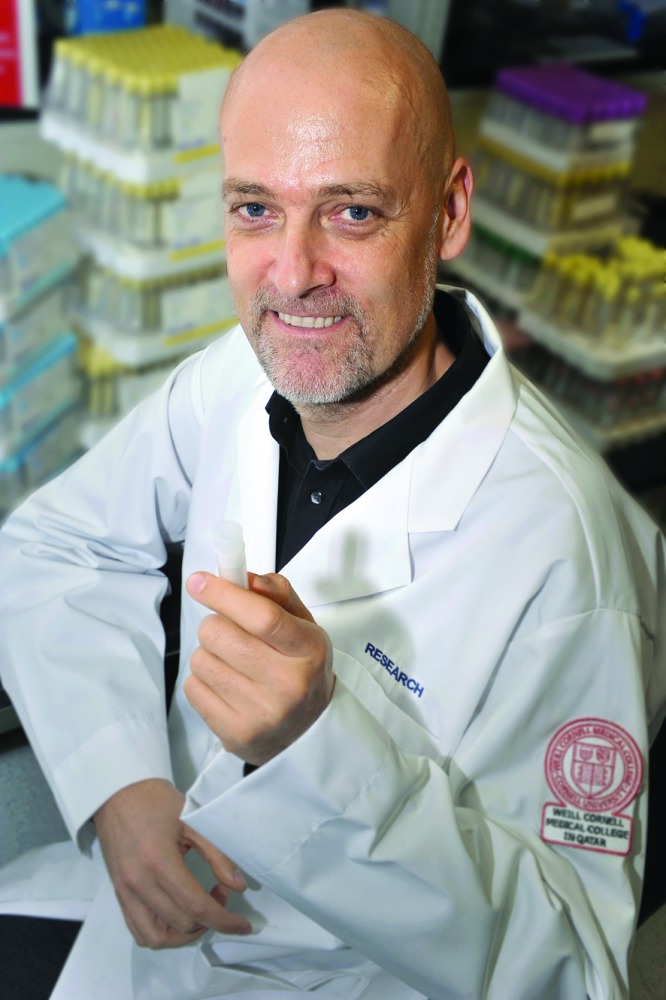
Dr Karsten Suhre, Professor of Physiology and Biophysics at WCM-Q.
Qatar-based research has revealed many previously unknown links between genetic variations and a series of debilitating conditions, including Alzheimer’s disease, heart disease, autoimmune disorders and cancer.
A ground breaking study by Weill Cornell Medicine-Qatar (WCM-Q) researchers, led by Dr Karsten Suhre, Professor of Physiology and Biophysics, has analysed the genetic data of more than 1,300 individuals from Europe, Asia and the Middle East and identified over 450 genetic variants, many of which are involved in serious diseases.
However, the study went a step beyond conventional genome studies, which generally focus on simply attempting to identify genes which are associated with disease.
In contrast, Dr Suhre’s research aimed to understand in greater detail the many complex chemical processes involved in translating the information held within genes into the actual physical characteristics of diseases. Discovering the secrets of these intricate chemical processes – known as ‘pathways’ - is essential to provide a basis for the development of a new generation of drug therapies and more effective diagnostic tools for a host of complex diseases.
“Since the human genome was first mapped in its entirety in 2003, researchers have been working to understand the function of every gene in our body so that one day we can use this knowledge to truly cure complex diseases, like diabetes and cancer,” said Dr Suhre.
“However, in order to translate this knowledge of the human genome into new drugs or treatment, it is not enough to simply know which genes are involved in a disease – we know a lot of that already. Rather, we need to understand the roles that disease-associated genes play in the pathways that lead to disease. So the challenge for medical science is no longer to simply find out what genes are involved in which disease but to work out precisely how they are involved.”
Explaining the research further, Dr Suhre said that the human genome essentially acts as a series of blueprints that tell the body how to produce the approximately 20,000 different proteins that are the building blocks of our body. In recognition of this, the research aimed to understand how variation in genes influences the proteins that are made from them and how this leads to disease. The WCM-Q research is different because in addition to analysing the cohort’s genomes and health states the study also examined more than 1,100 proteins.
The project conducted the world’s first GWAS (genome-wide association study) to analyse more than 1,100 proteins in 1,300 individuals – no previous study of this kind has analyzed such a large cohort nor so many different proteins.
To achieve such a large-scale study the researchers had to bring a protein measurement tool capable of handling very high volumes of data to Qatar for the very first time. The study marks the very first time the tool, provided by US-based company Somalogic, has ever been used outside of the USA. This platform is now available for use by all researchers in Qatar.
Moreover, the blood samples used by the researchers were sourced from a previous study that was conducted in collaboration with the dermatology department of Hamad Medical Corporation in Qatar. The study also performed all genetic analyses through the WCM-Q genomics core facility.
Importantly, the paper combined analysis of the genome, known as genomics, with analysis of an organism’s proteins, known as proteomics. This combined approach, called ‘multiomics’, helps researchers understand the interactions between genes and the proteins that they encode.
The groundbreaking study, entitled ‘Connecting genetic risk to disease endpoints through the human blood plasma proteome’, has now been published in the prestigious UK-based journal Nature Communication.