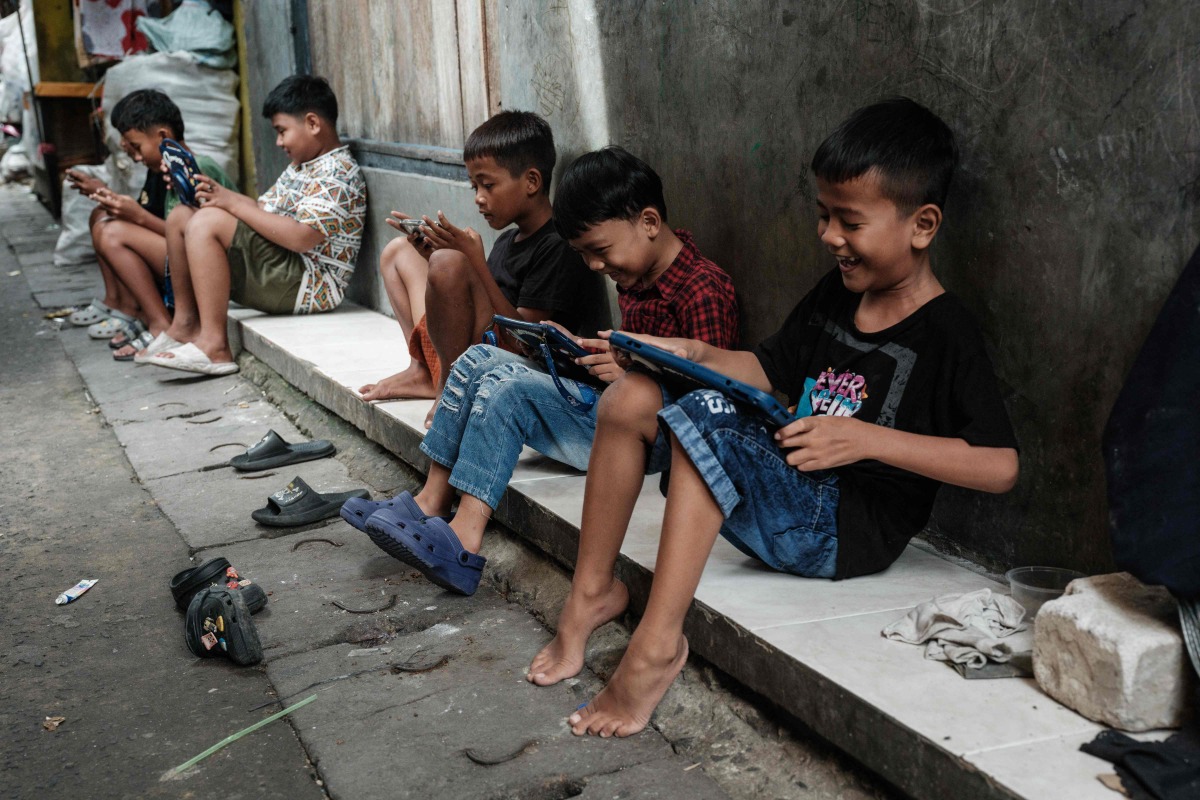
Children play online games against each other on smartphones and tablets along an alley in Jakarta on March 26, 2026. Photo by YASUYOSHI CHIBA / AFP
Jakarta: Bradley Rowen Liu, 11, wonders what he will do with himself once Indonesia's social media ban for under-16s enters into force on Saturday. As things stand, he spends most of his free time on TikTok.
The primary schooler is one of about 70 million children the government is hoping to shield from the threats of cyberbullying and internet addiction.
Several countries have proposed teen social media bans since Australia's landmark move in December to stop users under 16 from holding accounts on many popular platforms.
But Indonesia is among the first to act as concerns grow over the impact of such apps on kids' mental and physical wellbeing.
YouTube, TikTok, Facebook, Instagram, Threads, X, Bigo Live and Roblox -- deemed "high-risk" platforms by authorities in the Southeast Asian nation -- will from Saturday start deactivating underage accounts.
Liu, who says he can easily spend five hours a day on TikTok at weekends, told AFP he worries the ban will leave him driftless.
"Maybe I'll do some other activities," he shrugged, without much conviction.
"But I think I'm going to ask my dad or my mom to help me access" the video-sharing app, the boy said after class at a private academy in Jakarta where he learns computer coding.
Onus on platforms
"Parents no longer have to fight alone against the giants of the algorithm," communications minister Meutya Hafid said when she announced the ban three weeks ago.
Like in Australia, the Indonesian rules place the onus on platforms to regulate teen access.
Non-compliance of the ban, which will be phased in over time, will put defaulters at risk of a fine or even a suspension.
Indonesia has not said how it plans to monitor implementation, and the communications ministry did not respond to AFP's requests for comment.
It is part of a global reckoning over the potential harms of social media for minors.
A Los Angeles jury on Wednesday found Meta and YouTube liable for harming a young woman through the "addictive design" of their platforms, ordering the companies to pay $6 million in damages.
Britain's upper house of parliament voted this week in favour of banning children from social media, piling pressure on the government to follow suit.
'Brain rot'
Though annoyed about the looming interdiction, Liu concedes even he is worried about screen addiction.
"Sometimes I have to remember to keep track of time... Like when it's a holiday, I kind of get really attached to my phone."
A fellow pupil, 15-year-old Maximillian, said he spends too much time on social media, leaving him feeling "unproductive". He supports the ban.
Some want the government to go even further.
Randi Putra Chaniago, who teaches at the academy, said social media -- including the surreal AI-generated clips known as brain rot -- was a distraction in class.
"It's concerning, really, because some of this 'brain rot' content is weird and can disturb children's way of thinking," he said.
The 23-year-old, who uses YouTube to teach some classes, said the ban would challenge teachers to find better educational tools.
The P2G Indonesian Teachers' Association, for its part, wants the government to ban cellphones in classrooms altogether.
'Unhealthy use'
YouTube parent company Google said the two platforms have already introduced features allowing parents to limit scrolling time.
It said AI tech will be launched in Indonesia by next year to determine a user's age.
But "blanket account restrictions... will deprive young people accessing YouTube of the protections, parental controls, and security features we've integrated into supervised accounts", it argued in a statement.
TikTok said it would work with the government to ensure "teens can continue to access safe online spaces".
And gaming platform Roblox pledged to introduce "additional controls" for minors.
Karina Adistiana, an Indonesian educational psychologist, told AFP several studies have shown that intensive social media use is harmful for young people.
"Intensive in the sense that social media becomes the child's main world. That's where the danger lies," she said.
"Depression, difficulty concentrating, trouble sleeping, anxiety, constantly wanting to check notifications -- those are clearly signs of unhealthy use in children."