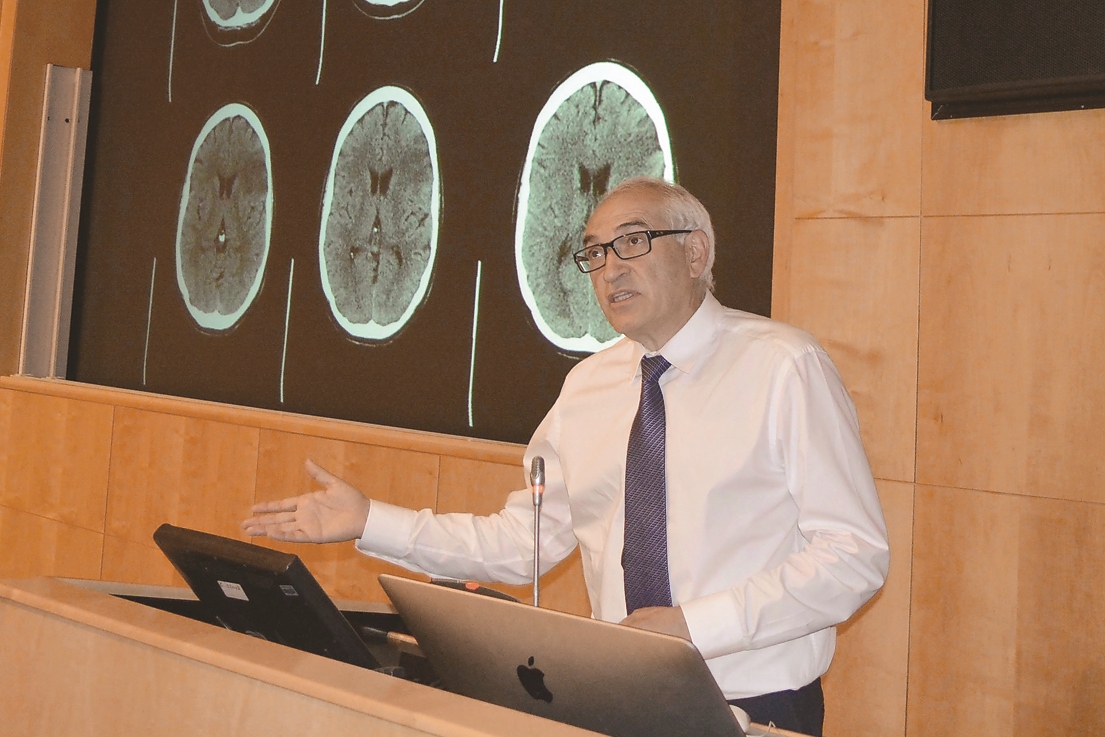
Professor Ashfaq Shuaib, Director, Neuroscience Institute, Hamad Medical Corporation, giving a presentation. (file photo)
DOHA: Hamad Medical Corporation (HMC) has made significant advances in providing highest standards of care for stroke patients in the recent years, say senior officials.
One important achievement is maintaining the ‘door to needle time’ in stroke patient care according to international standards. This is the length of time that passes between when an acute stroke patient arrives at the emergency department to when they receive specialist treatment.
The recruitment of specialist nurses and expert consultants, the opening of dedicated facilities and introduction of advanced technology — including a dedicated stroke ward, a telemedicine service and a Neuroangiograhy Suite — as well as the redesign of care processes, have all delivered improved outcomes for stroke patients in Qatar.
“The assessment, evaluation and imaging of acute stroke patients is a very complicated process. Because of this complexity, the American Stroke Association sets a target for hospitals to treat approximately 50 percent of acute stroke patients in under 60 minutes,” said Professor Ashfaq Shuaib, Director of HMC’s Neurosciences Institute.
“In early 2014, our stroke programme began an integrated programme to improve the door to needle times for acute stroke patients. In the two years since the programme was implemented, the team has consistently achieved times of less than 40 minutes for 44 per cent of patients and under 60 minutes for 68 per cent of patients. This compares very favourably to the majority of tertiary stroke centres in Europe and North America, which achieve this 60-minute door to needle goal only 50 to 60 percent of the time,” he added.
The rationale behind the need for fast treatment of stroke patients is that ‘time is brain’, meaning the faster treatment can be given following a stroke, the better the chances of recovery are for patients. The sooner acute stroke patients can be given thrombolysis, a clot breaking drug, to open the artery and renew blood flow to the brain, the better the outcome for them.