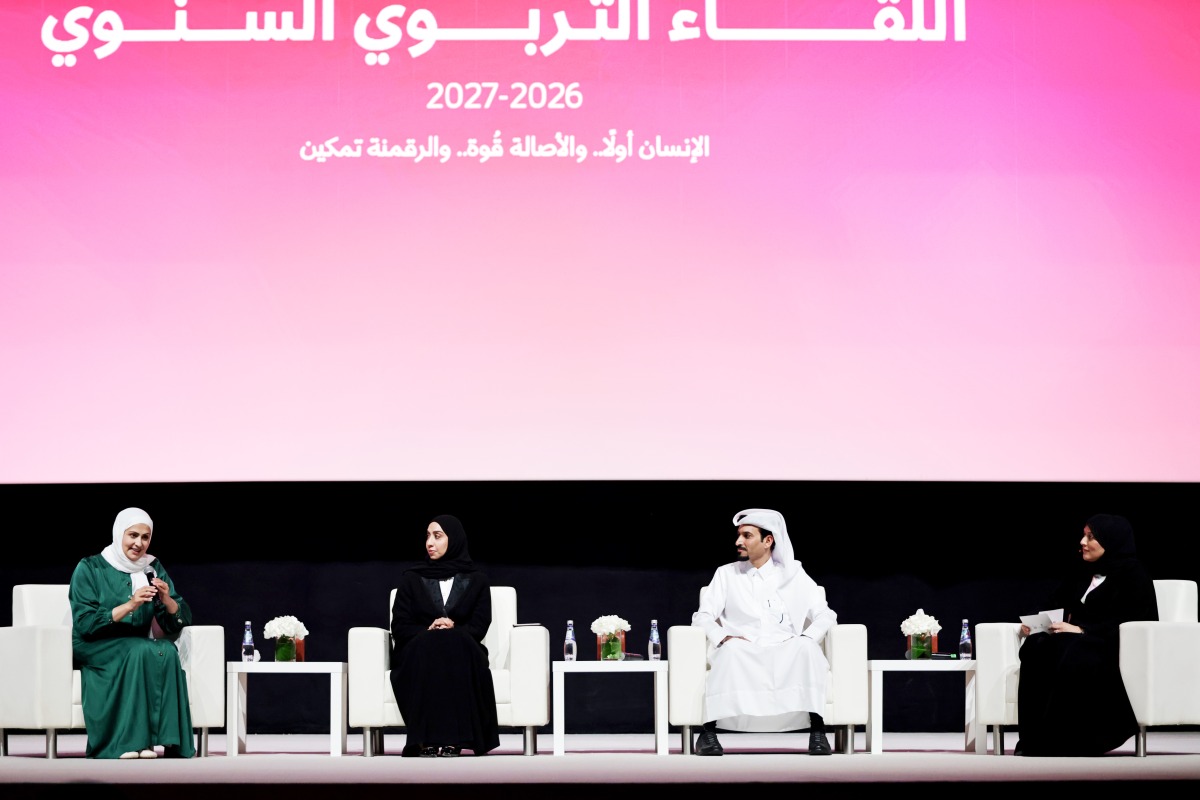
Panellists during the session held at QNCC yesterday. Pic: Salim Matramkot/The Peninsula
Doha, Qatar: A panel discussion at the Ministry of Education and Higher Education’s annual educational meeting for the 2026–27 academic year has highlighted the need to keep students at the heart of education while using technology and artificial intelligence as tools to empower learners and teachers.
Held under the theme “People First… Authenticity is Strength… Digitalisation is Empowerment,” the session explored how the theme could be translated into practical approaches within schools, with a particular focus on developing well-rounded students who are proud of their identity and values while being prepared to navigate a rapidly changing world. The session featured Chairperson of the Board of Trustees of the Center for Wellbeing H E Sheikha Hessa bint Hamad bin Khalifa
Al Thani, Assistant Undersecretary for Digital Government Affairs at the Ministry of Communications and Information Technology Mashael Ali Al Hammadi, and Director General of Pre-University Continuing Education at Qatar Foundation, Jameel Ketaim R. Al-Shammari. It was moderated by Director of the Public Relations and Communication Department at MoEHE Maryam Abdullah Al Muhannadi.
The panellists discussed the importance of placing the human being at the centre of educational practice and creating school environments built on respect, guidance and positive role models. They stressed that education should go beyond academic achievement to help students develop their personalities, values, talents and interests, enabling them to become confident individuals who are connected to their identity while capable of responding to future challenges. The discussion also highlighted the role of school leaders in translating educational values and priorities into an institutional culture and everyday practices. Effective school leadership, the participants noted, can contribute to enhancing the student experience while supporting teachers and strengthening overall school performance.
A major focus of the session was preparing students for a future increasingly shaped by technology and artificial intelligence. The panellists emphasised the potential of digital tools to empower teachers and students and enhance the learning process, while stressing that technology should remain a means of empowerment rather than an end in itself.
They also underlined the importance of responsible and conscious use of modern technologies. Students need to develop the ability to analyse and evaluate information, solve problems and distinguish reliable information from misleading or inaccurate content, particularly as digital and AI-generated content becomes increasingly prevalent.
At the same time, the panellists stressed that technological advancement must be accompanied by preserving the essential human role of teachers and schools. Technology can support the educational process, but it cannot replace the guidance, interaction, values and human connection that remain central to effective education.