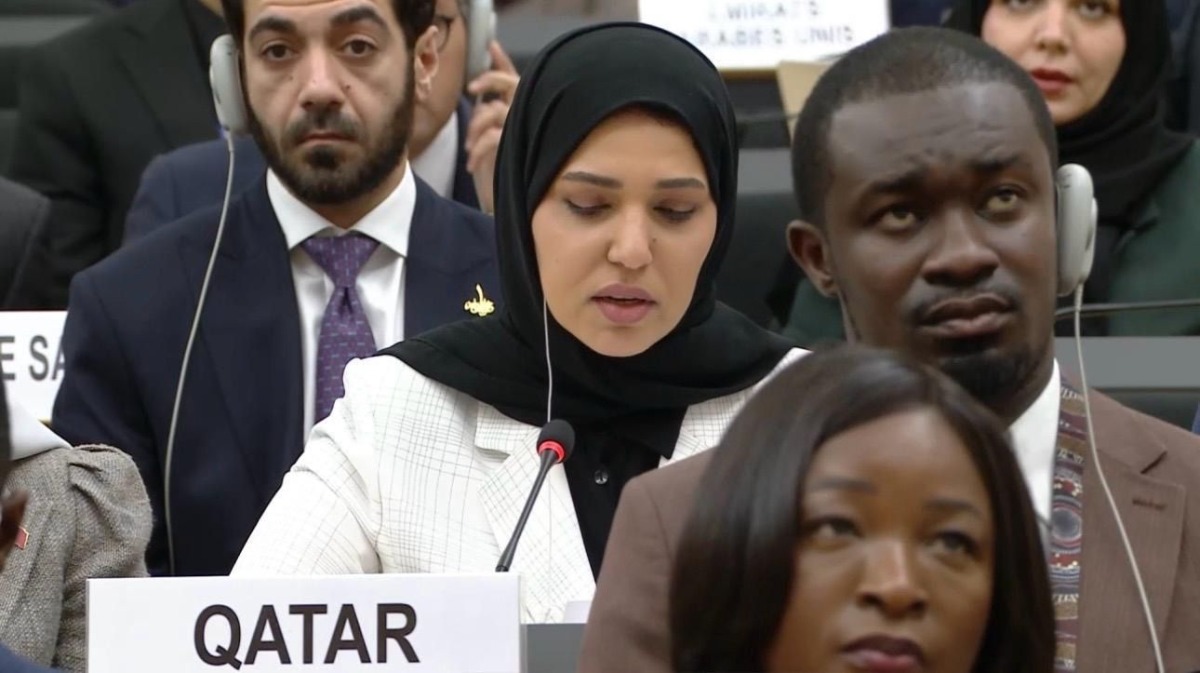
Permanent Representative of Qatar to the United Nations Office in Geneva H E Dr. Hind Abdulrahman Al-Muftah
Geneva: The UN Human Rights Council (UNHRC) condemned yesterday Iran’s attacks on its Gulf neighbors, urging it to quickly provide compensation to all its victims.
The 47-member council endorsed a resolution put forward by the six GCC states and Jordan condemning Iran’s moves to close the Strait of Hormuz and demanding that Tehran immediately cease all unjustified attacks.
The Human Rights Council adopted, without a vote, the resolution titled: “Human Rights Impacts of Unjustified Attacks by the Islamic Republic of Iran on the United Arab Emirates, Bahrain, Oman, Qatar, Kuwait, the Kingdom of Saudi Arabia, and Jordan”, which was co-sponsored by more than 100 countries.
Qatar strongly condemned the missile and drone attacks carried out by the Islamic Republic of Iran targeting Qatari territory.
It described them as a blatant violation of its national sovereignty and territorial integrity and a clear breach of the United Nations Charter, particularly the prohibition on the use of force or threat thereof.
This statement was delivered by Permanent Representative of Qatar to the United Nations Office in Geneva H E Dr. Hind Abdulrahman Al-Muftah during her participation in the emergency session of the Human Rights Council held in Geneva. The session addressed the human rights consequences of Iran’s unjustified attacks on Qatar, the UAE, Saudi Arabia, Bahrain, Oman, Kuwait, and Jordan.
She noted that the session was convened in a highly critical context, following the unjustified Iranian attacks on GCC countries and Jordan, which have resulted in serious repercussions not only for international peace and security but also for the full enjoyment of human rights.
Al-Muftah emphasized that these indiscriminate attacks targeting civilians and civilian infrastructure constitute a grave violation of international law, including international humanitarian law and international human rights law, highlighting attacks on critical infrastructure such as airports, ports, energy facilities, and water desalination plants.
She affirmed that these acts pose not only a regional security threat but also a direct assault on a range of fundamental rights guaranteed under international human rights law. The continuation of such attacks is deeply concerning and must not be ignored. Qatar has suffered ballistic missile and drone attacks resulting in civilian casualties, disruption of essential services, and interruptions to water and energy supplies, in clear violation of the rights to life, health, education, and safety.
Al-Muftah explained that targeting energy and water facilities has severe environmental consequences, affecting the right to a safe, clean, healthy, and sustainable environment, a right emphasized in Human Rights Council resolutions. These violations disproportionately affect vulnerable groups, including children, women, the elderly, and persons with disabilities, in direct contradiction to international obligations, particularly the Convention on the Rights of the Child and the Convention on the Rights of Persons with Disabilities.
Al-Muftah also highlighted that targeting vital infrastructure and maritime navigation routes, especially in the Strait of Hormuz, raises serious concerns due to their extended impact on the global economy, supply chains, and energy security, which in turn negatively affects the enjoyment of economic, social, and developmental rights, particularly in developing countries. She emphasized that protecting civilian infrastructure and ensuring freedom of international navigation are both legal and moral obligations that cannot be compromised.
She stressed that the attacks on Qatari territory are inconsistent with the principles of good neighborliness and cannot be justified under any circumstances, especially given Qatar’s consistent support for dialogue and peaceful mediation to resolve conflicts. Attacking a state that is not a party to the conflict and that has not allowed its territory or airspace to be used in hostilities constitutes a serious violation of international law and adversely affects international peace, security, and the enjoyment of fundamental rights.
She stated: “Qatar has refrained from participating in this war since its outset and has ensured it does not engage in any escalation. However, Iran persists in targeting Qatar and neighboring countries, in an irresponsible approach that undermines regional security and threatens international peace. In this context, we affirm the inherent right of states to self-defense under Article 51 of the UN Charter, in accordance with international law.”
Al-Muftah welcomed UN Security Council Resolution 2817 (2026), which strongly condemned the aggressive attacks carried out by Iran on the Gulf countries and Jordan, recognizing these acts as violations of international law and serious threats to international peace and security. She emphasized the need for effective remedies, including full and fair compensation for victims and affected states.
She concluded that human rights, peace, security, and development are interlinked and mutually reinforcing, and that any violation of one undermines the others.