Calls for closer cooperation between media institutions, universities
Published: 25 Dec 2025 - 09:14 am | Last Updated: 25 Dec 2025 - 09:18 am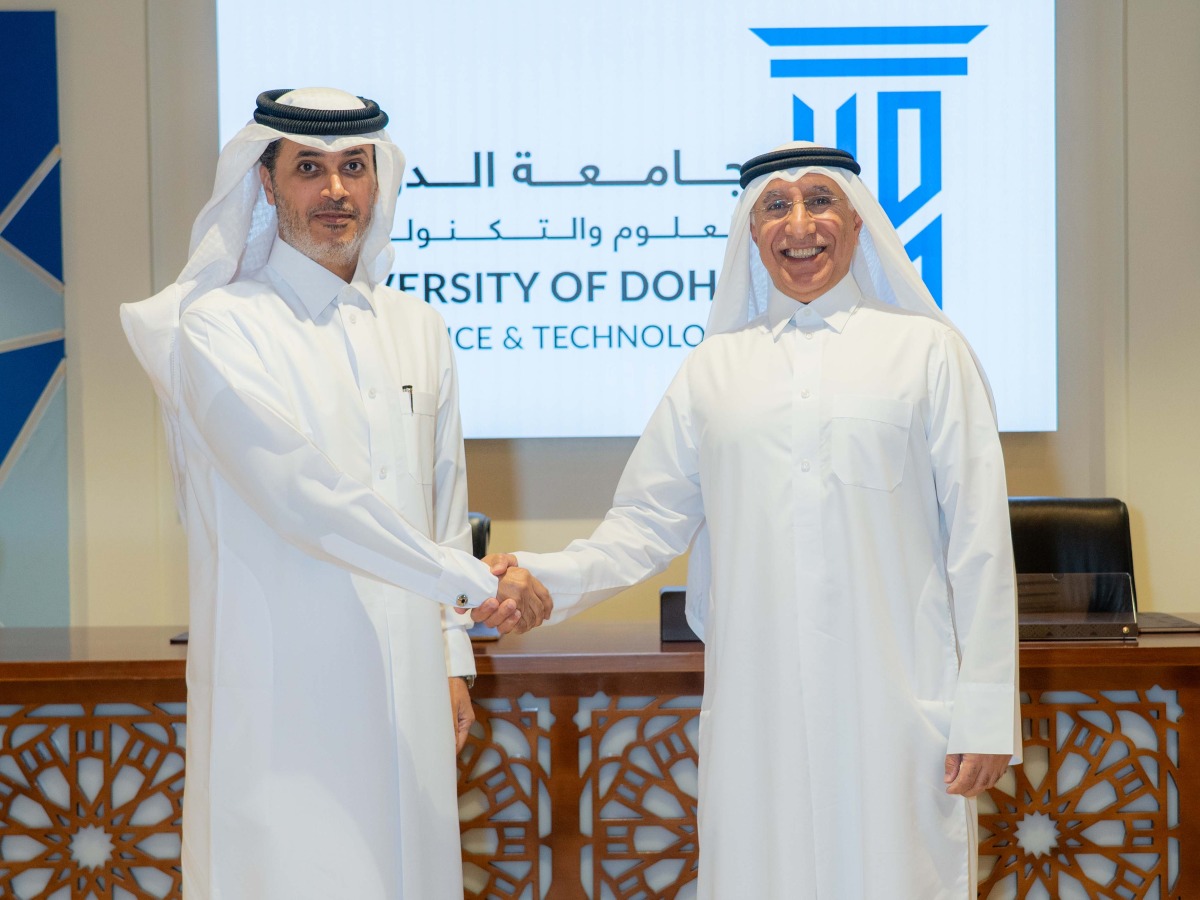
President of the University of Doha for Science and Technology (UDST) Dr. Salem Al-Naemi and Editor-in-Chief of The Peninsula and Media Advisor at Qatar Media Corporation (QMC) Prof. Khalid Mubarak Al-Shafi during honouring ceremony held recently at UDST premises.
Doha, Qatar: Editor-in-Chief of The Peninsula and Media Advisor at Qatar Media Corporation (QMC) Prof. Khalid Mubarak Al-Shafi has said that academic partnerships have become a cornerstone in strengthening the media sector, as cooperation between national media institutions and universities plays a vital role in preparing qualified professionals for a rapidly evolving industry.
This was highlighted by Prof. Al-Shafi, following his recent honouring by the University of Doha for Science and Technology (UDST), in an interview with Qatar Radio, where he emphasised the importance of applied education and close alignment with labour market needs.
President of the University of Doha for Science and Technology (UDST) Dr. Salem Al-Naemi, recently honoured Prof. Khalid in recognition of his contributions to strengthening cooperation between academic institutions and the national media sector.
Speaking in an interview with Qatar Radio (Masa al-Doha programme), he stressed that modern media has become a leading force in shaping public opinion, particularly as the sector continues to evolve rapidly with the approach of 2026.
Prof. Al-Shafi highlighted that UDST, as an applied university, fully understands that media education is not confined to theoretical instruction, but rather depends heavily on hands-on practice and real-world application. “This shared understanding led to close cooperation between the university and Qatar Media Corporation to design academic pathways aligned with labour market needs.”
He explained that the partnership began as part of a broader vision within Qatar Media Corporation and according to directives of QMC CEO H E Sheikh Khalid bin Abdulaziz bin Jassim Al-Thani to strengthen ties with academic institutions and review university outputs to ensure graduates are well prepared for the media job market. “This vision focuses on empowering young Qatari talent to represent the country locally and internationally across various media platforms.”
He added, “As part of this vision, attention was drawn to UDST’s Digital Communication and Media Production programme, which was launched in English in 2022. After reviewing the programme’s practical structure and applied coursework, Qatar Media Corporation proposed developing an Arabic-language track to better serve national media institutions.”
Prof. Al-Shafi noted that the proposal received strong support from UDST President, who welcomed the collaboration and affirmed the shared mission of serving Qatar.
He said that the Arabic track of the programme was officially launched in Fall 2024, with curricula closely aligned to the operational needs of Qatar Media Corporation. “The cooperation allows students to engage directly with professional environments through on-air participation, studio training in radio and television, and hands-on experience in journalism across QMC’s various platforms.”
Prof. Al-Shafi emphasised that Qatar Media Corporation has provided full support to ensure students benefit from its advanced infrastructure and professional expertise, reinforcing the link between academic study and workplace readiness.
He also credited the initiative to strategic directives from QMC leadership, aimed at preparing a new generation of media professionals capable of keeping pace with rapid developments, including digital transformation, artificial intelligence, and social media.
Prof. Al-Shafi explained that the initiative was launched in response to directives from QMC CEO H E Sheikh Khalid bin Abdulaziz bin Jassim Al-Thani, dating back to his tenure as Director of the Media Development Department.
Sheikh Khalid, he noted, had a clear vision focused on the need to develop young Qatari media talent and produce new generations of graduates capable of keeping pace with the rapid evolution of the media sector.
“This vision underscored the importance of building strong partnerships with universities and reviewing academic programmes to assess their ability to prepare students for entry into the labour market.”
Prof. Al-Shafi noted that as a result of this approach, cooperation with academic institutions was strengthened, paving the way for emerging Qatari youth who are ambitious, forward-looking, and talented to contribute effectively to the future of media in Qatar.