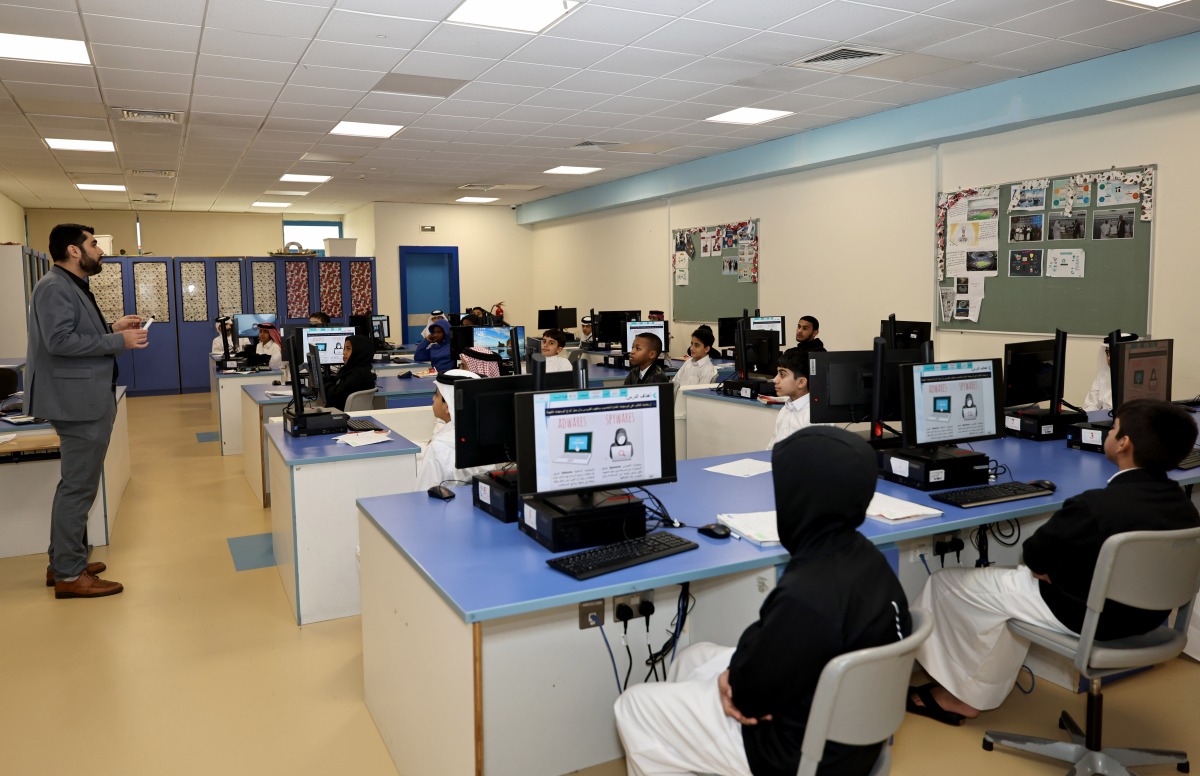
File photo of students in a classroom in Doha.
Doha, Qatar: Qatar’s students have achieved significant long-term progress in science, while the growing use of artificial intelligence (AI) is opening new opportunities for learning and digital skills development, according to the latest international assessment by the Organisation for Economic Co-operation and Development (OECD).
The OECD’s Programme for International Student Assessment (PISA) 2025 results highlight Qatar’s progress in strengthening educational outcomes over the past decade, alongside the increasing integration of AI tools into students’ learning practices.
The country’s results in science, mathematics and reading were “among the highest ever measured by PISA” in Qatar, the OECD said, with performance significantly above the levels recorded in 2015.
Qatar’s average science score reached 434 points in 2025, reflecting sustained progress over the longer term. Although performance remained broadly stable compared with 2022, the decade-long improvement points to advances in students’ scientific knowledge and skills.
The proportion of students performing below baseline proficiency in science declined by seven percentage points between 2015 and 2025, demonstrating progress in strengthening foundational learning.
The assessment covered 6,674 students from 246 schools in Qatar, representing approximately 22,300 15-year-olds, or an estimated 94 percent of the country’s population in that age group.
The broad coverage provides an important evidence base for assessing educational progress and informing future policy.
The report also highlighted the growing role of AI in students’ educational experiences, with Qatar recording a level of adoption in line with the OECD average.
Some 46 percent of students in Qatar reported using AI chatbots to help them learn at least once a week, demonstrating how digital tools are becoming part of everyday learning practices.
Students are using AI for a range of educational activities. Around 34 percent reported using it to conduct preliminary research on a new topic, while the same proportion used it to summarise assigned reading. Another 30 percent used AI to draft text for writing assignments.
These findings illustrate the expanding role of digital technology in helping students access information, organise material and explore new subjects. They also provide a useful foundation for educators to examine how AI can complement classroom teaching and encourage independent learning. The assessment further highlighted students’ curiosity and willingness to persevere. Some 68 percent of students in Qatar said they were curious about many different things, while 65 percent reported putting in additional effort when work became challenging.
Such attributes are important for developing scientific understanding, problem-solving abilities and the capacity to adapt to a rapidly changing technological environment.
The findings offer valuable insights as Qatar continues to develop its education system and strengthen the skills needed for a knowledge-based economy. The OECD released the PISA 2025 results on September 8, 2026.