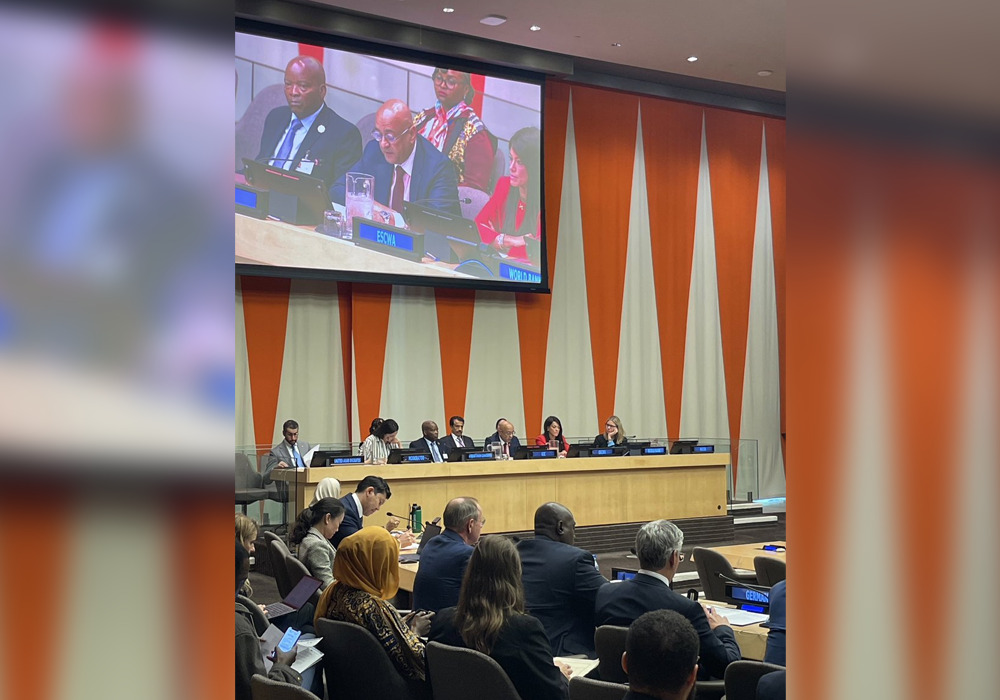
New York: Secretary General of the Gulf Cooperation Council (GCC), Jasem Mohamed Albudaiwi underscored that water security constitutes a strategic priority for GCC member states, transcending environmental concerns to intersect directly with human security, economic prosperity, food security, and energy security, serving as an indispensable pillar of societal stability and resilience.
Albudaiwi's remarks were delivered during his participation in a panel session titled "Water as a Strategic Imperative: From Global Challenges to Collective Action", organised by the Permanent Mission of the United Arab Emirates (UAE) to the United Nations (UN) on Friday, held on the margins of the 81st session of the UN General Assembly (UNGA) in New York.
The GCC the Secretary General explained that while water scarcity has posed a continuous challenge to the Gulf region for decades, adding that it has simultaneously driven GCC states to innovate, invest, collaborate, and pursue forward-looking planning.
In this context, Albudaiwi highlighted the extensive expertise accrued by member states across desalination, wastewater reuse, demand management, and the deployment of advanced technologies, alongside reinforcing the nexus between water, energy, food security, climate resilience, and sustainable economic development.
"Technology alone is insufficient to guarantee water security," he stated, underscoring the critical importance of regional cooperation and joint action.
He pointed to the collective mechanisms, policies, and programmes developed by GCC nations to safeguard water resources, highlighting ongoing initiatives to explore and develop a regional water grid interconnection. Such strategic integration, he noted, will significantly enhance supply security, elevate collective readiness, and reinforce joint response capabilities during emergencies and water crises.
Furthermore, Albudaiwi indicated that compounding challenges linked to climate change, demographic growth, economic transitions, and escalating demand for natural resources exert mounting pressure on water systems globally.
The GCC Secretary-General stressed that shared water challenges demand shared solutions, adding that multilateral cooperation in this domain fosters mutual trust, mitigates collective vulnerabilities, unlocks economic opportunities, and bolsters regional stability.
He also underlined the necessity of harnessing innovation and cutting-edge technologies -including artificial intelligence (AI), digital transformation, smart water management systems, and renewable energy- to maximise operational efficiency and resilience. He called for establishing collaborative financing models that bring together governments, development institutions, research centres, and the private sector to translate promising solutions into scalable, and bankable infrastructure projects.