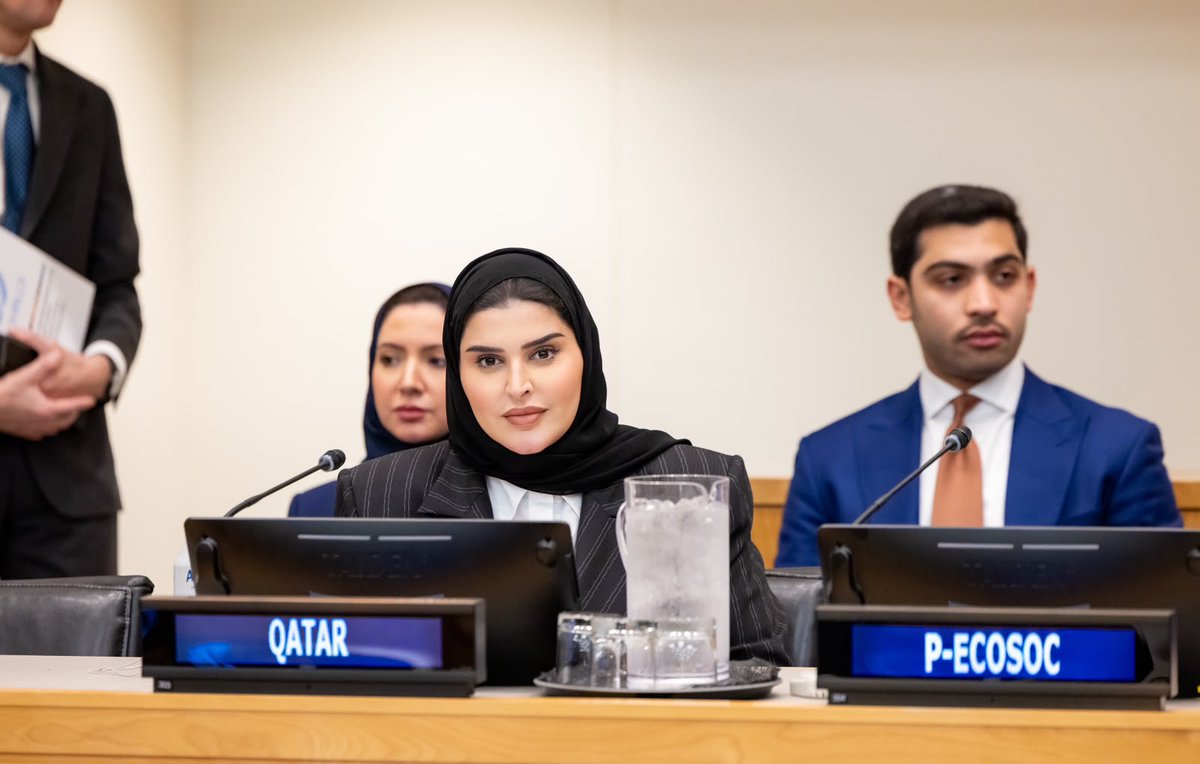
New York: Qatar has called for stronger international action to support the world's least developed countries (LDCs), warning that overlapping economic, climate and food crises are compounding their long-standing structural challenges.
Minister of State for International Cooperation HE Dr Maryam bint Ali Al Misnad made the remarks during the annual ministerial meeting of the least developed countries, held on the sidelines of the 81st session of the United Nations General Assembly in New York.
HE Al Misnad said support for LDCs was not only a matter of international solidarity, but also an investment in sustainable development, peace and international stability.
She reaffirmed Qatar's commitment to supporting the world's least developed countries, citing multilateral cooperation and effective partnerships as key to achieving inclusive and sustainable development.
Qatar hosted the Fifth United Nations Conference on the Least Developed Countries (LDC5) in Doha in March 2023. During the conference, HH the Amir Sheikh Tamim bin Hamad Al-Thani pledged $60 million to support the implementation and outcomes of the Doha Program of Action, including $10 million for program activities and $50 million to strengthen resilience in LDCs.
HE Al Misnad said Qatar was working to translate those commitments into practical partnerships. In September 2025, the Qatar Fund for Development signed two agreements worth a combined $21 million with the UN Office of the High Representative for the Least Developed Countries, Landlocked Developing Countries and Small Island Developing States.
The agreements support resilience-building in LDCs and the establishment of a food-storage mechanism, she said.
Qatar also hosted a high-level meeting on achieving sustainable and resilient graduation from the LDC category in December 2025, according to the minister.
Al Misnad called for greater international cooperation to close the development financing gap facing LDCs, expand concessional financing and investment, mobilize domestic and international resources, and develop innovative financing mechanisms tailored to the circumstances of vulnerable countries.
She also highlighted the need to strengthen resilience to economic, climate and food-related shocks, while maintaining investment in education, healthcare, social protection and skills development.
The minister said sustainable graduation from the LDC category should be treated as a long-term development process that protects gains already made and prevents countries from falling back into the category.
She pointed to the high-level midterm review of the Doha Program of Action, scheduled to take place in Doha from March 25 to 27, 2027, as an opportunity to assess progress, identify gaps and renew political and financial commitments during the second half of the program.
Al Misnad also addressed the impact of the closure of the Strait of Hormuz, saying prolonged disruption to shipping had implications beyond energy security and global trade, affecting food security and energy supplies, particularly in developing countries.
She said disruption to fertilizer supply chains had also affected agricultural production and called for the restoration of navigation through the strait in accordance with international law and UN Security Council Resolution 2817 (2026).
Qatar's priority, she said, was to contain escalation and create space for diplomatic efforts. Any future arrangements concerning the strait, she added, should be based on regional consensus and full respect for international law.
Al Misnad said the success of the Doha Program of Action was a collective responsibility and urged development partners to increase their efforts, strengthen international solidarity and direct more resources and investment towards the world's least developed countries.
Qatar, she said, would continue working with its partners to implement the program and support more inclusive, equitable and sustainable development.