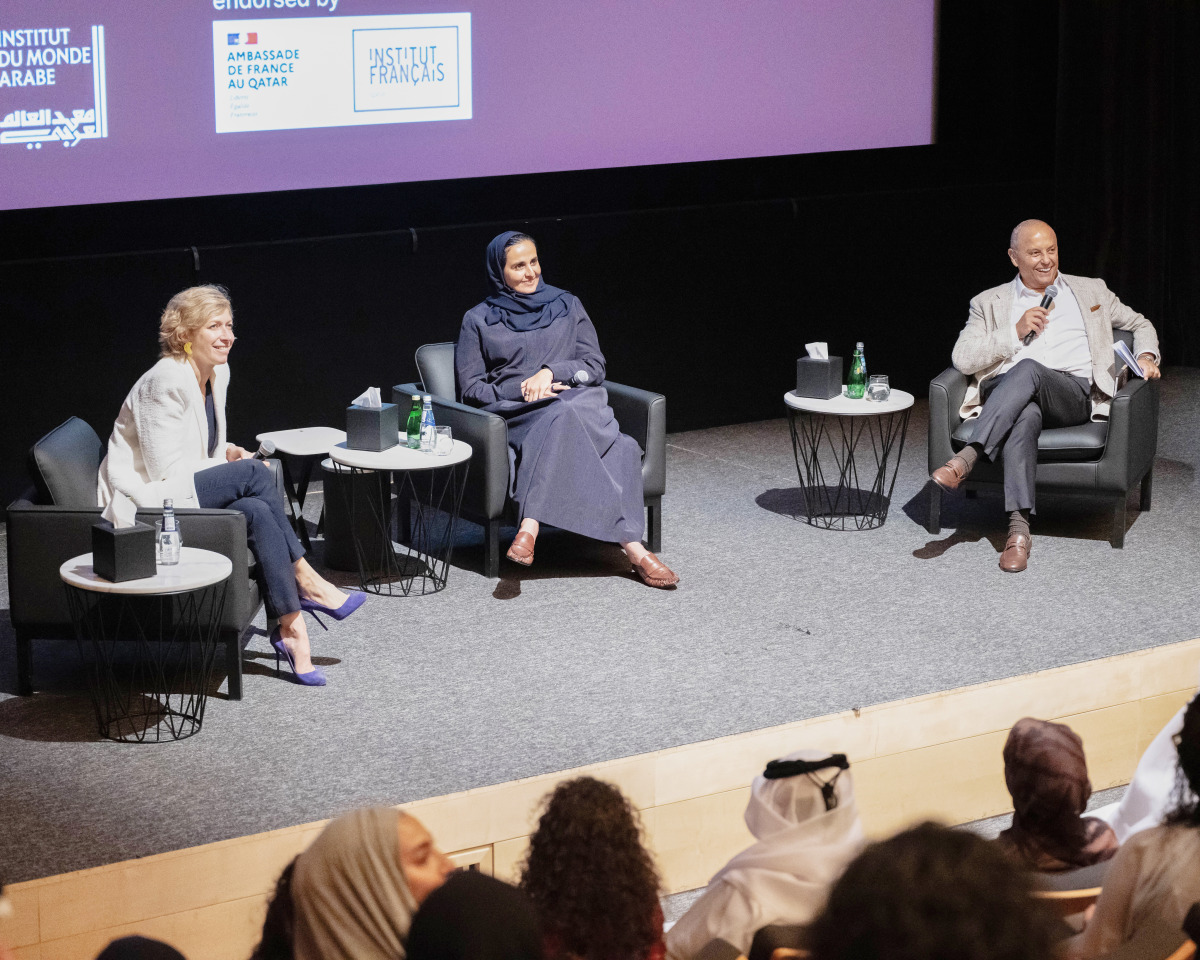
H E Sheikha Al Mayassa bint Hamad bin Khalifa Al Thani (centre) with President of the Institut du monde arabe (IMA) in Paris Anne-Claire Legendre (left) and Dr. Safwan Masri during the event yesterday.
DOHA: Cultural institutions can play a powerful role in strengthening international relationships, fostering dialogue and building understanding between societies, Chairperson of Qatar Museums H E Sheikha Al Mayassa bint Hamad bin Khalifa Al Thani has said.
Speaking yesterday at the Qatar Creates Talks session titled “Culture as Diplomat: How Cultural Institutions Shape International Relationships,” Sheikha Al Mayassa said cultural diplomacy should be viewed as a complement to political diplomacy, creating spaces for dialogue even when formal political engagement becomes difficult.
The special conversation brought together Sheikha Al Mayassa and President of the Institut du monde arabe (IMA) in Paris Anne-Claire Legendre, with Dr Safwan Masri, scholar and author, serving as moderator.
Reflecting on her own journey into cultural leadership, Sheikha Al Mayassa said her involvement with Qatar Museums was not a departure from her initial ambition to pursue international diplomacy, but rather “a new arrival” into another form of diplomatic engagement.
She said her father, the late Amir H H Sheikh Hamad bin Khalifa Al Thani, encouraged his children to dream big and placed strong emphasis on human development and public service.
“When I returned after my studies, we had this museum,” she said, explaining that she initially regarded her appointment as a temporary responsibility before recognising the broader significance of cultural institutions.
“I feel very privileged and honoured to be able to shape a very important form of diplomacy on behalf of my country,” she said.
Sheikha Al Mayassa highlighted Qatar’s growing role as a regional hub for culture and creativity, pointing to initiatives spanning museums, film, fashion, design and artistic production.
She said culture creates a different space for international engagement because it begins with curiosity and the desire to understand others at a human level.
“Culture starts at the point of curiosity,” she said, adding that cultural relations can continue even when political conversations cease.
She cited Qatar’s cultural diplomacy initiatives in Latin America, including visits to Brazil, Argentina and Chile, as examples of how cultural engagement can encourage collaboration and deeper understanding between communities.
Legendre, who has a background in diplomacy and previously served in senior diplomatic roles, said her move to the IMA represented a return to an important part of her intellectual and professional journey.
She said her early interest in literature and Arabic had shaped her understanding of the importance of culture in building empathy, while her diplomatic career showed her the limitations of traditional diplomacy in addressing some social and cultural challenges.
The discussion also examined how cultural diplomacy can challenge perceptions that societies or civilisations are monolithic.
Legendre said the IMA’s role was not to define what the Arab world should be, but to reflect its diversity, history and contemporary cultural expression.
She stressed the importance of recognising different identities, languages, histories and artistic traditions within the Arab world and its diasporas.
Sheikha Al Mayassa similarly argued against rigid divisions between East and West, Muslim and non-Muslim, or other categories used to describe societies.
“Everything can coexist,” she said, emphasising that Qatar’s cultural initiatives seek to provide platforms for talented artists and creatives based on the quality of their work rather than identity-based categorisation.
She also stressed the importance of cultural institutions in an era when young people increasingly obtain information through social media.
Museums and cultural organisations, she said, can provide opportunities for people to engage directly with history, archives, art and different perspectives.
She encouraged parents to take children to museums so they can develop curiosity and critically examine information they encounter online.
The speakers also discussed the limits of cultural diplomacy, acknowledging that cultural institutions cannot replace foreign ministries or political negotiations.
However, Sheikha Al Mayassa said cultural institutions can sometimes maintain relationships when political channels become constrained.
She cited cultural exchanges involving countries with which political engagement may have been difficult, noting that museums and cultural institutions can facilitate conversations through exhibitions, loans and artistic collaborations. She also recalled Qatar’s approach during periods of political tension, saying artists and creators should not necessarily be treated as representatives of governments or political disputes.
“People remain connected to each other and it allows us to continue our narrative,” she said.
The conversation also reflected on Qatar’s Years of Culture initiative, which Sheikha Al Mayassa described as a response to the need for countries and communities to understand one another through sustained cultural engagement.