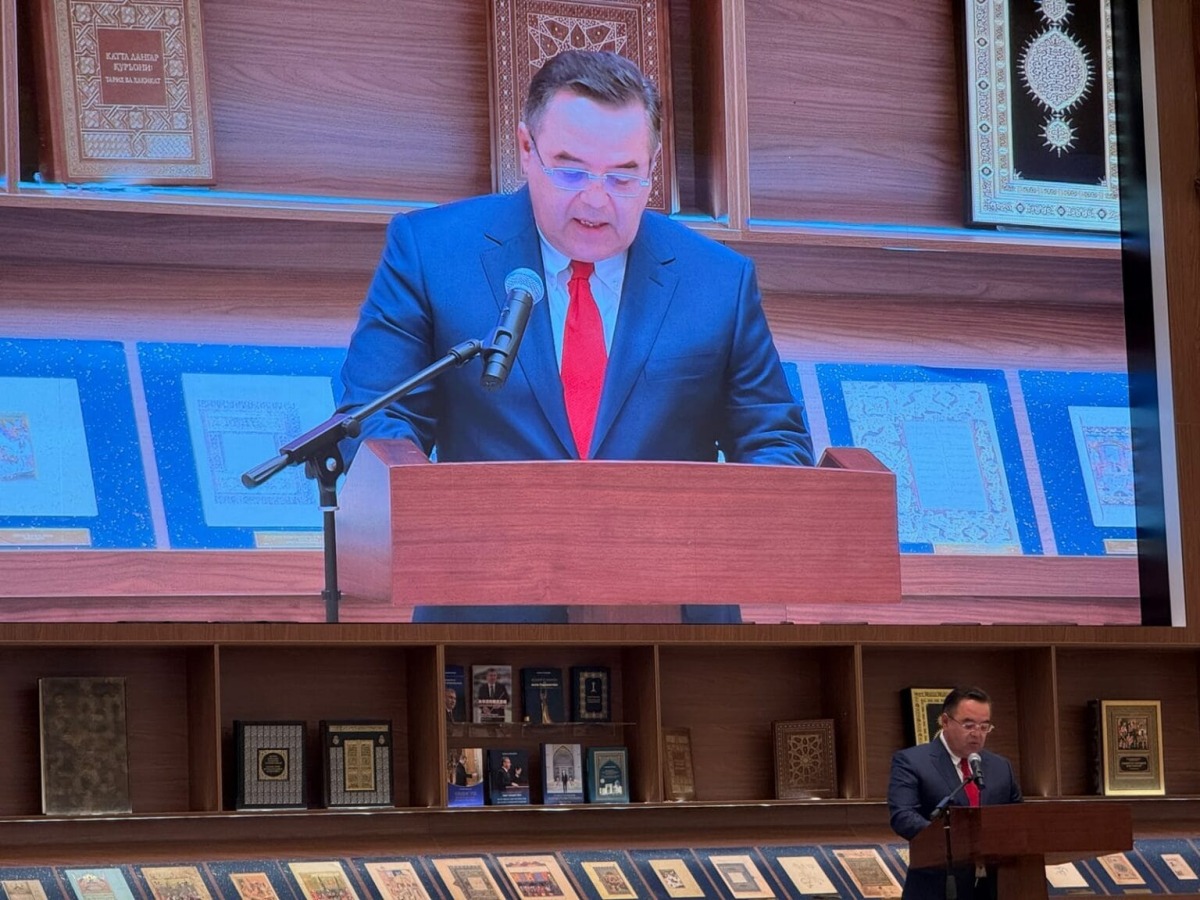
Dr. Firdavs Abdukhalikov, Director General of the Center for Islamic Civilization in Uzbekistan speaking during the forum.
TASHKENT, Uzbekistan: An international media forum examining the historical legacy, cultural heritage and contemporary relevance of Islamic civilization opened in Tashkent on Tuesday, bringing together journalists, scholars, filmmakers, publishers and media professionals from around the world.
Held under the theme “Islamic Civilization: A New Perspective — New Discoveries,” the forum is exploring how the scientific, intellectual and cultural achievements of Islamic civilization can be communicated to contemporary audiences through journalism, documentary filmmaking, publishing and emerging digital technologies.
The main programme is being held at the Center of Islamic Civilization in Uzbekistan, a major cultural and research institution established as part of the country's efforts to study, preserve and promote its historical and intellectual heritage.
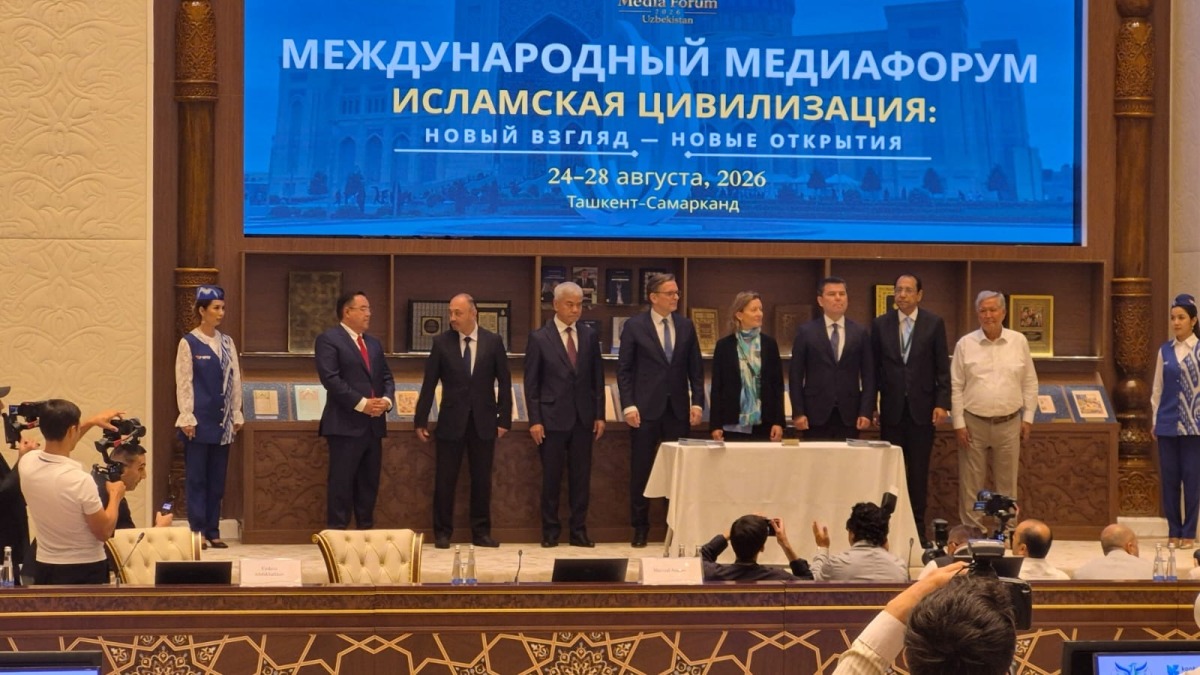
Participants during the forum.
The gathering has drawn representatives from international and national media organisations, including 26 television and radio companies, 24 international publications, 14 newspapers and five international media associations, according to organisers.
CNN and Euronews are serving as general media partners for the forum, reflecting organisers' efforts to broaden the international reach of discussions and projects emerging from the event.
The programme includes plenary sessions, expert presentations, panel discussions and practical master classes, alongside documentary screenings, thematic media exhibitions, press briefings and presentations of international publishing and media projects.
Journalists, filmmakers, producers, publishers and researchers are also holding bilateral and professional meetings aimed at exploring opportunities for future cooperation.
Discussions are focusing on the contribution of Islamic civilization to global science and culture, the legacy of prominent Muslim scholars and the preservation and study of the Holy Quran, while examining how those subjects can be presented through contemporary media formats.
Organisers say the forum is intended to go beyond academic discussion by creating a practical platform where scholars studying the past can engage directly with media professionals responsible for communicating history and culture to modern audiences.
A central theme running through the forum is the use of modern technology to make historical, cultural and spiritual heritage more accessible to younger generations and international audiences.
Participants are examining the potential of documentary filmmaking, television, publishing, museum technologies, artificial intelligence, digital avatars and immersive media to bring historical narratives to life.
The discussions reflect a broader effort in Uzbekistan to connect the preservation and study of the country's past with new forms of storytelling and digital communication.
For media organisations, the challenge extends beyond documenting historical sites and artefacts. Speakers are considering how complex historical subjects can be translated into compelling and accessible narratives without losing their academic and cultural context.
The forum's international dimension was highlighted during the opening programme by a special report titled “New Proximity: Connecting Europe and Central Asia through Culture, Media and Ideas — the Center of Islamic Civilization in the Global Information Space,” presented by Claus Strunz, CEO and Editorial Director of Euronews.
The official opening programme also included addresses by Sherzod Asadov, Press Secretary to the President and Head of the Communications Department of the Presidential Administration of Uzbekistan, and Muzaffar Komilov, State Counsellor to the President of Uzbekistan.
Delegates were also presented with the special film “A World View of the Center of Islamic Civilization,” introducing the institution and its work to the international media audience.
The opening session also produced a concrete initiative aimed at strengthening specialist journalism on Uzbekistan's cultural heritage.
The Center of Islamic Civilization in Uzbekistan and the University of Journalism and Mass Communications of Uzbekistan signed a joint programme to create a media platform focused on studying and popularising the country's cultural heritage among young journalists.
The initiative underscores one of the forum's broader objectives: developing the professional expertise needed to communicate historical and cultural subjects accurately while adapting them to rapidly changing media platforms and audience habits.
Such cooperation could also provide young journalists with greater access to researchers, historical materials and cultural institutions while encouraging new approaches to multimedia reporting on heritage.
The programme extends beyond the Uzbek capital, with delegates scheduled to travel to Samarkand, one of Central Asia's most historically significant cities and a crossroads of cultures, scholarship and trade for centuries.
Participants are expected to visit the Imam al-Bukhari Memorial Complex and sites connected with Samarkand's UNESCO World Heritage status.
The visit will provide international journalists and media professionals with an opportunity to experience first-hand some of the places central to Uzbekistan's Islamic and cultural history.
Samarkand's inclusion in the programme is particularly significant to the forum's wider narrative. Central Asia produced scholars whose work contributed to the development of theology, mathematics, astronomy, medicine, philosophy and other fields across the wider Islamic world.
By connecting academic discussions in Tashkent with historical locations in Samarkand, organisers are seeking to demonstrate the relationship between the region's physical heritage and its broader contribution to world civilization.
Dr Firdavs Abdukhalikov, Director General of the Center of Islamic Civilization in Uzbekistan, said the forum was intended to help translate President Shavkat Mirziyoyev's vision for preserving and promoting the country's historical heritage into international media projects capable of reaching audiences around the world.
The Center is seeking to present the legacy of Islamic civilization in a contemporary language, drawing on global media, cinema, publishing, digital technologies and artificial intelligence to expand its international reach.
According to organisers, materials and projects associated with the Center have already reached media organisations in 65 countries, generating hundreds of news reports and sponsored features as well as documentaries, television reports, video projects and books.
The forum is therefore placing considerable emphasis on transforming professional contacts into longer-term partnerships.
Potential areas of cooperation include jointly produced documentaries and films, television programmes, books, publishing initiatives and digital media projects designed for audiences beyond Uzbekistan and Central Asia.
The approach reflects an effort to move beyond conventional presentations of cultural heritage, in which history is primarily displayed through museums, academic publications and commemorative events, towards formats capable of engaging global audiences across television, streaming, social media and other digital platforms.
One of the forum's underlying questions is how historical knowledge can be made accessible without diminishing its complexity.
Bringing researchers together with journalists and audiovisual storytellers provides an opportunity to bridge two professional worlds: scholars responsible for studying and interpreting historical evidence, and media practitioners tasked with translating that knowledge into stories understandable to broad audiences.
For Uzbekistan, the discussion also carries an international dimension as the country seeks to draw greater attention to Central Asia's role in the scientific, intellectual and cultural development of Islamic civilization.
The region was home to influential scholars whose works circulated far beyond Central Asia and became part of wider traditions of learning across the Muslim world and beyond.
Modern media technology, participants argue, offers new opportunities to introduce those figures, manuscripts, monuments and intellectual traditions to audiences who may have little previous knowledge of Central Asian history.
At the same time, the rapid expansion of artificial intelligence and digitally generated content is raising new questions about historical accuracy, authenticity and the responsibilities of media organisations when presenting cultural and religious heritage.
These issues place journalists, researchers and cultural institutions at the centre of a changing information environment in which technology can dramatically expand access to history but also requires strong standards of verification and scholarship.
The forum is also taking place in the context of events marking the 35th anniversary of Uzbekistan's independence, adding a contemporary national dimension to discussions about historical identity and international cultural engagement.
Since gaining independence in 1991, Uzbekistan has increasingly sought to present its historic cities, manuscripts, scholars and cultural institutions as part of a heritage with significance extending well beyond its national borders.
The Tashkent gathering positions media cooperation as an important component of that effort.
Rather than treating cultural heritage solely as a subject of preservation, the forum is examining how it can become the foundation for international collaboration among researchers, journalists, filmmakers, publishers and technology specialists.
For participating media organisations, the gathering also provides access to historical sites, academic expertise and potential production partners in a region whose contribution to global intellectual history remains comparatively underrepresented in much international media coverage.
The forum is expected to conclude with further professional exchanges and discussions on potential international collaborations in journalism, documentary filmmaking, television, publishing and digital media.
Ultimately, the gathering's ambition extends beyond the event itself: to establish new channels through which the intellectual and cultural legacy of Islamic civilization — and Central Asia's place within it — can be researched, documented and communicated to audiences around the world.