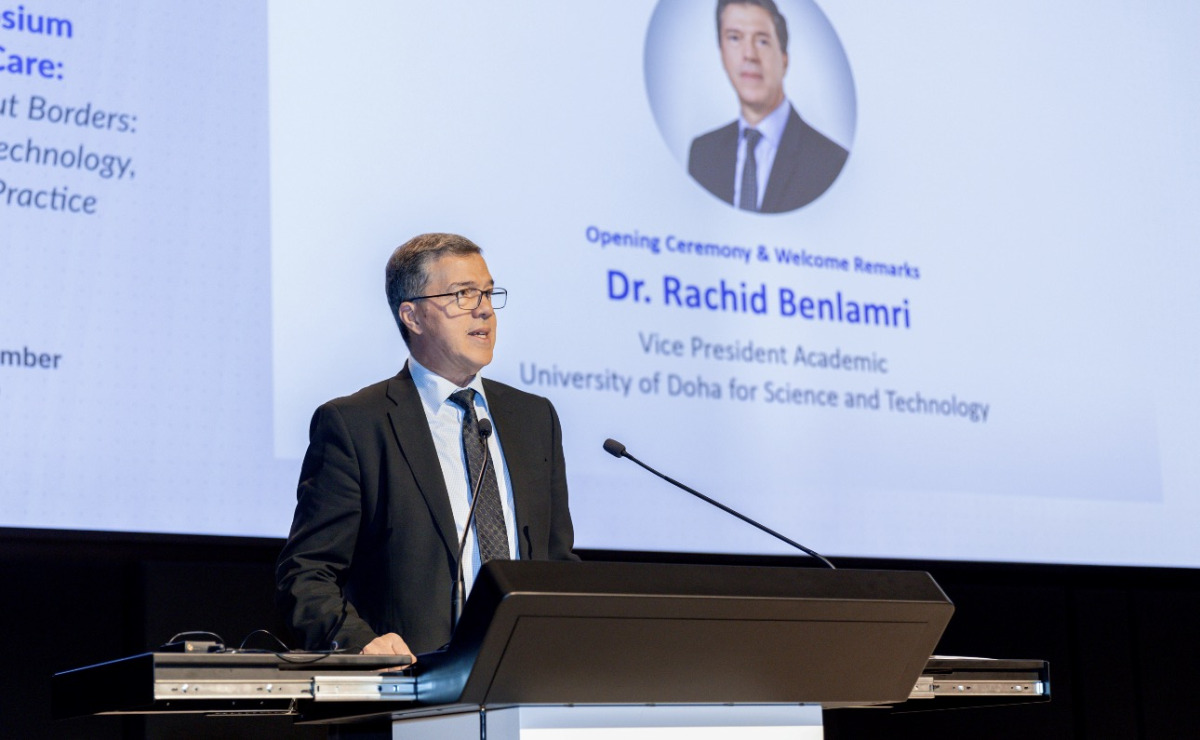
UDST Vice President for Academic Affairs Dr. Rachid Benlamri addressing the symposium.
Doha, Qatar: The University of Doha for Science and Technology (UDST) hosted the 5th Symposium on Diabetes Care, marking World Diabetes Day 2026 under the theme ‘Diabetes Care Without Borders: Integrating Science, Technology, and Team-Based Practice.’
The symposium was attended by Sheikh Dr. Mohammed Al Thani, Director of the Non-Communicable Disease Prevention Programmes Department at the Ministry of Public Health; Dr. Rachid Benlamri, Vice President for Academic Affairs; and national and international healthcare experts, researchers, academics, and practitioners to exchange knowledge and explore innovative approaches to diabetes prevention, treatment, and management.
The scientific programme featured contributions from leading experts representing the Ministry of Public Health, Hamad Medical Corporation, Primary Health Care Corporation, the World Health Organisation Office in Qatar, Sidra Medicine, The View Hospital, Weill Cornell Medicine-Qatar, King Abdulaziz University in Saudi Arabia, and Hamad Bin Khalifa University, alongside UDST academics and researchers.
A key highlight was the panel discussion titled ‘Early Action, Better Outcomes: Closing the Diabetes Diagnosis Gap,’ which brought together representatives from UDST, Qatar Diabetes Association, Hamad Medical Corporation, and Sidra Medicine.
The symposium provided a forum for multidisciplinary dialogue on advancing diabetes care through health systems transformation, collaborative healthcare models, technological innovation, and evidence-based interventions.
It also highlighted the importance of equitable and culturally responsive healthcare services in addressing the growing challenges associated with diabetes across diverse populations.
The event featured a comprehensive scientific programme of keynote presentations, expert talks, and interactive discussions led by distinguished healthcare professionals and specialists.
Topics included Qatar’s national diabetes strategy, the integration of diabetes education into health professions curricula, and multidisciplinary models of diabetes care.
Further discussions explored cardiovascular and diabetes-related complications, diabetic retinopathy, childhood obesity and the prevention of youth-onset type 2 diabetes, as well as emerging treatments and advances in diabetes technology, including continuous glucose monitoring (CGM) and automated insulin delivery systems.
Commenting on the symposium, Dean of the College of Health Sciences, Dr.Shahrokh Esfandiari, said, “At UDST, we recognise that addressing diabetes requires more than advances in clinical treatment; it calls for an integrated approach that brings together education, research, technology, and healthcare practice.
Through initiatives such as the Symposium on Diabetes Care, we aim to strengthen collaboration between academic institutions and healthcare providers, promote the exchange of expertise, and support the development of healthcare professionals equipped to respond to evolving health challenges. By advancing applied education and multidisciplinary collaboration, we remain committed to contributing to Qatar’s national health priorities and improving health outcomes across the community.”
The symposium also addressed the importance of early intervention, particularly in relation to diabetes during pregnancy, postpartum care, childhood obesity, and the identification of individuals at risk of developing Type 1 diabetes.
Discussions highlighted the role of health literacy, patient education, and coordinated healthcare delivery in improving long-term outcomes. The 5th Symposium on Diabetes Care reaffirmed UDST’s commitment to advancing healthcare education, strengthening partnerships with key healthcare institutions, and supporting national efforts to improve diabetes prevention and management through applied research, professional development, and multidisciplinary collaboration.