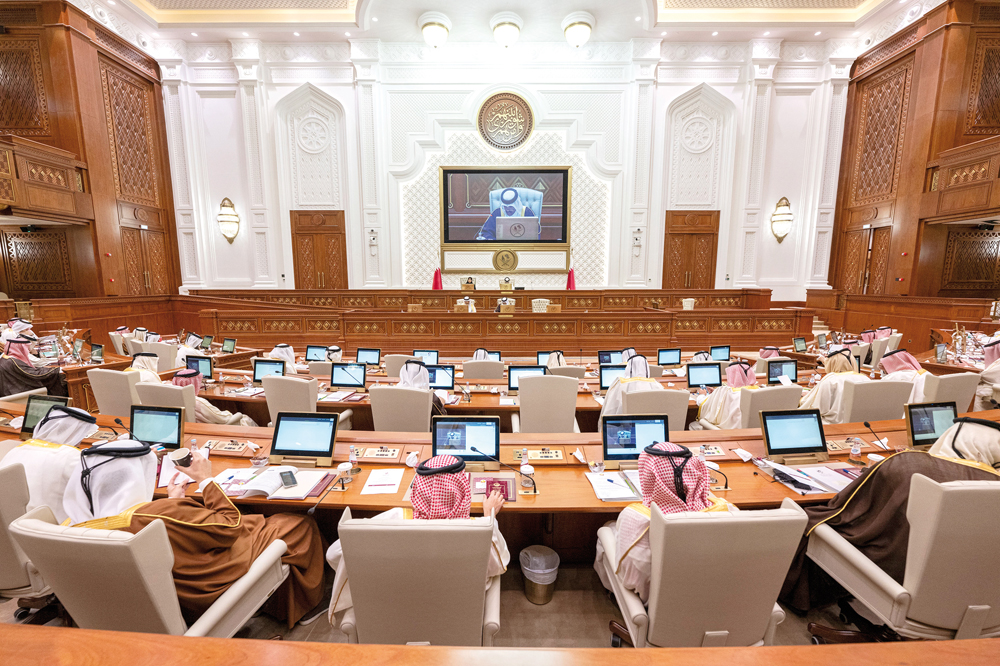
A file photo of Shura Council Speaker H E Hassan bin Abdullah Al Ghanim chairing the Council’s session.
The State of Qatar embarks tomorrow on a new phase of its Shura journey chosen by the wise leadership and the loyal Qatari people as a method for running and managing the country’s affairs. This method of governance aligns with the Islamic and Arab identity alongside the deep-rooted heritage, traditions, and values of Qatari society.
To mark the beginning of a new legislative term, the Amir H H Sheikh Tamim bin Hamad Al Thani will patronise tomorrow morning the opening of the third regular session of the first legislative term, corresponding to the 52nd annual session of the Shura Council, in the Tamim bin Hamad Hall at the Shura Council’s headquarters. H H the Amir will deliver a speech addressing the state’s policies, future priorities concerning citizens and residents and upcoming developments, and outlining a renaissance centred on transparency and national competencies to achieve Qatar National Vision 2030. H H the Amir’s speech is expected to shed light on the State of Qatar’s stance on several Arab, regional, and international issues, and its growing role in diplomacy. The current challenges faced by the Arab region will undoubtedly be addressed. Given the exceptional circumstances, the content of H H the Amir’s speech will also be exceptional. The Shura experience in Qatar is a rich and distinguished experience marked by cooperation, generosity, harmony, and unity among all state institutions to establish popular participation. Since its inception in the 1970s, the Council’s progress has been significant, thanks to the support of the wise leadership, the objective discussions, the exchange of views among their members, and the Council’s keenness to play its role in serving the interests of the nation and its citizen. The Shura Council’s long journey saw the approval of many legislations and laws that contributed to advancing the nation in all sectors. The current reality affirms the movement towards broader horizons so that the state of institutions and law continues to develop and prosper.
Last November, the Shura Council celebrated its 50th anniversary. The second session of the first legislative term was marked by holding 35 plenary sessions, two extraordinary sessions, and 69 meetings of the Council’s permanent and temporary committees, characterized by positive and fruitful cooperation between the Council and the esteemed government, which was keen to take review the Council’s proposals and implementing it.
Additionally, the Council discussed eight draft laws to amend certain laws, six general discussion requests submitted by the Council’s members, and six recommendations to the esteemed government.
The Shura Council plays a pivotal role in the local scene as a legislative authority, embodying the unity and cohesion between Qatar’s wise leadership and people who have remained active partners in the country's development process. Since its establishment in 1972, the Shura Council has seen five Shura Council Speakers. H E Abdulaziz bin Khalid Al Ghanim (1972-1990), H E Ali bin Khalifa Al Hitmi (1990-1995), H E Mohammed bin Mubarak Al Khulaifi (1995-2017), H E Ahmad bin Abdullah bin Zaid Al Mahmoud (2017-2021), and current Speaker H E Hassan bin Abdullah Al Ghanim.
The history of the Shura Council dates back to 1972, with the issuance of the amended temporary statute on April 19, 1972, to organize the structures and institutions of the modern state including the Shura Council. The first Shura Council included 20 appointed members, with its composition being modified on several occasions. Currently, the Shura Council comprises of 45 members, 30 of whom are elected by public secret direct ballot, while H H the Amir appoints the remaining 15 members from ministers or others. Membership in the Shura Council is terminated in the event of death, total disability, the expiration of the membership term, resignation, dismissal, or dissolution of the Council.
In November 2020, the Amir H H Sheikh Tamim bin Hamad Al Thani announced the holding of the first-ever elections in 2021. This step aligns with Qatar’s ambitious policy to develop its legislative mechanisms by expanding the scope of popular participation to reflect the values of the Qatari Constitution and the Qatar National Vision 2030.
The first legislative elections were held on October 2, 2021, Saturday, to elect Shura Council members. Subsequently, on Oct. 14, 2021, H H the Amir issued Amiri Decision No. 56 of 2021 appointing 15 members of the Shura Council. The Councils term is set at four calendar years starting from the date of its first meeting.
In efforts to expand popular participation in the Shura Council and ensure its representation of all segments of society, the Council currently includes two female members, highlighting the important role of the Qatari woman in serving the country and society across all sectors. Qatari women have proven their competence in top administrative and scientific positions, contributing actively in various fields of the Qatari society.
In Qatar, the Shura Council represents one of the two wings of the authority. Laws are only issued after drafts are reviewed and studied by the Council. Meanwhile, the other wing, the Cabinet, is responsible for proposing laws, preparing their drafts, and referring them to the Shura Council.
The Shura Council elects in its first session of the annual ordinary session a speaker, a deputy speaker, and two or more observers as needed by secret ballot and relative majority. The Shura Council has five permanent committees formed during the first week of each annual ordinary session from among its members, namely: Legal and Legislative Affairs Committee; Financial and Economic Affairs Committee; Public Services and Utilities Committee; Internal and External Affairs Committee; and Cultural Affairs and Information Committee. The Council may form other permanent and temporary committees according to the need, and each permanent or temporary committee may form one or more sub-committees from its members. The committees submit to the Speaker of the Shura Council a report on each subject referred to it within thirty days at most from the date of referral, unless the Council decides otherwise.
The Shura Council exercises its powers to adopt, approve, or even reject some laws from the draft laws and other matters presented to it. The Council is competent to discuss and propose many issues, the most important of which is the discussion of draft laws, decrees by laws, and the general policy of the state in the political, economic and administrative aspects, which are referred to it by the cabinet, as well as the affairs of the country in the social and cultural fields in general and referred to it by the Council of Ministers or considered on its own initiative.
The Shura Council also discusses the draft budget for public projects, the Councils draft budget and its final account. It is also responsible for following up on the states activities and achievements regarding all matters referred to it by the Council of Ministers, as well as all matters related to the social and cultural fields, whether these matters were referred to it by the cabinet or considered on its own initiative.
It also directs questions to the ministers with the intention of clarifying a specific matter related to the affairs that fall within its jurisdiction and to make recommendations and express desires to the government regarding the matters referred to. In terms of its external activity, the Shura Council strengthened its parliamentary relations with parliamentary assemblies in various countries of the world. The Council succeeded in reaching agreements with the UN regarding the establishment of the Programme Office on Parliamentary Engagement in Preventing and Countering Terrorism (UNOCT) in Doha, which activities cover all parliaments of countries around the world.
The Shura Council represents the State of Qatar in parliamentary unions and international organizations, including the Inter-Parliamentary Union (IPU), Arab Inter-parliamentary Union (AIPU), Arab Parliament, Conference of Union of Councils of the Organization of Islamic Cooperation (OIC) Member States, Asian Parliamentary Assembly (APA), Association of Senates, Shura Councils, and similar councils in Africa and the Arab world.