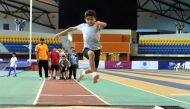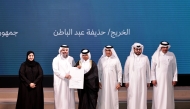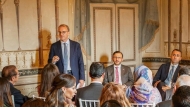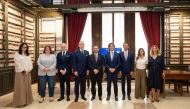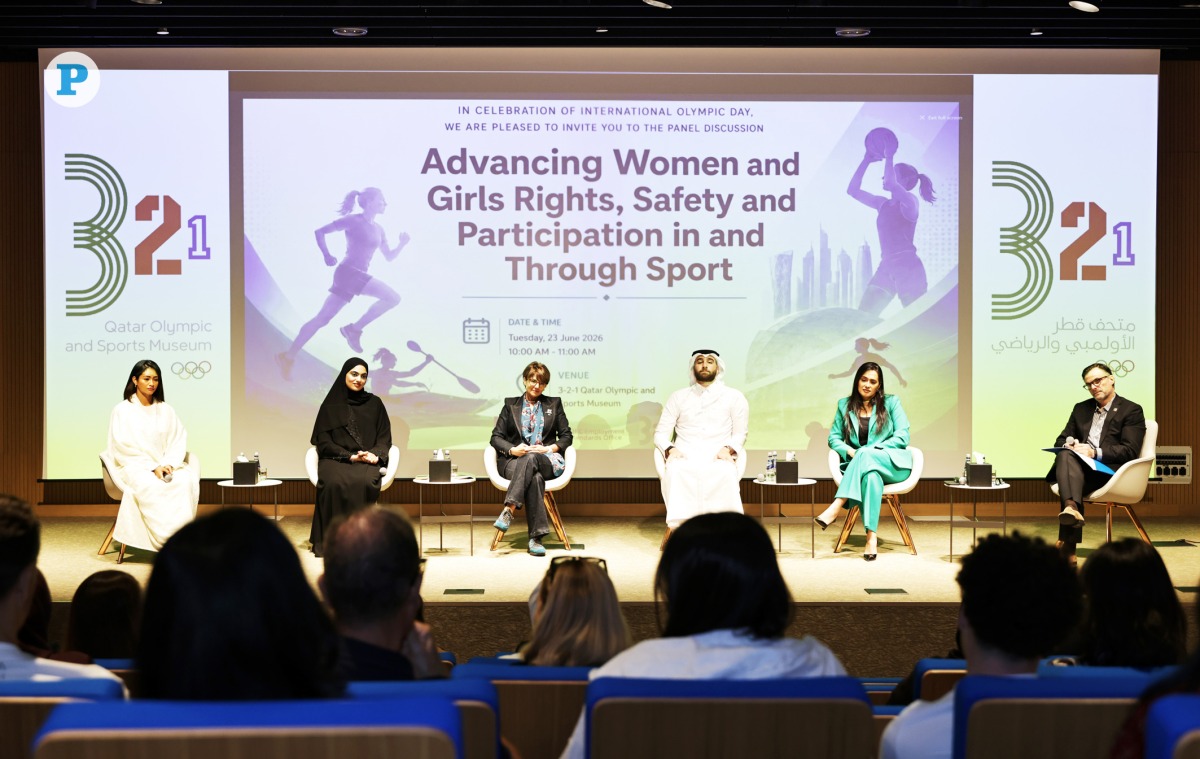
Panellists reflected on the progress made and the ongoing challenges facing women and girls in sport. Pic: Salim Matramkot/ The Peninsula
Doha, Qatar: Qatar’s growing commitment to empowering women and girls through sport was highlighted on International Olympic Day as policymakers, athletes and experts gathered to discuss how to advance women’s rights, safety and participation in sport.
Hosted by the European Union Delegation to the State of Qatar in coordination with the Employment Standards Office at Qatar Financial Centre, the discussion, titled ‘Advancing Women and Girls’ Rights, Safety and Participation in and Through Sport,’ was held at the 3-2-1 Qatar Olympic and Sports Museum, yesterday.
The event showcased Qatar’s efforts to position sport as a vehicle for empowerment and social development while examining the challenges that women and girls continue to face in their sporting journeys.
In her keynote address, Deputy Director of the Human Rights Department at the Ministry of Foreign Affairs Mashael bint Mana Al Hajri said Qatar views women’s participation in sport as a human rights issue and an integral part of the country’s development agenda.
“The full and equal participation of women and girls in sports is fundamentally a matter of human rights,” she said, noting that this conviction is reflected in Qatar National Vision 2030.
Al Hajri highlighted Qatar’s investment in sport, from hosting the FIFA World Cup Qatar 2022 to preparations for the Asian Games 2030, as well as the increasing participation of Qatari women in the Olympic Games.
“Qatar’s support for women extends across every field and sector, from education, diplomacy and the economy to sports and sports management,” she said. “Nowhere is this more visible than in sports itself.”
She emphasised that Qatar’s progress is not limited to participation on the field but extends to leadership roles. During the FIFA World Cup Qatar 2022, more than 300 women contributed to the tournament’s delivery in senior positions across the organizing structure.
Al Hajri also pointed to Qatar’s international efforts to promote women’s rights in sport, including its leadership, alongside Indonesia and Morocco, in introducing a Human Rights Council resolution affirming every woman and girl’s right to participate in sport in a safe, inclusive and discrimination-free environment.
Deputy Head of Mission at the Delegation of the European Union to Qatar Angelos Lenos praised Qatar’s growing role in global sport and its efforts to expand opportunities through investment and international cooperation.
“The 2022 FIFA World Cup was a landmark, not just for Qatar, but for the entire region,” he said. “It accelerated Qatar’s sports strategy, its investment in infrastructure, in grassroots participation and in hosting rights across multiple disciplines.”
Lenos said that sport has become an important area of cooperation between the European Union and Qatar. He said the panel discussion was a direct outcome of last year’s EU-Qatar Human Rights Dialogue, during which both sides identified women’s participation in sport as a priority area for joint action.
“Participation is not possible when half the population face barriers that the other half does not,” he said.
The event featured a panel comprising Commissioner of the Employment Standards Office at Qatar Financial Centre Luigia Ingianni; Qatari archer Nada Zeida; basketball player and entrepreneur Abdulrahim Abuissa; triathlete and the first Qatari woman to complete the Ironman challenge Lulwa Al Marri; and fencer and filmmaker Sheikha Maha. The discussion was moderated by Unesco Chairholder on Governance and Social Responsibility in Sport at Hamad Bin Khalifa University, Dr. Christos Anagnostopoulos.
Panellists reflected on both the progress achieved and the barriers that remain for women and girls in sport. They spoke about the challenges faced by pioneers who entered sporting spaces with few role models before them, creating opportunities for future generations. The discussion highlighted the importance of representation and storytelling in shaping perceptions of what young girls can achieve, while also emphasising the need for long-term investment, accessible pathways and trusted systems to sustain participation.
Addressing future priorities, panellists agreed that inspiration alone is not enough to create lasting change. They called for stronger infrastructure, accountability mechanisms and policies that translate into tangible improvements in girls’ everyday sporting experiences. Closing the event, Dr. Anagnostopoulos praised Qatar’s long-term commitment to integrating sport into national development.
“For around two decades now, this country has done something still rare in the world,” he said. “It has woven sport deliberately into the fabric of its national development, treating sport not as a pastime at the margins, but as an instrument of human progress.”
He added that the global conversation on women in sport has evolved significantly. “It is profoundly encouraging to see how far sport has travelled, from an era when decisions were made without women and girls, to one where they were made for them, to the era we are entering now, where they are made with them, and increasingly by them.”