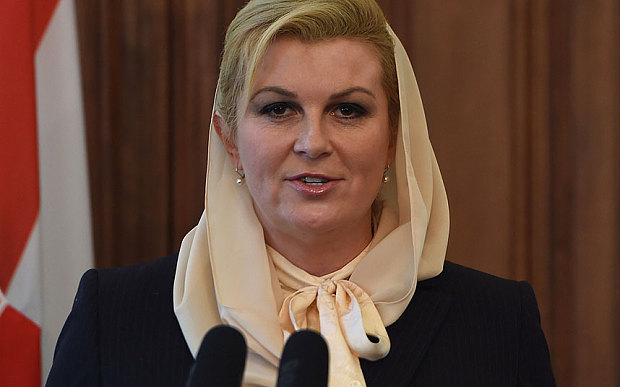

Zagreb: Croatia's main opposition conservatives and a small party that emerged as a kingmaker in last month's election have secured the parliamentary majority to form a government, President Kolinda Grabar-Kitarovic said Tuesday.
Members of the Patriotic Coalition, led by the main opposition conservative HDZ, and the smaller Most party "informed me that they enjoy the support of majority, or 78 deputies" in the 151-seat assembly, Grabar-Kitarovic told reporters.
The last round of consultations between the president and the parties will be held Wednesday when a deal on choosing the new prime minister should be reached, she said.
"By Wednesday evening either we will have a PM-designate or I will name a temporary government and call early parliamentary elections," Grabar-Kitarovic said.
The breakthrough comes more than six weeks after elections that failed to produce an outright winner.
It led to difficult talks, marked by numerous twists, between a bloc led by the incumbent Social Democrats, the HDZ-led coalition and the Most party trying to reach a deal on reforms that would be implemented by a new government.
Under the constitution, the president had to consult with parties to assign a new prime minister who enjoys the support of a majority of deputies.
Most (meaning 'Bridge' in Croatian) initially insisted that the new premier should be non-partisan, although it eventually accepted that its leader Bozo Petrov be nominated for the position.
Both Petrov and HDZ have continued to express support for a non-partisan premier, without giving a name.
But HDZ leader Tomislav Karamarko said the new premier could be someone from Most, possibly hinting to Petrov.
Political newcomers Most emerged as a powerful force in the election, coming third with an unexpected 19 seats. But the party has since been beset by internal wrangling, with at least four members leaving.
Focused on the need for widespread reforms of the public sector, judiciary and fiscal policy, most of Most's leadership hail from a conservative background.
The eventual PM-designate has up to 60 days to secure support for a cabinet and if unsuccessful another candidate can be named. After a second failure, the president would have to call fresh elections.
The political deadlock has been delaying badly-needed economic reform as Croatia slowly emerges from six years of recession and faces an unprecedented influx of refugees on their way to northern Europe.
AFP