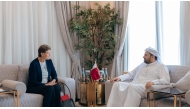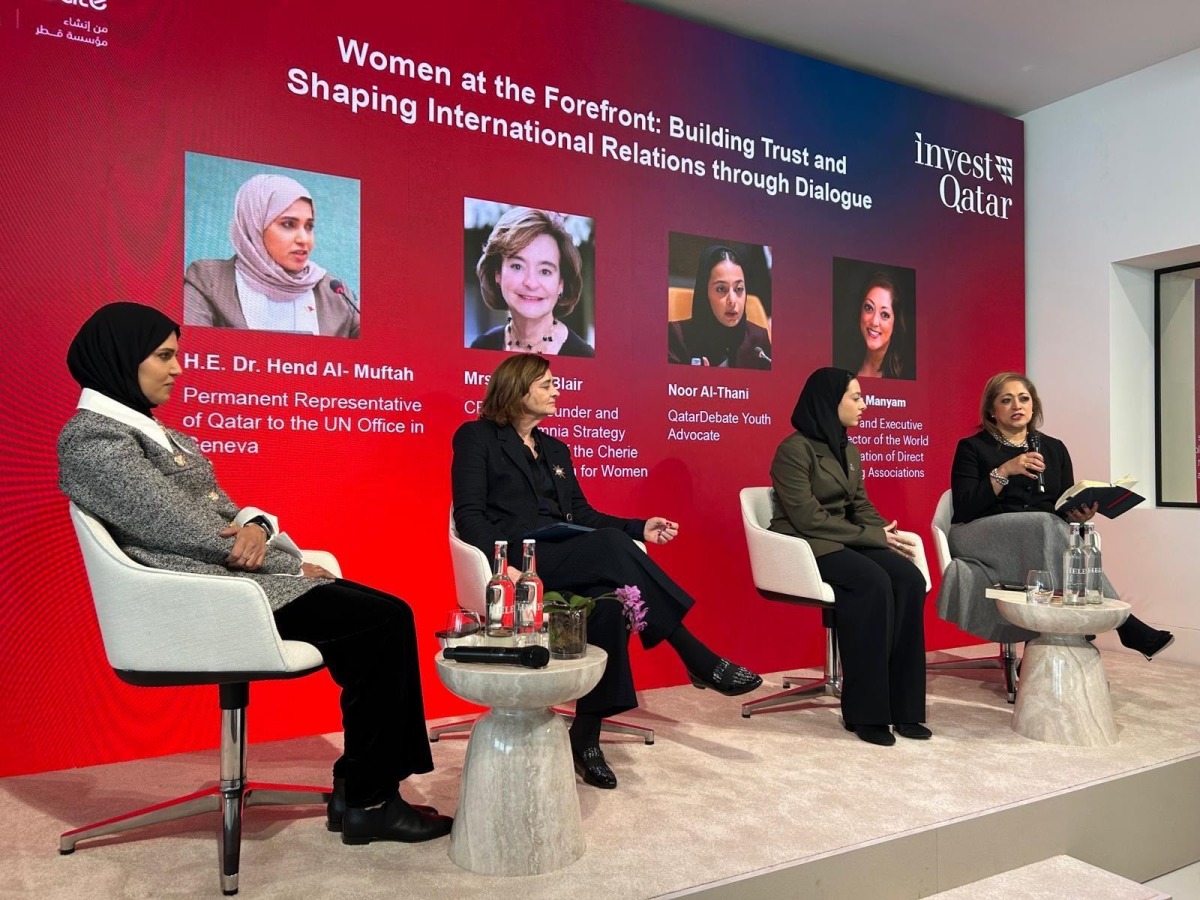
Davos: The Permanent Representative of the State of Qatar to the UN Office in Geneva , HE Dr.Hind bint Abdulrahman Al Muftah took part in a panel discussion on shaping international relations through dialogue, which was held as part of the activities in the World Economic Forum 2026 in Davos.
During the session, Her Excellency noted that the multilateral system was facing unprecedented challenges, marked by intensified competition among major powers and the growing politicisation of multilateral action, in addition to eroding trust in international institutions, particularly in contexts of protracted conflicts and crises. Her Excellency said that this has contributed to a state of relative paralysis in the international system’s ability to respond swiftly and effectively to emerging and prolonged crises.
Her Excellency mentioned the launch of third edition of the Global Cooperation Barometer 2026, which measures levels of international cooperation across five main areas: trade and capital, innovation and technology, climate and natural capital, health and well-being, and peace and security. Her Excellency noted that the report underscored that addressing major global challenges cannot be achieved through unilateral efforts by states, but rather requires renewed international engagement and the establishment of flexible and well-defined frameworks for cooperation.
Her Excellency added that international conflicts were no longer merely sporadic military confrontations, but have become a central driver in reshaping the global political and economic order, with repercussions for economic systems, technological competition, cyberspace, and energy and food security. Her Excellency stressed that this reality reflects a more complex international landscape characterised by multidimensional competition and shifting alliance maps.
Her Excellency said that, despite the approach of 2030, now only four years away, collective progress toward achieving the Sustainable Development Goals remains faltering. She added that this requires strengthening a multilateral approach that improves integration between humanitarian action, development, and peacebuilding, enhancing coherence and collective impact, particularly for the most vulnerable groups affected by conflicts and humanitarian emergencies.
Her Excellency affirmed that the United Nations still possesses strong and effective tools to preserve and strengthen regional and international cooperation if they are employed strategically and comprehensively. She noted that this includes investing in preventive diplomacy and mediation, supporting political solutions before crises escalate, backing peacebuilding efforts, protecting and promoting human rights, and expanding coordination with regional organisations and civil society.
She added that even amid fragmentation and polarisation, the United Nations can play a decisive role in sustaining and reinvigorating global engagement through political leadership, practical cooperation, and advancing institutional reform.
She further noted that through inclusive dialogue, results-oriented action, preventive diplomacy, effective communication, and continuous renewal, the United Nations can help bridge gaps and maintain constructive regional and global cooperation in an international environment increasingly marked by uncertainty.
Guided by the State of Qatar’s firm belief in the importance of establishing a strong strategic partnership with the United Nations, Her Excellency emphasised that Qatar continues to play an active role in supporting international efforts to enhance international peace and security, achieve sustainable development, protect human rights, provide humanitarian assistance, and contribute to peacekeeping operations. She noted that Doha has become a leading international platform for dialogue by hosting conferences, meetings, and workshops dedicated to mediation, peacebuilding, development, and the promotion of a culture of peace.
Her Excellency stressed that strengthening regional and global cooperation requires sustained and coordinated action across several interconnected tracks, particularly in light of mounting pressures on trust in multilateralism and the growing global challenges. She underlined the importance of reforming global governance and restoring the credibility of international institutions by modernising decision-making mechanisms, especially within the Security Council, to make them more representative, inclusive, and equitable.
She added that this also requires enhancing transparency and accountability within the multilateral system, and engaging developing countries as genuine partners in shaping global priorities and decisions, rather than merely as stakeholders.
Her Excellency further emphasised the need to prioritise preventive diplomacy and mediation as cost-effective and politically sustainable tools for achieving peace, while increasing investment in early-warning systems, conflict analysis, and preventive measures, and maintaining sustained support for mediation efforts at both regional and local levels. She stressed that promoting political solutions that take into account the cultural, social, and political specificities of each region is essential to ensuring long-term legitimacy and stability.
Her Excellency highlighted the importance of strengthening cooperation in addressing cross-border challenges such as climate change, pandemics, food and water insecurity, migration, and displacement, noting that making tangible progress on these issues is fundamental to restoring public trust in multilateral action, given their direct and lasting impact on people’s daily lives and long-term well-being.
Her Excellency underscored the importance of systematically enhancing the role of women in dialogue, mediation, and peacebuilding, noting that accumulated experience demonstrates that meaningful participation by women leads to more sustainable peace agreements, greater social cohesion, and faster, more inclusive post-conflict recovery. Her Excellency affirmed that advancing gender equality in peace processes is a strategic necessity.
She also emphasised that empowering civil society and youth is a cornerstone of sustainable peace and cooperation, explaining that supporting cross-border initiatives in education, technology, peacebuilding, and social cohesion helps counter hate speech, polarisation, and disinformation, while simultaneously fostering a culture of dialogue, innovation, and shared responsibility across generations.
In conclusion, HE the Permanent Representative of the State of Qatar to Geneva affirmed that multilateral cooperation remains an indispensable necessity despite the challenges facing the international system. She noted that the United Nations’ ability, through its close partnership with member states, regional organisations, and communities, to adapt, rebuild trust, and draw on successful regional experiences will be a decisive factor in shaping the future of global governance, delivering effective responses to shared crises, and building a more peaceful, stable, and resilient world.