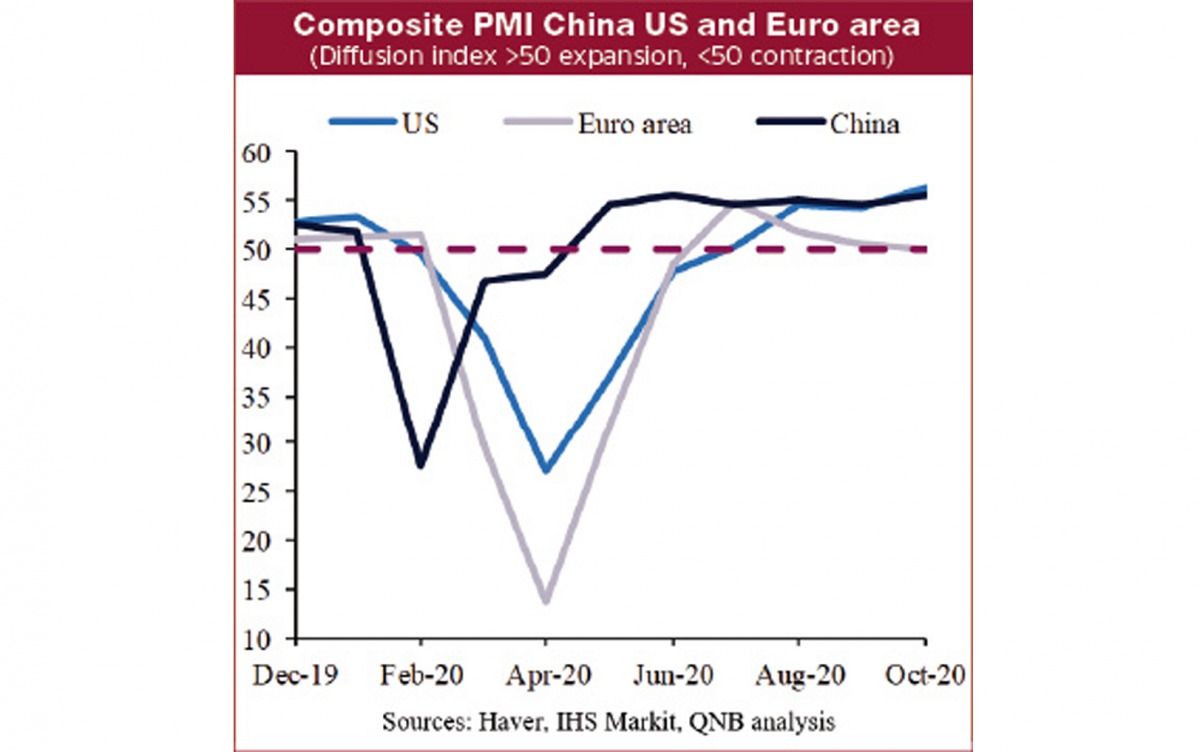
Doha: This year started on a positive note for the global economy. Bullish sentiment was rampant while overall activity was setting the stage for another period of accelerating expansion. However, global conditions took a dramatic turn with the spread of the COVID-19 pandemic. A rare “once-in-a-century” event, the pandemic led to the imposition of lockdowns and social distancing measures across all continents, in a synchronised movement that produced the largest economic shock since World War II.
European countries have been more proactive than US states in re-imposing social distancing measures, local lockdowns and in some cases even national lockdowns (e.g., France and Austria). Tighter measures are necessary to avoid overwhelming health services, but may well put festive travel, gatherings and celebrations on ice.
Fortunately, widespread wearing of facemasks, along with improvements in testing, contact tracing and treatment, all help to reduce both the natural rate of infection and the severity of symptoms in most cases. This in turn allows for less-restrictive and more-targeted measures, which will have a proportionally smaller impact on economic activity. Indeed, even Europe, which has seen the biggest surge in new cases, has only seen a modest easing in economic activity according to the Purchasing Managers Index (PMI), although even more timely mobility data shows a bigger impact and we expect the PMI to ease further in November and December.
Our analysis considers the outlook for the US, Europe, China and Emerging Asia based on the high-frequency indicators already shown, economic policy support and the impact of recent events including the US election and vaccine announcements.
First, the outlook for the US economy in Q4 is challenged by the need to dampen the surge in cases of COVID-19. Another headwind is the continuing failure of congress to reach a bi-partisan deal on an extension of fiscal support for employees and businesses impacted by lockdown measures and social distancing. Fortunately, the Fed seems willing to do everything it can to support the economy and may well provide further policy support at its next meeting. Indeed, the strength of policy support so far has helped the US economy to maintain its Q3 expansion into the beginning of Q4. All in all the US economy may avoid a double-dip contraction, but the level of activity will remain below pre-COVID-19 levels for some time.
Second, we consider Europe. Despite the effectiveness at bringing the virus back under control, more proactive lockdowns unfortunately will come with a larger impact to GDP. Consequently, we expect a double-dip contraction in the Euro area with GDP falling in Q4 relative to Q3.
Third, China, where COVID-19 was first detected, took drastic action to limit new infections and rapidly got the virus under control. China and emerging Asia saw a much more modest impact to economic activity in 2020 than either the US or Europe.
Finally, recent positive news regarding the efficacy of the Pfizer/BioNTech vaccine is welcome. Vaccinations will begin only gradually and then take some time to ramp-up given both production and distribution challenges.
But there is now “light at the end of the tunnel” and we expect a significant number of the most vulnerable people to be vaccinated by the end of 2021. It is worth noting however, that vaccines will boost the outlook for the US and Europe, by more than China, simply because these economies were hit that much harder by the virus in 2020.
Emergency health measures have limited the damage done by COVID-19 in 2020, and support from both monetary and fiscal policy has helped avoid a wave of persistent unemployment and bankruptcies in the US, Europe and China.
However, the US and Europe stand to benefit more than China in 2021 from the effective rollout of vaccines, simply because they suffered more from COVID-19 in 2020.