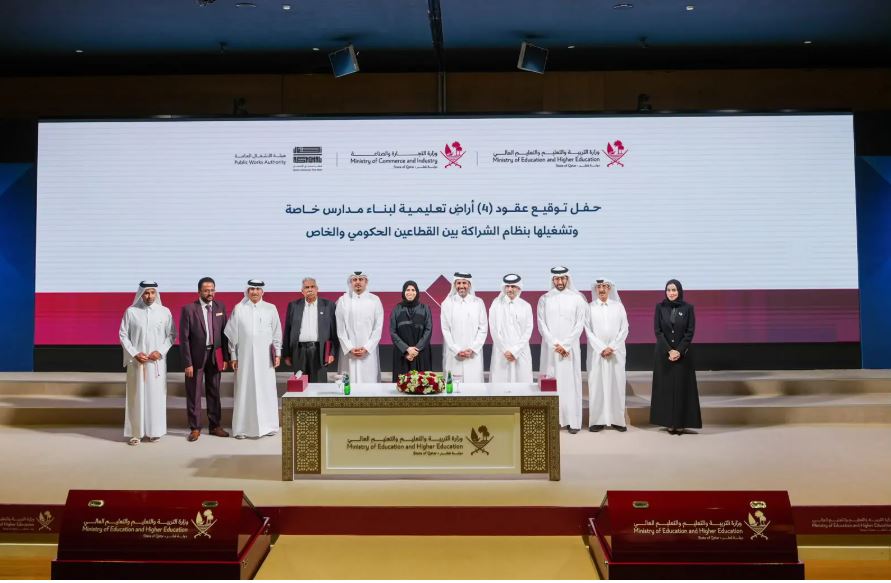
Doha, Qatar: The Ministry of Education and Higher Education (MoEHE) has signed contracts with four national companies to build and operate private schools on government-allocated land, providing 5,000 additional student seats as part of efforts to expand private education in Qatar.
The four schools will be located in Al Wukair, Al Mansoura and Al Sailiya, offering Indian and Egyptian curricula at affordable tuition fees. All schools will be coeducational and cover all educational stages.
The contracts were signed on Thursday in the presence of Minister of Education and Higher Education HE Lolwah bint Rashid Al Khater, Minister of Commerce and Industry HE Sheikh Faisal bin Thani bin Faisal Al Thani, and President of the Public Works Authority (Ashghal) HE Eng. Mohammed bin Abdulaziz Al Meer.
The schools include Indian Islamic School in Al Wukair, following the Indian curriculum; Cardiff International School in Al Wukair, following the Egyptian curriculum; Pearl Podar School in Al Mansoura, following the Indian curriculum; and Al Zaytoun International School in Al Sailiya, also following the Indian curriculum.
The contracts were signed by Assistant Undersecretary for Private Education Affairs at the Ministry of Education and Higher Education Omar Abdulaziz Al Naama, on behalf of the Minister, and representatives of the four schools.
The project is expected to attract approximately QR1.48 billion in private sector capital and operating expenditure over 25 years, according to Assistant Undersecretary for Industry and Business Development Affairs at the Ministry of Commerce and Industry Saleh Majed Al Khulaifi.
Al Khulaifi said the initiative would strengthen public-private partnerships and expand private sector participation in development projects, with investors responsible for financing, designing, constructing, operating and maintaining the schools.
Meanwhile, Al Naama said the new schools would provide additional educational opportunities for students and parents, noting that their locations were selected following a study of population density and geographical distribution across the country.
He highlighted the continued expansion of Qatar's private education sector, which currently includes 354 private schools and kindergartens, offering 25 educational curricula and serving more than 271,090 students.
Al Naama also outlined incentives offered to investors, including customs exemptions, exemptions from electricity and water fees, land and school building allocations, and educational vouchers for Qatari students.
For his part, Chairman of the Committee for Studying and Following Up Public-Private Partnership Projects at Ashghal Eng. Mohammed Masoud Al Marri said the contracts reflected cooperation between government entities and private companies to develop educational infrastructure and improve project implementation efficiency.
Dr. Rania Mohammed, National Project Leader for Public-Private Partnerships and Investment Attraction in the Private Education Sector, said further partnerships and initiatives would be announced soon to support the development and diversification of private education services.
The Ministry said the initiative supports Qatar National Vision 2030 by expanding educational capacity, diversifying school options and strengthening private sector investment in education.