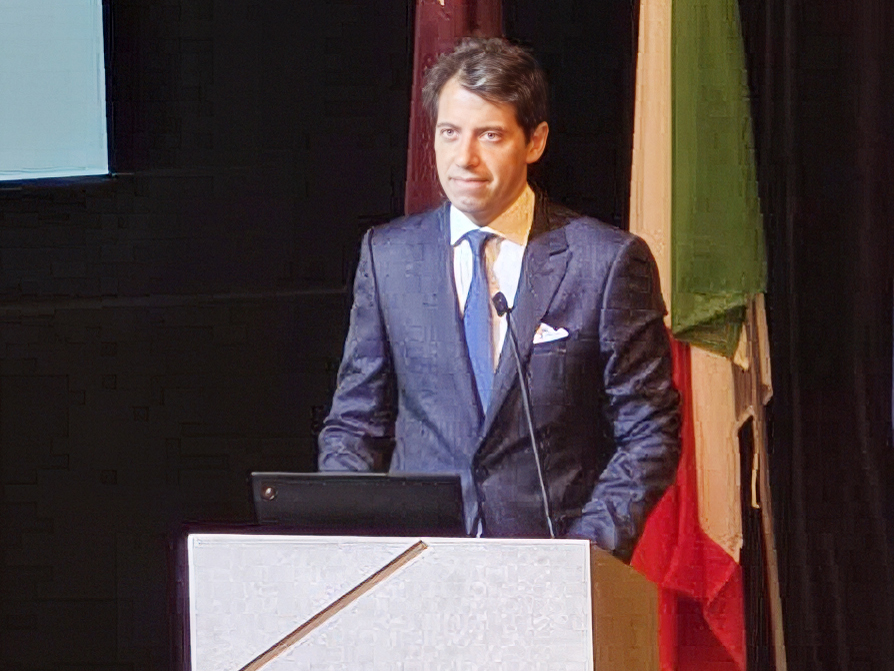
Italian Ambassador to Qatar H E Paolo Toschi delivering his address at the event.
Doha, Qatar: An immersive exhibition dedicated to the Great Mosque of Rome, Europe’s largest mosque, opened yesterday at the Museum of Islamic Art, highlighting architecture as a bridge between cultures, faiths and traditions.
The world-premiere production, conceived in Doha by architect David Borra of Noreal Interactive, was inaugurated at an event hosted by the Italian Embassy in Qatar in partnership with Qatar Museums, the Museum of Islamic Art, Sapienza University of Rome and the Islamic Cultural Centre of Italy. The exhibition will remain open to the public for two months until November 21.
Italian Ambassador to Qatar H E Paolo Toschi described the mosque, officially inaugurated on June 21, 1995, as far more than a place of worship.
“It offered a place of dialogue and of community building,” he said. Designed by renowned Italian architect Paolo Portoghesi, the complex embodies a vision of architecture that transcends rigid rules in favour of dialogue between the present and tradition.
Portoghesi freely quoted the great Baroque masters of Rome such as Bernini and Borromini as well as classic Roman architecture, the ambassador noted. Unbound by the fear of not being modern enough, the architect taught how to move beyond canons and boundaries.
“If we accept this definition of what is post-modern what is more post-modern than an Italian, Roman Catholic architect to design a mosque, and the largest mosque in Europe at that, in Rome,” Toschi said.
He linked the project to contemporary challenges, including the need to govern artificial intelligence while remaining guided by values. Drawing on the insights of Italian scholar Umberto Eco, the ambassador stressed that the freedom to connect across time, space and cultures requires a compass of shared principles.
“This lesson in freedom, in dialogue between different elements, and the search for beauty and functionality, always needs to be based on values,” he added.
Toschi expressed Italy’s continued support for Qatar’s commitment to dialogue and diplomacy at a time when the United Nations General Assembly is underway, with both countries’ authorities actively participating. He thanked Chairperson of Qatar Museums H E Sheikha Mayassa bint Hamad Al Thani for her leadership and vision, and Director of the Museum of Islamic Art Sheikha Al Nasser for hosting the project. Special appreciation was also extended to Fabrizio Sapia and the embassy’s cultural team, Sapienza University professors including Stefania Portoghesi, niece of the late architect, and the Islamic Cultural Centre of Italy.
Secretary General of the Islamic Cultural Centre of Italy Dr Abdellah Redouane traced the institution’s history from its founding as an association in 1966 by six Muslims seeking a shared place to pray.
Temporary premises in an apartment in northern Rome gradually gave way to legal recognition by the Italian Republic in 1974 and the allocation of approximately 30,000 square metres of land by the City Council of Rome in 1975.
An international architectural competition led to the final design by Paolo Portoghesi and Vittorio Gigliotti of Italy together with Sami Mousawi. The first stone was laid in 1984 in the presence of President Sandro Pertini. After years of construction, the mosque was inaugurated in 1995 with President Oscar Luigi Scalfaro in attendance. “Muslims in Rome and in Italy finally received a permanent and dignified home,” Redouane said. “The mosque became part of the city with respect and confidence.”
Its architecture reflects both Islamic tradition and the character of Rome, expressing the centre’s deeper mission of dialogue. Over the years, Italian presidents, ministers and mayors have visited the complex, including a notable meeting between President Giorgio Napolitano and the Muslim community in 2012. Today the centre welcomes worshippers from many countries, delivers Friday sermons in Arabic and Italian, maintains a major Islamic library, and pursues education, cultural activities and interfaith engagement as a public responsibility of faith.
Redouane underlined that the Great Mosque has become an important European reference point not solely for its size but for demonstrating how a Muslim community can become stable, visible and responsible while combining religious identity with active citizenship. “Europe needs places where communities can meet without fear and prejudice,” he said. “Qatar’s experience and noble example are for us both a model and source of inspiration.”
The exhibition employs technology to make the heritage of the Great Mosque of Rome accessible to new audiences, many of whom have yet to visit the landmark in person. Officials expressed the hope that visitors to the immersive display in Doha will one day experience the original structure.