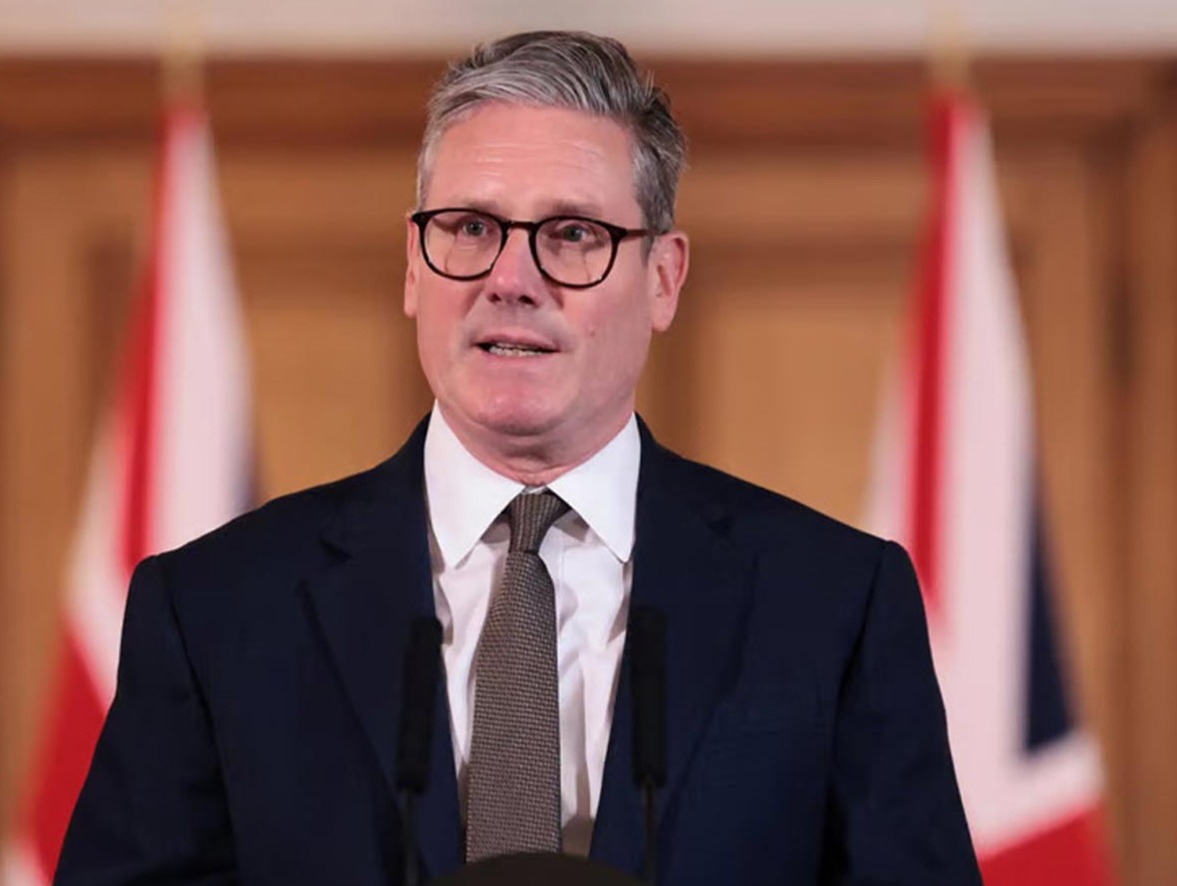
Doha, Qatar: As widely anticipated over the past several days, British Prime Minister Keir Starmer declared on Monday that he is resigning from his post and stepping down as leader of the governing Labor Party.
Speaking outside the Prime Minister's Office at 10 Downing Street, Starmer said that if there is a leadership contest, a new Labor leader would be chosen before Parliament returns from its summer recess in September.
He added that he would do everything possible to ensure a smooth and orderly transfer of power and that he would give his full support to his successor.
Starmer's resignation comes less than two years after he led Labor to a landslide victory in the 2024 general election, in which he had pledged to bring an end to what he described as chaos in British politics.
In his resignation speech, Starmer described entering Downing Street in 2024 as "the proudest moment" of his life, stressing that he entered politics to improve the lives of millions and bring about positive change in the country.
He also reviewed his leadership of the Labor Party since taking over in 2020 from Jeremy Corbyn, saying he inherited a party that was, in his words, "politically, financially, and morally bankrupt".
He added that he had repeatedly faced predictions of the party's collapse, but succeeded in reversing that trajectory, working to restore confidence in the economy, defense, and national security, as well as addressing antisemitism within the party.
Starmer led a shift in Labor's orientation toward the political center after years of more left-leaning policies under Corbyn, in an effort to strengthen the party's electoral prospects and regain voter trust.
Pressure on Starmer to step down has been mounting recently, but it was intensified by Andy Burnham's landslide victory in the Makerfield constituency in northwestern England, where he nearly doubled Labor's majority.
Andy Burnham later confirmed that he would run for the leadership of the Labor Party and thus for the office of British Prime Minister following Starmer's resignation.
Former UK Health Secretary Wes Streeting, who had previously expressed his intention to succeed Starmer, also endorsed Burnham- suggesting that Burnham could secure both the party leadership and the premiership without significant opposition.
Starmer was first elected to the UK Parliament in his fifties after a career as a lawyer. He entered the House of Commons in 2015, when Labor was in opposition.
He later served in the Shadow Cabinet as Shadow Home Secretary, overseeing scrutiny of government policy, particularly on immigration. Following the UK's vote to leave the European Union (Brexit), he became Shadow Brexit Secretary, using the role to push for a second referendum on Brexit.
Starmer secured his opportunity to become leader of the Labor Party after the 2019 general election. The results of that election were regarded as a catastrophe for the party, which suffered its worst defeat since 1935, leading to the rejection of Jeremy Corbyn and forcing him to resign.
As such, his resignation marks the sixth resignation of a British Prime Minister since David Cameron announced his departure on the morning after the Brexit referendum over a decade ago, which falls on June 23.
This represents an unprecedented rate of leadership turnover and reflects continued instability in British politics.
During his tenure, Starmer strove to gradually reset relations with the European bloc through a mix of incentives and political pressure, before attempting to accelerate engagement as his political capital weakened.
His resignation also comes just one month before the EU-UK summit he had been working hard to convene.
The British political theater has, in recent days, witnessed a marked escalation in pressure on Starmer. These developments conspicuously highlight growing internal divisions within the political landscape, with competing forces becoming more entrenched and increasingly difficult for the leadership to manage.
Pressure heightened following Andy Burnham, Greater Manchester Mayor and nicknamed the "King of the North,” winning a parliamentary by-election, which allowed him to formally enter the Labor leadership race.
Burnham stated in his victory speech that the party now has a "chance for change", signaling his readiness to enter the leadership contest.
With Starmer's resignation, Britain stands before the election of its seventh Prime Minister in roughly a decade. Press reports in London suggest that Starmer's rival and Labor colleague, Andy Burnham, is the frontrunner to succeed him as Prime Minister.
Burnham is scheduled to be sworn in today as the new Member of Parliament for Macclesfield following his by-election victory last week.
British parliamentary sources say that Burnham has already proven himself a highly capable politician over 25 years, having governed a major city- Manchester- as mayor for nine years, meaning he has already been tested in office.
Analysts view Starmer's resignation as placing Britain before decisive weeks, describing it as a pivotal moment in British politics. It offers Labor the opportunity to overcome internal divisions and unite around a more popular figure such as Andy Burnham, who enjoys a strong base in traditional party strongholds.
They added that Labor retains a comfortable parliamentary majority, meaning the transfer of power to a new leader won't lead to immediate general elections, giving the government a degree of stability until 2029, while also exposing it to increasing pressure from the opposition.
As for relations with the European Union, Britain is expected to continue broadly along the same approach set by Starmer, who sought to gradually reset relations with Brussels.