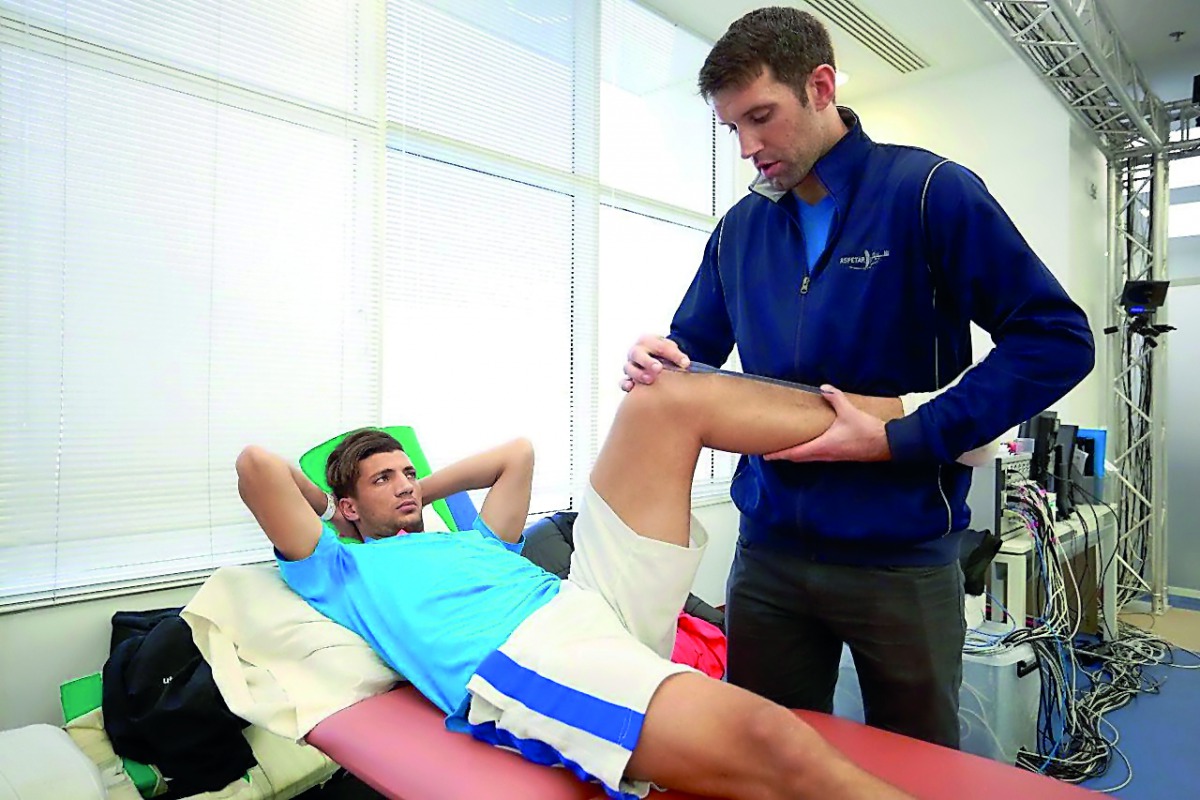
A member of the Tunisian team undergoes a series of medical and performance assessments at Aspetar, the leading specialised orthopaedic and sports medicine hospital in Qatar, in preparation for the 2018 FIFA World Cup in Russia.
Doha: The Tunisian national football team has recently concluded a series of medical and performance assessments at Aspetar, the leading specialised orthopaedic and sports medicine hospital in Qatar, to prepare for the 2018 FIFA World Cup Russia.
Over the course of three days, the so called “Eagles of Carthage” underwent comprehensive medical screening tests and benefited from Aspetar’s extensive experience in injury prevention and enabling athletes to fulfil their potential.
Commenting on the team’s three-day tests at Aspetar, Tunisia’s national team physician Souheil Chemli, said: “The science of sports medicine and performance development are two sides of the same coin, and we are well aware of the world-class facilities and human resources available at Aspetar. Our players have benefited from Aspetar’s scientific expertise in injury prevention and extensive medical follow-ups, which is one of the main reasons behind our decision to choose this hospital as we prepare for Russia 2018.”
Chemli also pointed out that one of Aspetar’s unique selling points is its considerable contribution to international research into the impact of fasting on sports performance, which is particularly relevant for the Tunisian team given the holy month of Ramadan begins just prior to the start of the FIFA World Cup in Russia.
Commenting on preparations leading up the tournament, particularly during Ramadan, Dr. Chemli said: “Many Muslims find it difficult to exercise during Ramadan, but it’s important to note that this is also a month of patience and sacrifice. Exercising during Ramadan is a case of ‘mind over matter’ – and our players are used to training and playing when they are fasting.”
Meanwhile, Tunisian striker Taha Yassine Khenissi said: “We cannot leave anything to chance. We have to consider all aspects of our game – both technical and physical – in order to be fully prepared for the big day and to play in the World Cup.”
“This is my first time in Aspetar, but it is world-class in every sense of the word. I am impressed by the international standards of the facilities and I am proud to have such an organisation in an Arab country. I hope someday to see one similar in my home country.”
The Tunisian striker also praised the hospitality of the people of Qatar and said that this type of support will motivate the team to excel in the World Cup and to instill pride amongst the Tunisian people and all Arab nations.
The Tunisian team will now head to another training camp in Switzerland in March, followed by one other camp before the World Cup begins. The team will compete in the group stages against Belgium, ranked number five in the world, and England ranked 15th, along with Panama.”
Khenissi described their group as “difficult” and said the players are “aware of the level of responsibility they have, but we will aim to get past the group stages.” During the team’s physical tests at Aspetar, the Tunisian team defender Khalil Chemmam described the team’s training camp as “outstanding” and said: “We benefited a lot from Aspetar’s expertise in helping us to identify our physical readiness.”