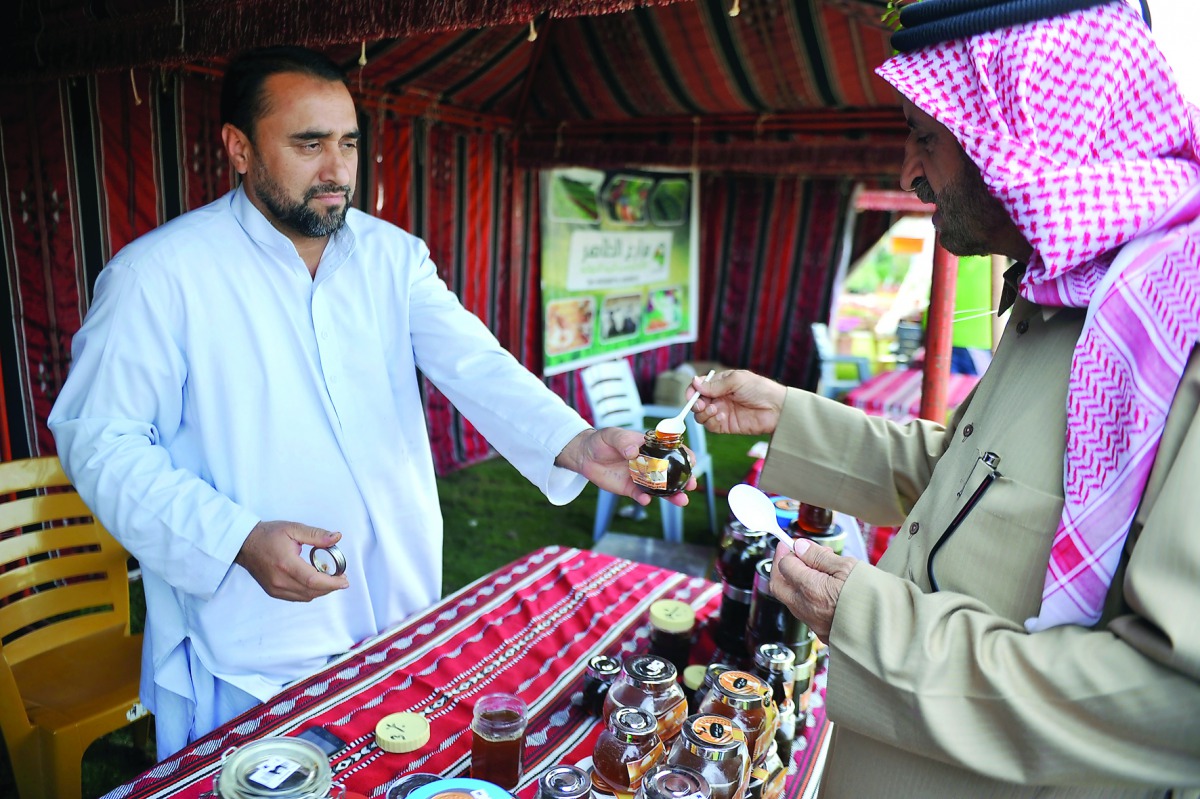
A local honey seller at Wakrah Vegetable yard. Pic: Abdul Basit/ The Peninsula
With increasing popularity, demand for locally produced honey has also gone up. The annual ‘Honey Festival’ at winter vegetable markets that concluded at Al Wakrah yesterday, bought remarkable profits for the farmers with huge response from the public. Honey lovers had flocked to the festival venues over the last two weeks to buy the best local honey, mostly the Sidr.
The festival was organised by Ministry of Municipality and Environment. The festival aimed to encourage the production of honey by giving honey farmers technical and financial support. It is part of the national honey bee project which was initiated in 2012 to make honey farming popular and provide support.
The first leg of the festival kicked off on 5 January in Mazrouah Yard, moving on to Al Khor – Dhakira yard the following weekend and third leg that concluded yesterday opened at Al Wakrah yard on 19 January. The annual event attracted both beekeepers and honey-lovers to purchase a variety of locally produced honey.
Local honey is becoming popular , with increased number of takers , as it is trusted by people for its quality and purity.
“We saw a huge demand for honey products at the last two venues and, our sales are also going remarkable. More people are coming here to taste and know about the production. They then go on to buy the products,” said one of the vendors, Engineer Mohammed Abu Zeid of Al Taher Farm. Local farmers were able to sell not less than 1 tonne of honey and wax in the first two legs of the festival. According to earlier reports, at least one farm was able to sell its entire products on first day of the festival itself. This year’s festival saw the participation of more farmers, visitors and participants than last year. Some 16 local farms and four companies took part in the event at various markets this year.
“Most of the farms here have two types of honey, the Sidra and poly-floral honey .The Sidra honey production begins in September, with the bees collecting nectar from the Sidra flowers. It has a slightly darker colour and is in high demand because of the quality,” said Abu Zeid.
The taste of Sidra honey is considered to be a true luxury and it is often described as rich and unforgettable. Its distinctive taste and fragrance is attributed to the nectar of the flowers of the Sidra tree.
“Some 400kg of honey is produced at the farm every six months. Sidra honey is sold at QR200 for 750g here,” said Abu Zeid. Honey is classified according to the flower from which the bees extract nectar. The colour and flavour of the honey are determined by the type of plants visited by the bees. It can be either mono-floral, coming from a single type of flower or poly-floral.
Ministry scheme to popularise bee farming
In Qatar, the poly-floral honey is produced in November, when the flowers begin to bloom. “Usually the flowers, including the vegetable flowers in the farm and also the wild ones that bloom during this season provide the nectar needed for the poly-floral honey,” one of the vendors at the Honey Festival. The flavour, purity, quality and medicinal value, has increased the demand for the locally produced honey.
“People also have a trust in the purity of locally produced honey, which are do not go any treatment unlike the ones available in shops,” said the vendor.
The festival was part of national honey bee project, that aims to promote indigenous honey production by providing financial and technical support to farmers.
Since the launch of the national project in 2012, the Ministry has set up a programme to support and popularise bee farming. From 30 farms in 2012, the number of farms increased to 50 in 2014 and there are some 130 farms in honey production currently, according to experts.