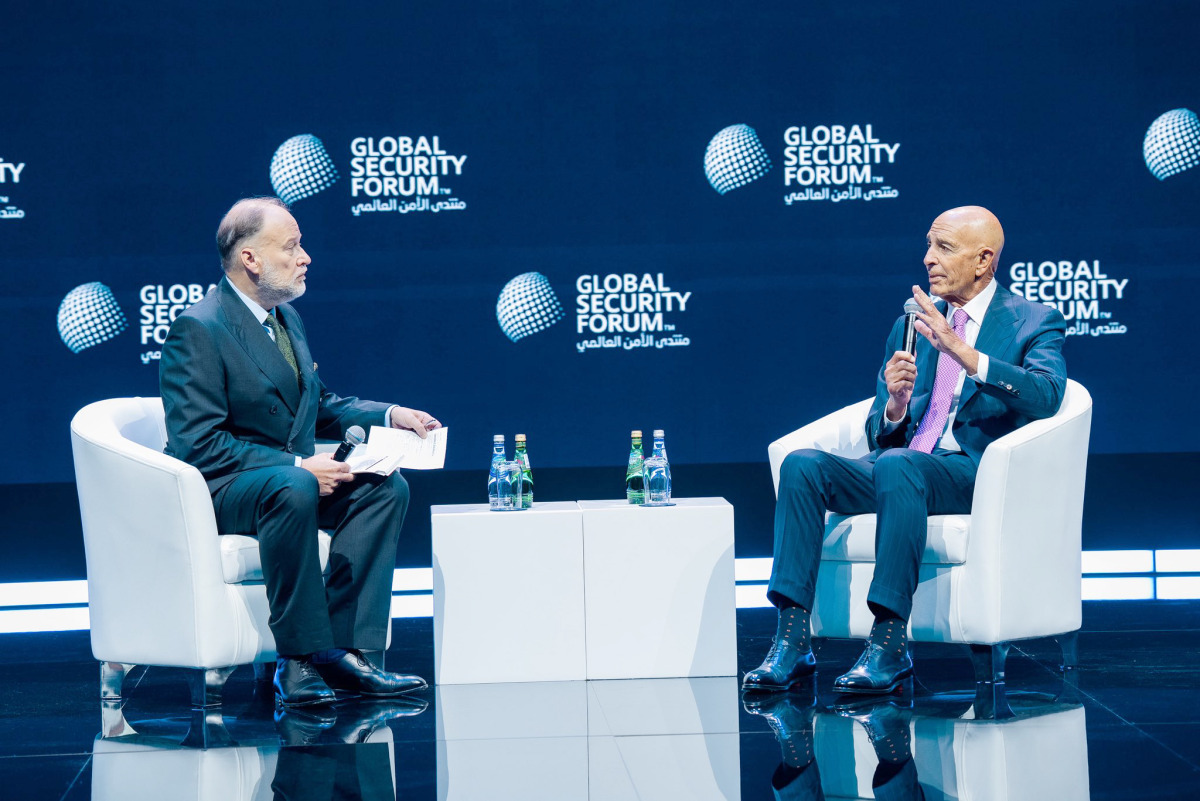
US Ambassador to Türkiye and Special Envoy for Syria and Iraq Thomas J Barrack (right) speaking during a panel discussion.
Doha, Qatar: Qatar’s role in mediating between Washington and Tehran could prove critical to ending the Iran conflict, US Ambassador to Türkiye and Special Envoy for Syria and Iraq Thomas J. Barrack said, arguing that a ceasefire and a negotiated settlement offer a way out of a crisis with consequences extending across the Middle East and beyond.
Speaking at the Global Security Forum during a discussion yesterday titled “A Region Reshuffled: The Middle East’s Evolving Strategic Landscape,” Barrack credited Qatar and other regional intermediaries with efforts to bridge a fundamental lack of trust between the United States and Iran, while warning that continued military action would not resolve the region’s underlying political problems.
“Qatar has been trying to intervene. Oman has been trying to intervene. The Swiss have been trying to intervene. Pakistan has been trying to intervene,” he said. Barrack also credited Doha with helping advance a diplomatic proposal involving Pakistan, saying the memorandum had been negotiated through Qatar’s prime minister and his team.
“Qatar has been instrumental in helping us get there in the Islamabad to Pakistan memo, was really negotiated through Sheikh Mohammed and his team, but it’s who goes first. There’s no trust,” he said.
His remarks came as the conflict with Iran raised wider concerns over Gulf security, economic disruption and the Strait of Hormuz, a critical route for global energy supplies.
The waterway’s disruption has become a central concern in efforts to restore regional stability. Barrack said the immediate priorities should be a ceasefire, reopening the strait and reducing the suffering of ordinary Iranians, arguing that neither side could expect a straightforward military victory to deliver a lasting solution.
“The answer is a modified version of saying everybody keeps relevance. There’s no win or loss. We’re not going to win or loss. We’re going to an event in which everybody over time survives,” he said.
“That starts with a ceasefire. The components of that are a ceasefire, open the straits, ease the pain on the Iranian people.”
He also questioned the long-standing assumption that Washington could guarantee regional security through military intervention, arguing that the United States was moving towards a different relationship with its Middle Eastern partners.
“The bargain is not to own, not to control, but to tend, not to leave,” Barrack said.
He added that regional governments would increasingly have to develop their own security arrangements rather than expect Washington to solve every problem, although he maintained that the United States would continue supporting its partners.
Barrack warned that attempts to change governments through military intervention had repeatedly produced unintended consequences, citing the US experience in Iraq, Afghanistan, Libya and Syria.
The discussion also addressed the risk of a wider confrontation involving Israel, Türkiye and Syria. Barrack said heightened tensions and inadequate communication could turn an isolated military incident into a much larger crisis, saying neither Washington nor Ankara had been informed of the incoming Israeli aircraft.
Despite the competing interests involved, Barrack argued that sustained dialogue remained the only viable path towards a more stable regional order. “Let’s relieve. Let’s get to a ceasefire. Let’s open up economic corridors, and let’s keep talking,” he said.