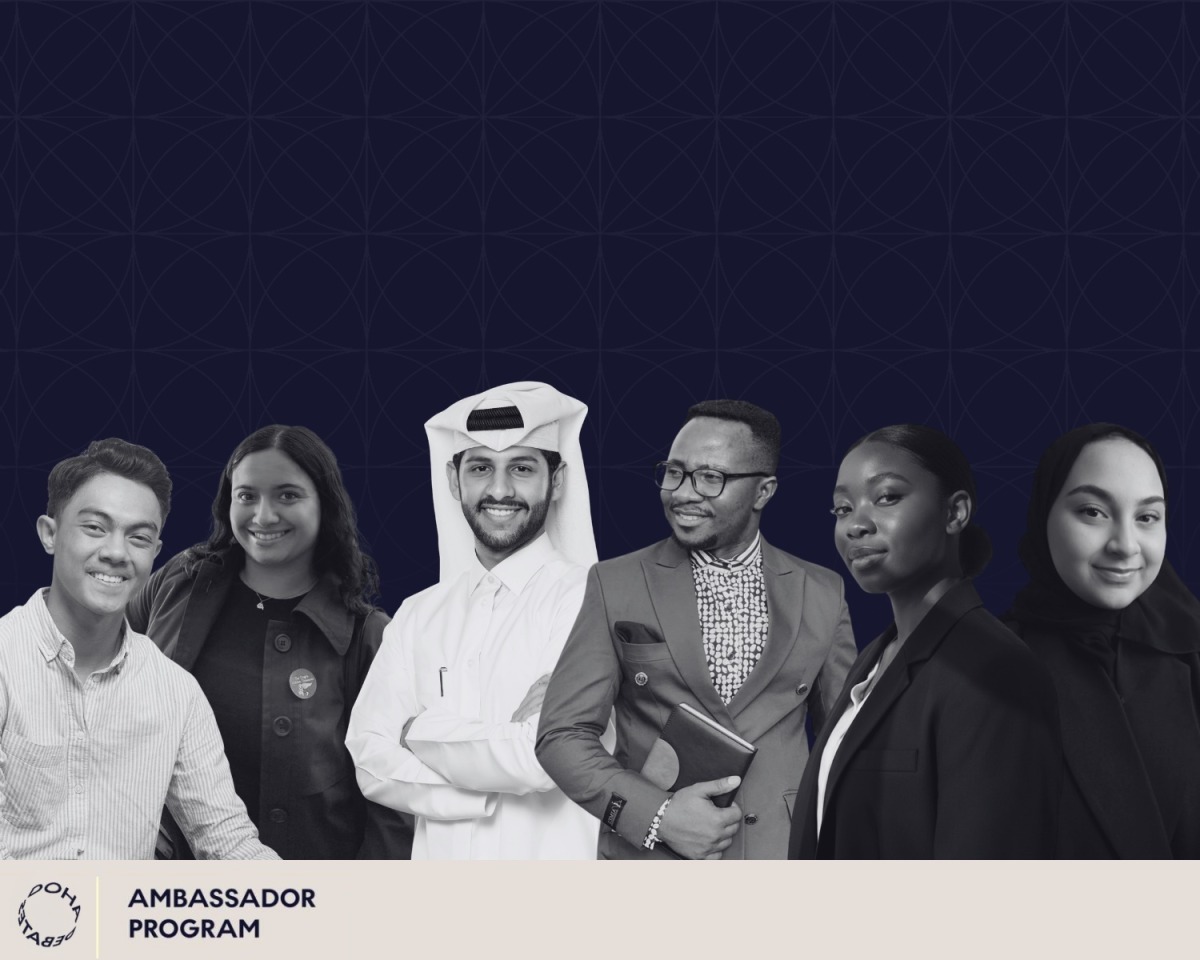
Doha, Qatar: In a world shaped by change and competing narratives, the ability to listen, question and engage in constructive dialogue has never been more critical. Through the Doha Debates Ambassador Programme, a production of Qatar Foundation, young people from around the world are not only learning these skills, but actively applying them in their communities, careers and areas of study.
This online educational programme teaches young people from across the globe to debate differently. Rather than engaging in a Western-style battle of ideas, participants take an approach to dialogue that is grounded in the Majlis—a welcoming social space to discuss community issues. Each year, more than 400 youth from over 80 countries come together to learn to listen to one another, understand points of view, and collaborate on solutions to complex problems.
Algoori Maki, 19, an engineering student at Qatar University, joined the programme with a clear intention: to be part of a space where ideas translate into impact. But she also came away understanding how to channel convictions into thoughtful exploration.
“I used to see debating as a way to prove your point and win an argument,” Maki says. “But my perspective has changed. Today, I see debate as a way to explore ideas, challenge assumptions and understand different viewpoints. It’s about listening with intention.”
For Mohammed Al-Qassabi, a 26-year-old Doha-based cybersecurity engineer with a Masters of Science in AI and cognitive cybersecurity, meaningful dialogue has always been tied to the way people collaborate, lead and create impact.
That belief led him to the ambassador programme, where his understanding of debate began to shift. “I saw debate as presenting arguments and trying to convince others,” he reflects. “Over time, I realised that discussions are less about winning and more about understanding.”
Across continents, participants have experienced similar transformations. For Maria Emilia Zapata, a 24-year-old lawyer from Quito, Ecuador, the programme provided a framework for values she had long held but had not articulated.
“The idea of using dialogue to foster understanding and find common ground really resonated with me,” she says. “Being part of the programme made me feel understood, and like I had found a community.”
With a background in law and human rights, Zapata had been trained in competitive environments. “I’ve come to see debate as a way to listen, embrace different perspectives and build mutual understanding,” she explains.
This kind of transformation is one of the programme’s primary goals. While Doha Debates programming reaches millions globally, its impact is measured not only in audience numbers, but in participants’ ability to articulate ideas, listen across differences and engage in constructive dialogue. These skills—the building blocks of healthier public discourse—extend far beyond the programme.
For Elijah Man’Ishimwe, a 31-year-old refugee leader and international relations student based in Nairobi, Kenya, such skills are essential.
Having grown up in Nakivale Refugee Settlement in Uganda, Man’Ishimwe witnessed firsthand how misunderstandings can escalate into conflict, and how important it is to amplify underrepresented perspectives. “I saw this programme as an opportunity to bring those voices into global conversations,” he says, “while strengthening my own ability to lead dialogue with empathy and structure.”
The Doha Debates Ambassador Programme reflects a broader commitment within Qatar Foundation to education that extends beyond traditional learning. Through initiatives like these, young people today are not only engaging with the world, but actively shaping what it could become.
The programme is open by application till August 24 to fluent English speakers between the ages of 18–24.
Interested candidates can learn more and apply at DohaDebates.com/Ambassador.