Picture: QNA/ X
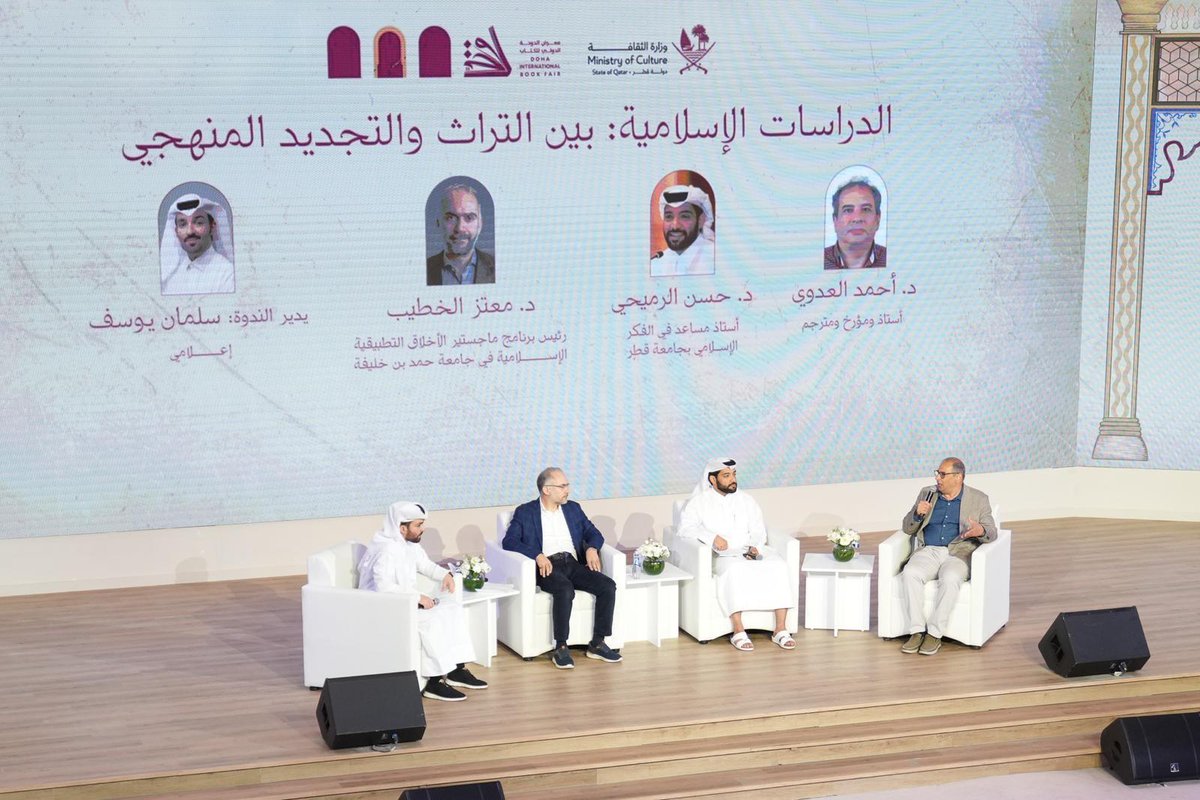
Doha, Qatar: A symposium held as part of the cultural events accompanying the 35th Doha International Book Fair (DIBF) explored the challenges of reading Islamic heritage in contemporary contexts, the methodological challenges facing researchers, and the relationship between Western studies and the Islamic intellectual legacy.
Participants in the symposium, held under the title Islamic Studies: Between Heritage and Methodological Renewal, emphasized the need of building new Arab and Islamic intellectual projects that stem from a deep understanding of heritage, coupled with a critical openness to modern methodologies.
This, they argued, would contribute to producing knowledge more relevant to the issues of humanity and contemporary society.
For his part, Dr. Ahmed Al Adawi, historian and translator, addressed the methodological challenges facing researchers in dealing with ancient sources.
He explained that a significant portion of the problems arises from the nature of dealing with heritage texts, where sometimes researchers are content with the surface meaning of the text without delving into its layers and intellectual contexts.
He pointed out that a number of classical texts have been published in inaccurate commercial editions, leading to scholarly errors.
He emphasized that many of these sources require meticulous scholarly re-examination that combines and compares different versions.
Al Adawi explained that some classical works underwent additions and modifications by their authors at later stages, and some editors fail to notice these differences, leading to confusion between different versions.
He considered such problems a real challenge for modern studies of classical texts.
For his part, Assistant Professor at the College of Sharia and Islamic Studies at Qatar University Dr. Hassan Al Rumaihi spoke about the development of Islamic studies, noting the existence of Muslim researchers today who seek to read Islamic heritage beyond the traditional Orientalist perspective.
He said that some modern studies attempt to fill the knowledge gap related to entire centuries of Islamic intellectual history, indicating that these new studies treat the heritage as a living intellectual continuum.
He stressed the importance of restoring confidence in Islamic heritage, particularly the civilizational heritage of the Muslim world.
Head of the Master's Program in Islamic Applied Ethics at Hamad Bin Khalifa University Dr. Moataz Al Khatib believes that part of the crisis in contemporary Islamic studies stems from the very nature of the questions being posed.
He explained that many Arab researchers are forced to grapple with questions that originated within the Western academic context, aiming to correct established perceptions there.
He added that critique is not a foreign element to Islamic heritage; rather, it represents an integral part of the structure of Islamic sciences.
He cited the sciences of dialectic, refutation, and debate that flourished throughout Islamic history, where scholars responded to one another and developed their knowledge through continuous discussion and critique.