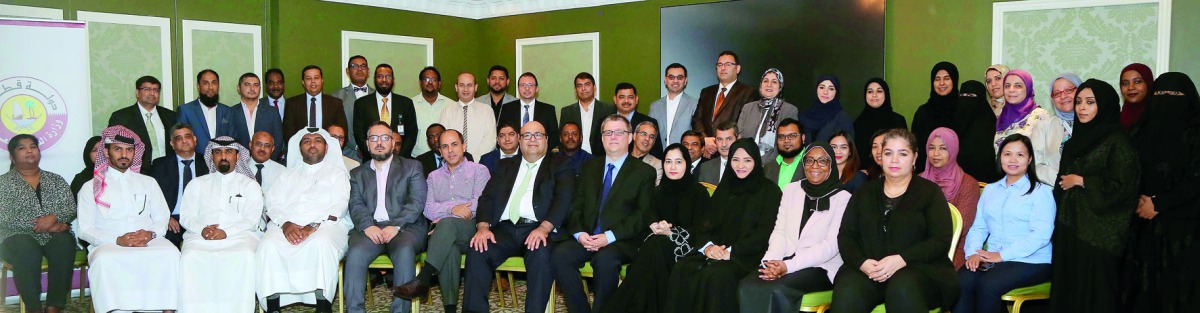
Participants at the workshop on the development of the national action plan to combat antimicrobial resistance (AMR) in the country.
Qatar is set to implement a national action plan and a task force to combat antimicrobial resistant micro organisms, which poses serious threat to global public health. The Ministry of Public Health recently conducted a workshop on the development of the national action plan to combat antimicrobial resistance (AMR) in the country.
“The importance of drafting the national action plan for AMR is one of the most important pillars for the successful implementation of the National AMR programme. The plan is aligned with the objectives of the global action plan developed by the WHO as well as the Gulf Corporation Council (GCC) strategy” said Huda Al Katheeri, Acting Director of Healthcare Quality and Patient Safety department at the Ministry of Public Health, during the workshop conducted in collaboration with the with Eastern Mediterranean Regional Office of the World Health Organisation.
AMR is the ability of organisms like bacteria and viruses to stop medicines from working against it. As a result, standard treatments become ineffective, infections persist and may spread to others. Misuse and overuse of anti-microbial drugs in human medicine, cattle rearing and food production have put every nation at risk. Hence, without an action plan, common infections could once again kill.
The implementation of the national action plan will start with continuous monitoring and evaluation against its objectives that were adapted from the WHO plan which necessitates implementation of integrated multi-sectoral interventions across all the relevant stakeholders.
The plan aims at establishing a national taskforce adopting “One Health Approach” defining the roles and responsibilities of key players to contain AMR problem. The action plan is expected to prioritise the interventions based on the importance and the urgency of the country requirements. The programme will ensure, for as long as possible, continuity of successful treatment and prevention of infectious diseases with effective and safe medicine that are quality-assured, used in a responsible way, and accessible to all who need them.
The move come at a time when WHO has recently warned of a dozen antibiotic-resistant “superbugs” pose an enormous threat to human health. The rate at which new strains of drug-resistant bacteria have emerged in recent years, prompted by overuse of antibiotics in humans and livestock, terrifies public health experts. Many consider the new strains just as dangerous as emerging viruses like Zika or Ebola, and healthcare is running out of treatment options.
Hence the workshop included some 60 officials from Ministry of Municipality and Environment, Qatar University and Hamad bin Khalifa University apart from healthcare organisations and facilities in the country as HMC, PHCC, MOI medical section, Qatar Army Force medical section, Qatar Petroleum, Sidra, Aspetar and private hospitals.