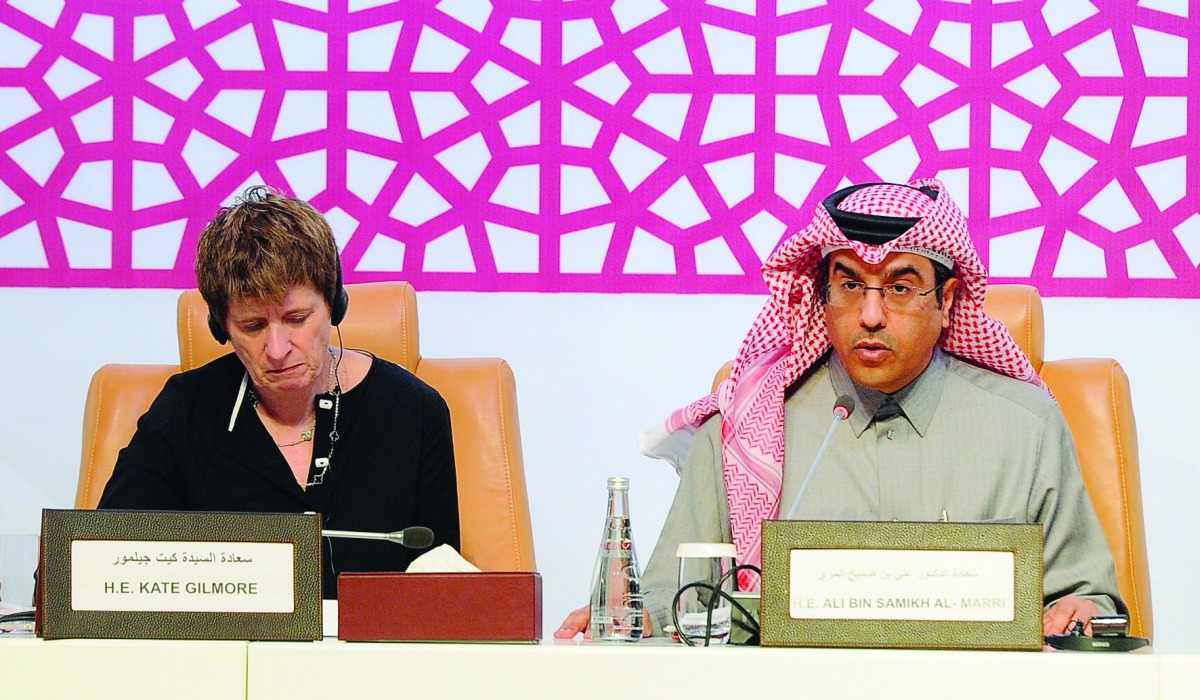
The United Nations Deputy High Commissioner for Human Rights, Kate Gilmore, and NHRC President Dr Ali bin Samaikh Al Marri at the conference.
The United Nations Deputy High Commissioner for Human Rights, Kate Gilmore, has called for an end to hostilities in Yemen.
Gilmore was the guest of the first session of the International Conference on Human Rights Approach to Conflict Situations in the Arab Region, along with Sarah Leah Witson, Executive Director of Middle East and North Africa, Human Rights Watch, and Abdel Elbaset Hasan, Arab Institute for Human Rights,
“We call on all parties to the conflict to do everything in their power to cease hostilities right now and come back to the table for an assertive and political negotiation and be committed to a defined and durable solution” Gilmore said on the sidelines of the conference about the humanitarian crisis in Yemen.
People in Yemen are facing an extraordinary food shortage and are in the midst of deprivation and there is no access to health and education in daily life," Gilmore told The Peninsula, adding that “for us, from the human rights standpoint, the human cost of conflict is far too high for anyone to bear and particularly for the people of Yemen at this time and all parties to the conflict have to do everything in their power to cease hostilities right now."
The UNHRC official expressed her enormous gratitude to the government of Qatar, and her gratitude to the QNHRC, which is a partner in the dialogue, and to the people of Qatar for their generous hospitality. She highlighted the Qatari efforts for opening dialogue on the grave challenges facing the region. "The worst of these challenges and the most complex and the most strategic is, of course, the Syria conflict," she said. She stressed the role of civil societies as many people are organizing themselves and are in dialogue with governments to set in process the pathway for peace.
“The conflict in Syria will need all of our support for a solution particularly when political solutions start. But the same is true of Yemen, Libya and Iraq, each is in a different place in regard to conflicts. But in every instance, without civil society, accountable government, independent judiciary and free press there will be no peace,” she told The Peninsula.
About the establishment of safe zone in Syria, Gilmore noted that “for the safe zones to work, we have to engage with all parties of the conflict and all parties have to understand they will be held accountable for their violation of international humanitarian laws and international human rights law”.
"We have to support people without access to humanitarian relief as indeed we struggled to provide humanitarian relief over these past horrible six or more years. We have to keep trying."
Asked about the major challenges, she said “we need unified and clear and unequivocal and unwavering stand by the governments in this region to uphold the international human rights standards."
"We would know nothing about people suffering without the support of the courageous people on the ground," she said when asked about the coordination between national organizations in countries suffering from armed conflicts. Moreover, she said “what an organization like the High Commission does is validate and corroborate and assess that evidence against the UN human right standards and report back to the international community of which those member states are part and say this is the case and is unacceptable”.
The first session addressed the subject of respect for human rights as a preventive approach, the role of education in promoting and protecting human rights and reducing the culture of hatred and seclusion.
During the session, Gilmore touched upon the Arab Spring and said it was born out of a yearning for dignity, freedom, justice, equality and democracy at a time when the rule of law and free media were absent.
She stressed on the importance of holding accountable all militant groups and organizations that violated human rights. Gilmore said the primary goal of institutions like the International Criminal Court (ICC) is not only to hold people accountable for crimes, but also to act as a deterrent to whoever dares to violate human rights or commit wars against humanity.
Some speakers believed that most conflicts in the Arab region resulted from violations of human rights and the cover-up of these abuses, and the international community's failure to hold accountable violators of human rights.
The second session discussed the human rights-based approach to conflict situations, while the third session focused on the situation of human rights amidst conflicts.
Talking to the media on the sidelines, Attorney General Dr Ali bin Fetais Al Marri said that the conference comes at the right time given the current situation in the Arab world which requires a strong backing in human rights issues.
He added that Qatar has become accustomed to hosting such distinguished international conferences, commending the QNHRC on its effort in organizing and hosting the event.
The GCC countries ratified a number of agreements pertaining to the international human rights treaties and their additional protocols, said Hamad bin Rashid Al Marri, Assistant Secretary-General for Legislative and Legal Affairs at the GCC General Secretariat. The GCC countries' efforts also include establishing national human rights committees for each member state and the international law can play a big part in enhancing human rights and protecting civilians during times of conflict.
Al Marri called on establishing a code for such conflicts that guarantees the safety of innocent civilians, particularly women and children.
Addressing the conference, the Vice President of the Arab Network for Human Rights Institutions, Youssef bin Abdullah Al Afifi, expressed regret at the increase of civil conflicts in the Arab countries which led to the killing of a large number of people, mainly women and children.
He noted that such a tragic situation requires more efforts to alleviate the suffering of people in those areas. Al Afifi called on the international community and humanitarian organizations to assume its responsibility in protecting the lives of innocent people.
The second day of the conerence today will witness another four sessions discussing a number of issues including the protection of women, children and minorities in conflict situations, the impact of armed conflict on the right to education, the human rights-based approach in transitional justice and humanitarian aid in the conflict zones in the Arab region.