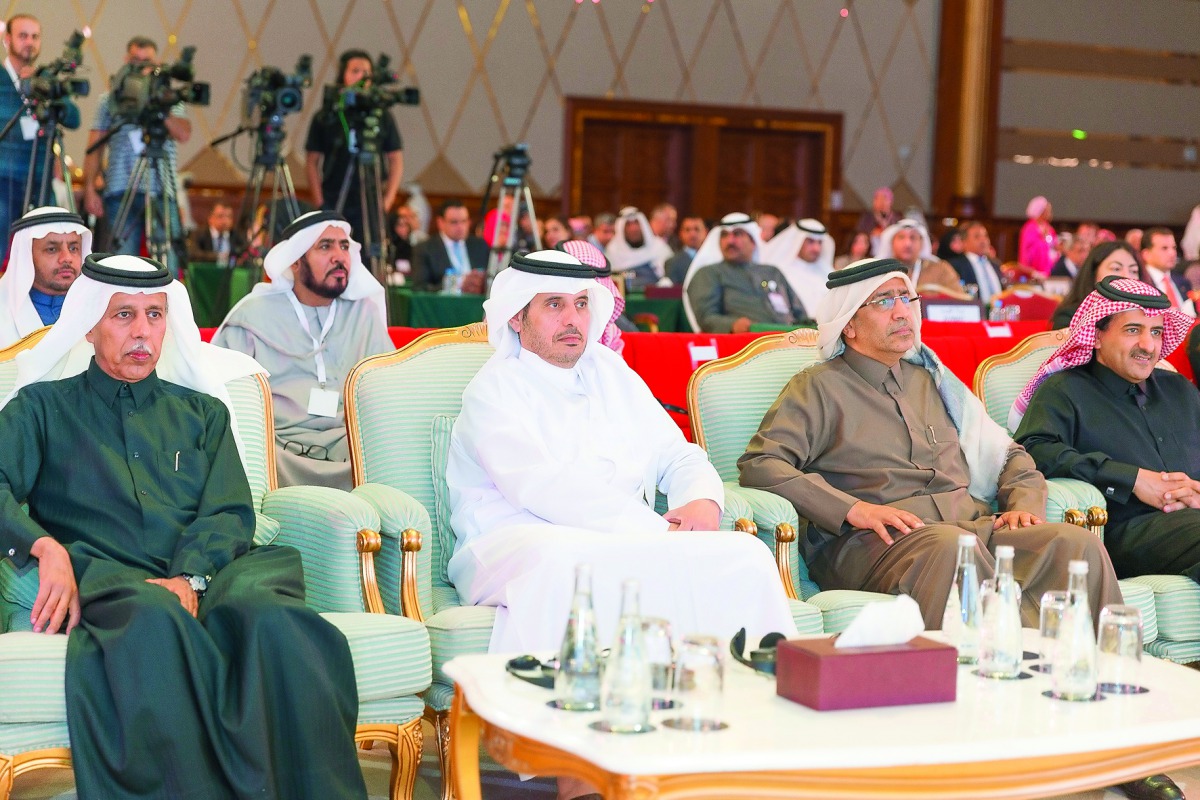
Prime Minister and Interior Minister H E Sheikh Abdullah bin Nasser bin Khalifa Al Thani at the two-day International Conference on Human Rights Approach to Conflict Situations in the Arab Region, at the Sheraton Doha, yesterday.
The International Conference on Human Rights Approach to Conflict Situations in the Arab Region began at the Sheraton Doha yesterday with a call on governments and non-governmental organisations to work together to find a solution to the challenges facing the region by respecting human rights and ensuring social justice.
The Prime Minister and Interior Minister H E Sheikh Abdullah bin Nasser bin Khalifa Al Thani opened the two-day conference attended by UN officials and representatives of governments and non-governmental organisations in the region.
The event is organised by the National Human Rights Committee (NHRC) and the UN High Commissioner for Human Rights (OHCHR), in cooperation with the General Secretariat of the Council of Arab Interior Ministers and the Arab Network for National Human Rights Institutions.
All governmental and non-governmental agencies must work together to find a way out of the dangerous challenges facing the region since 2011, said NHRC President Dr Ali bin Sumaikh Al Marri, in his opening speech.
Al Marri said such challenges manifest in the emergence of armed groups, spread of hateful, sectarian ideas and limiting space of freedoms.
He also drew attention to civil wars and crimes against humanity, particularly in Syria, Yemen and Iraq describing the refugee crisis as yet another challenge facing the region.
"The armed conflicts taking place in the Arab World are all a result of the failure to grant social, political and economic rights to the people and marginalization of many sections of the now-embattled societies," said Al Marri.
"Weapons alone will not be enough to end terrorism and the real way to do so is respecting human rights, involving in dialogue and establishing the groundwork for transitional justice," NHRC President Dr Ali bin Sumaikh Al Marri added, noting terrorism has no place in countries that respect freedom of rights, social justice. He stressed that there is no security without respect for human rights.
The conference is attended by around 320 participants including leaders, representatives of governments and regional and international inter-governmental and non-governmental organizations concerned with protection of human rights, conflict resolution and peacekeeping, as well as heads of regional and international investigative committees.
Al Marri said Islamophobia will not lead to progress in the fight against terrorism and the way forward is to build bridges between countries and cultures.
Al Marri noted that today's conference is held weeks after bloody and tragic battles of Aleppo and other Syrian cities, which led to the highest number of refugees since World War II.
Highlighting the Qatari role in supporting the Syrian people standing against war crimes committed by the Syrian regime, Al Marri praised the decision of the Emir H H Sheikh Tamim bin Hamad Al Thani cancelling celebration of the National Day in solidarity with the people of Aleppo.
He also renewed the call to implement a UN resolution which would examine crimes against humanity and war crimes committed in Syria, in order to punish the perpetrators who threatened international peace and stability.
Finally, he called on the international community to take a bold stand against Israel's illegal settlement policy and the judaization of Al Quds.
Secretary-General of the Arab Interior Ministers Council, Mohammed bin Ali Koman stressed the importance of respecting human rights and the rule of law during conflict and fighting terrorism.
He said that he understood the responsibility of Arab countries in protecting its citizens from terrorist threats but countering terrorism must be under respect of law and human rights he added.
He said that the conference comes at a crucial time as the Arab world is entrenched in conflicts and tensions, which led to a rise in human rights violations.
He added the council hosts an annual conference on human rights for Arab countries to ensure their commitment to the matter when pursuing their respective security agenda. The council also works on unifying the human rights standards among the member countries, Koman added.
Koman praised the Qatari efforts in this regards saying; Qatar has been keen to enhance all efforts aiming to promote human rights and resolve conflicts.
Taieb Baccouche, Secretary-General of the Arab Maghreb Union called for adopting preventative methods to avoid conflict, primarily dialogue, rather than violence which ultimately leads to terrorism and human rights violations.
Baccouche said avoiding armed conflict should always be a priority and countries need to adopt protective methods when in conflict and dialogue as means of preventing deterioration into armed conflict.
He also highlighted the importance role Non-Governmental Organizations (NGOs) could play in sponsoring dialogue between different political parties and societies need to ensure that the laws in their countries are fair in accordance with standards of the international treaties and conventions.
President of Saudi Arabia's Human Rights Commission Dr. Bandar bin Mohammed Al Aiban expressed thanks and appreciation to the Emir, government and people of Qatar for holding the Conference at a time when the region is facing many conflicts and in urgent need for concerted efforts in order to address human rights violations.
At the opening session Qatar's National Human Rights Committee (NHRC) signed a Memorandum of Understanding (MoU) with the Arab Parliament to enhance cooperation and coordination in fields of joint interest. President of NHRC Dr. Ali bin Sumaikh Al Marri signed the MoU along with Deputy Speaker of the Arab Parliament Adel Abdulrahman Mohammed Ahmed Al Assoumi.