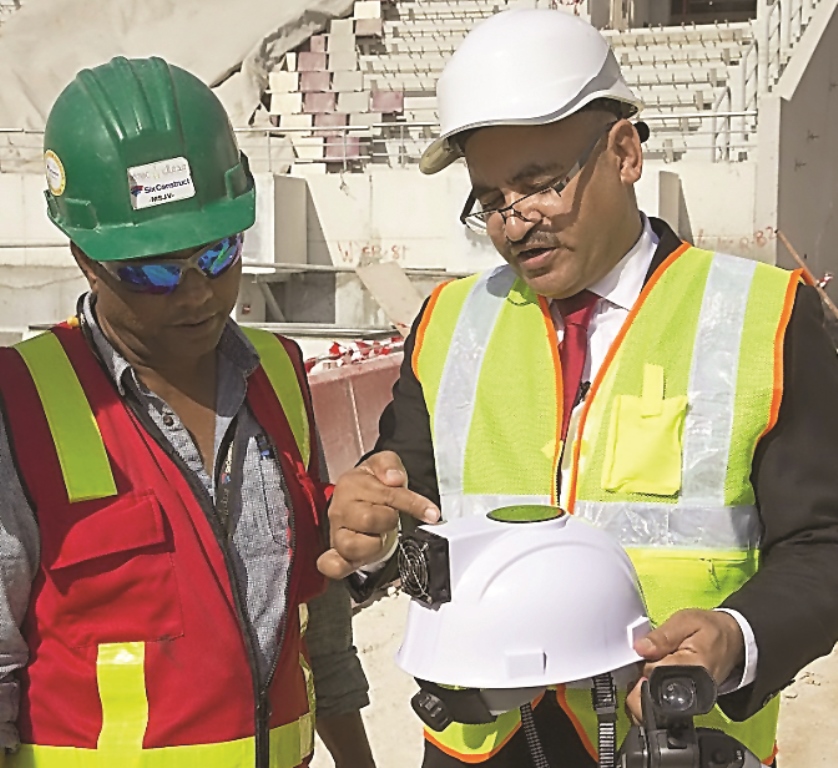
Doha: Providing a safer and more comfortable working conditions in the harsh summer months, researchers in Qatar have developed an innovative cooling helmet. Studies conducted so far show that the helmet has the potential to significantly reduce the body temperature of construction workers by up to 10 degrees centigrade, according to researchers working on the new system at Qatar University (QU).
The solar-powered helmet has been rigorously tested, patented worldwide and put through the production stage by a group of Doha-based scientists in cooperation with the Supreme Committee for Delivery and Legacy (SC) and Aspire Zone Foundation (Aspire). More units have now been ordered with the objective to incorporate them for the coming summer period across SC projects.
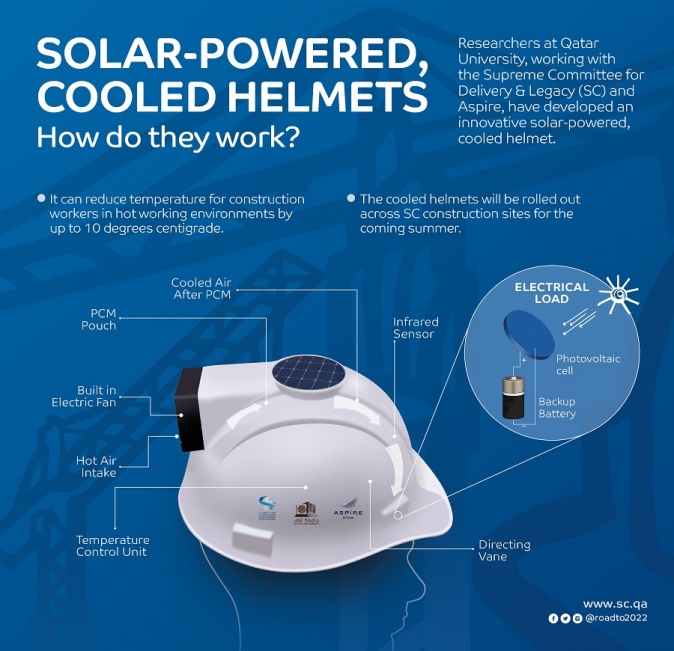
“Our concept is to use a solar-powered fan to blow air over a cooled material at the top of the helmet, which will then come down over the front of the person’s face and provide a cooler micro-climate for the worker,” said Dr Saud Abdul Aziz Abdul Ghani, Professor at the College of Engineering at QU.
An additional weight of just 300 grammes and a small solar panel attached to the helmet ensures that the new product is both safe and effective.
“The material we use inside the helmet is Phase Changing Material (PCM) contained in a pouch. This provides cooling in hot conditions for up to four hours straight. When they go for a break, workers can throw it into a refrigerator and pick up a cold pack and put it into their helmets,” he said.
Cooling helmet to be used in World Cup projects
“We did research on the best areas to lower body temperature, and it was the head and face. The additional cost is just twenty dollars in comparison to a normal passive helmet, but the results are felt immediately in terms of less lost time on site due to heat-related complaints,” Dr Saud Abdul Aziz Abdul Ghani said.
During the testing and development phases, a number of detailed studies were done. The system was tested in climatic chambers, analysing the amount of sweat and adding the effect of sun, air, wind and measurement of the amount of heat that passed through the head. Least possible weight and cost was added in order to keep the technology accessible.
“By reducing the temperature of the head and face, the rest of the body will naturally follow and ensure that workers have a constant flow of cooler air to refresh them throughout their day. We believe it has the potential to revolutionise the construction industry in hotter areas of the world,” Dr Abdul Ghani said.
The researcher has been working on the project for two years along with a group of students from Qatar, Jordan, Greece and Egypt, and is cooperating closely with the SC and Aspire on the project in order to implement it on construction sites for the 2022 FIFA World Cup Qatar.
“As we continue to place workers’ welfare as a top priority across all our construction sites, we are working hard to find and develop the most innovative and advanced solutions in our preparations for the 2022 FIFA World Cup in Qatar,” said Engineer Hilal Jeham Al Kuwari, SC Chairman – Technical Delivery Office Advanced testing has already taken place on the cooled helmet and the developers have pointed to a number of regions where the technology could also be applied once it goes into mass production.