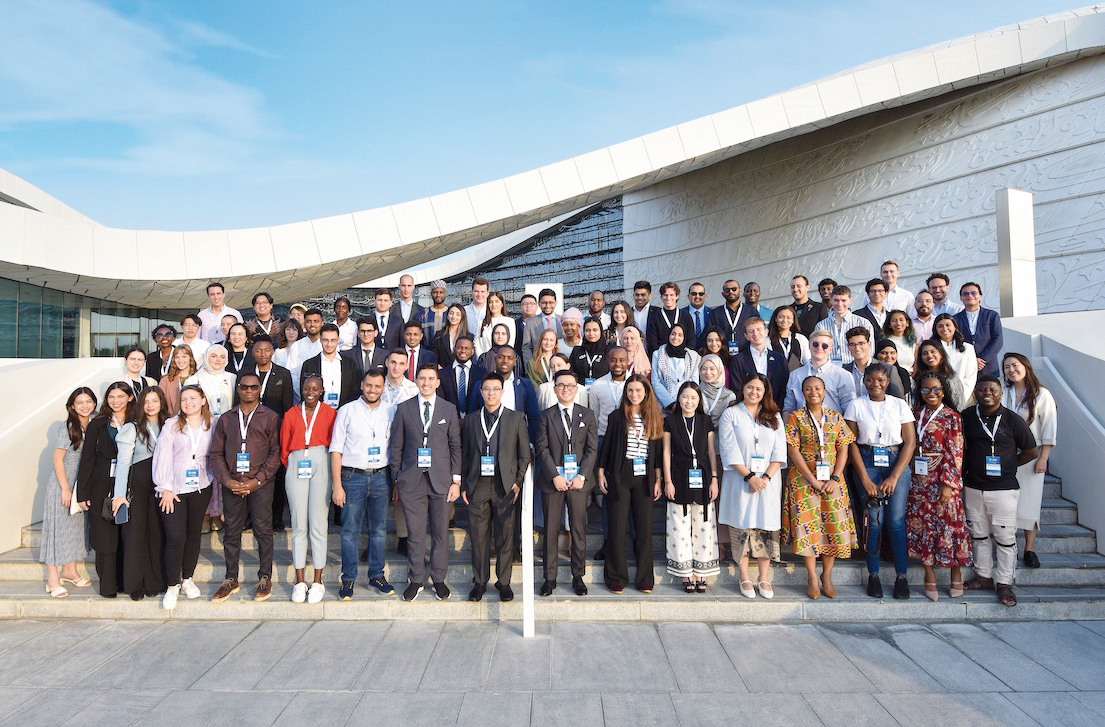
Group photo of participants of the Doha Forum: Youth Edition 2023.
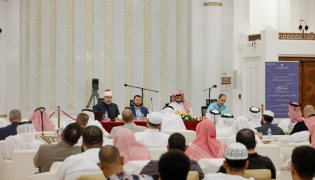
Doha, Qatar: Doha Forum: Youth Edition 2023, powered by QatarDebate Center, kicked off the second day of insightful discussions held at Georgetown University (GU-Q) yesterday, touching on issues ranging from the Palestinian-Israeli war to building a sustainable world for future generations.
In his opening speech prior to the first expert panel discussion, Dr. Norman Finkelstein, named in 2020 as the fifth most influential political scientist in the world, said, “We’ve had this brutal, heartless, illegal blockade of Gaza for over 20 years.”
Speaking to an audience of over 80 delegates from his home in Brooklyn, United States, he added, “It is a 20-year long crime against humanity, which the whole world is cognizant of but allows to continue. However, that’s only half the story. The other half of the story is that every few years, Israel mows the lawn in Gaza. Mowing the lawn in Gaza means every few years – 2008, 2012, 2014 – Israel commits a high-tech massacre in Gaza.” The first expert panel discussion titled “Bridging A Divided World: The Politics of Peace” was led by Palestinian moderator A. Safaa Jaber and comprised panelists Dr. Norman Finkelstein; Mouin Rabbani, a researcher and analyst specialized in Palestinian affairs, the Arab-Israeli conflict, and the contemporary Middle East; and, Taghreed Elkhodary, a former New York Times correspondent based in Gaza.
The panelists discussed the history and roots of the conflict that has spanned decades, leading to the October 7 attacks on Gaza. Delegates from over 75 countries listened to the engaging talk which shed light on the most prominent challenges facing the Palestinian people, key players and stakeholders in the conflict, global diverging legal views and the crucial role of media and foreign powers.
Commenting on the recent October 7 attacks, Mouin Rabbani, acknowledged that Israel have historically tried to eradicate Gazans from their homes. He noted, “Israel has always had the ambition to remove the population of Gaza.” On whether this will be successful, Rabbani noted that, “It is important to not underestimate the resourcefulness of Palestinians.”
Speaking on the nature of coverage by Western media on the situation in Gaza, Taghreed Elkhodary commented, “International media are living the Israeli narrative, they are embedded there and living the narrative by reporting either from Tel Aviv or from Jerusalem. So the stories coming from the Israeli side are rich and moving because it includes the life stories of people. Meanwhile, Gaza is simply covered as a news item with no context.”
During the second expert panel session titled “Sustainability and Economic Policy”, moderator Arina Najwa from Malaysia led discussions alongside a panel comprised of Donia Abdelwahed, Programme Officer for the Science Sector at Unesco; Professor Eduardo G. Pereira, a worldwide recognized scholar specialising in Natural Resources and Energy Law; and, Professor Damilola S. Olawuyi, SAN (QC), a Unesco Chairholder on Environmental Law and Sustainable Development at the College of Law in Nigeria.
The panel discussed the trends shaping global energy demand and efforts to maintain energy security, energy justice and the diversity of energy flows, as well as the industry’s ability to tackle pollution and reduce its carbon footprint by diversifying energy sources.
Donia Abdelwahed commented, “We must continue advocating and raising awareness at a community level with youth. They are already aware, and I believe that they know much more than previous generations.” She added, “There is a need to localize what is happening on a global level at their own community level, to take action within their community to try find solutions which resonate with their local community.”