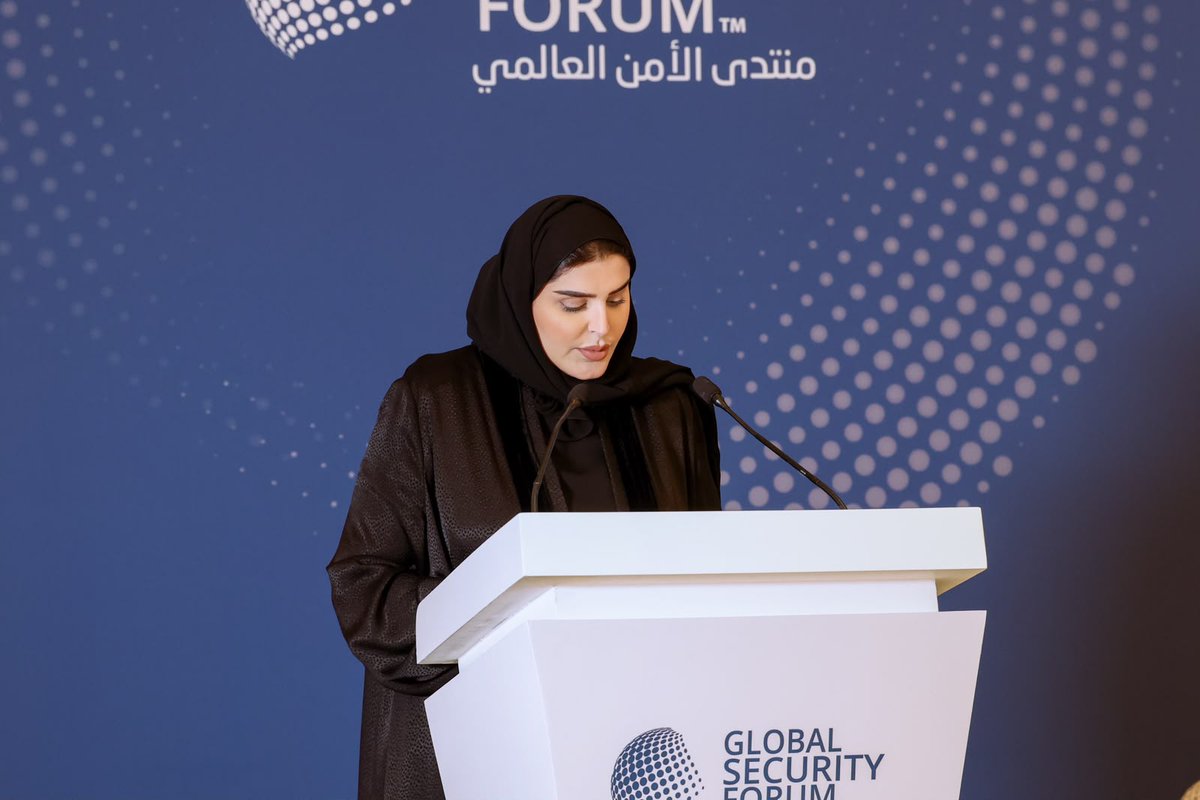
Doha: Minister of State for International Cooperation HE Maryam bint Ali bin Nasser Al Misnad participated today in a focus panel titled "Bridging Humanitarian Diplomacy to Water Security," held as part of the Global Security Forum 2026 in Doha.
In her opening remarks for the session, Her Excellency expressed her appreciation to the Geneva Water Hub and the Embassy of the Swiss Confederation in Qatar for organizing this important and timely dialogue regarding the role of humanitarian diplomacy in protecting water resources during armed conflicts.
This discussion comes at a critical time, as the region faces significant security risks that could have repercussions for the broader global economy, Her Excellency said.
She added that the State of Qatar's participation in this discussion is particularly significant, given its steadfast commitment to preventive diplomacy, mediation, and strengthening resilience in the face of regional and international challenges.
Her Excellency explained that Qatar's experience in conflict prevention, de-escalation, and the facilitation of humanitarian responses offers valuable insights into how diplomatic engagement can help mitigate the impact of crises on civilian populations and essential services.
She further noted that the region has faced mounting challenges to water security this year, amid escalating tensions and reports of attacks targeting critical water infrastructure.
She stated that these developments raise serious humanitarian concerns, as damage to water desalination plants, water treatment facilities, and distribution networks can undermine access to safe drinking water and adequate sanitation services, with far-reaching consequences for public health, human dignity, and the resilience of communities.
She emphasized that these challenges underscore the necessity of ensuring the protection of essential civilian infrastructure, in accordance with international humanitarian law, and strengthening international cooperation to prevent the disruption of vital water services. In this regard, she noted that humanitarian diplomacy remains a crucial tool for fostering dialogue, facilitating humanitarian access, and encouraging collective efforts to safeguard water security, particularly during times of conflict and crisis.
HE the Minister of State for International Cooperation stated that Qatar has contributed to the protection of essential resources during armed conflicts through humanitarian aid, diplomacy, mediation, the financing of reconstruction, and the provision of support to displaced civilians, efforts clearly demonstrated in its work in Gaza, Sudan, Afghanistan, Lebanon, Somalia, and Syria.
She continued: Qatar has worked with Egypt and the United States to reach a joint agreement ensuring the delivery of significant quantities of humanitarian and relief aid to our Palestinian brothers and sisters in the Gaza Strip. These efforts continue today, in cooperation with Qatar's mediation partners -Egypt, Turkey, and the United States- to ensure the implementation of the second phase of the ceasefire agreement in the Gaza Strip, the reopening of the Rafah crossing, and the delivery of humanitarian aid to the Gaza Strip.
Her Excellency emphasized that the protection of water infrastructure during armed conflicts is not limited to the safeguards provided by international humanitarian law; it is further reinforced by other branches of international law, including international human rights law and environmental law.
She stated that the greatest threat to the protection of civilians today is not the absence of laws, but rather the failure to comply with them or their selective application. For this reason, humanitarian diplomacy must be an integral part of the discourse on water security.
HE Minister of State for International Cooperation Maryam bint Ali bin Nasser Al Misnad underlined the importance of joining forces to influence parties to armed conflicts, urging them to protect essential resources for the benefit of those affected by such conflicts.
Furthermore, knowledge and expertise regarding resilience during armed conflicts should be shared to lay a foundation for global stability and to uphold the fundamental human right to access clean water.