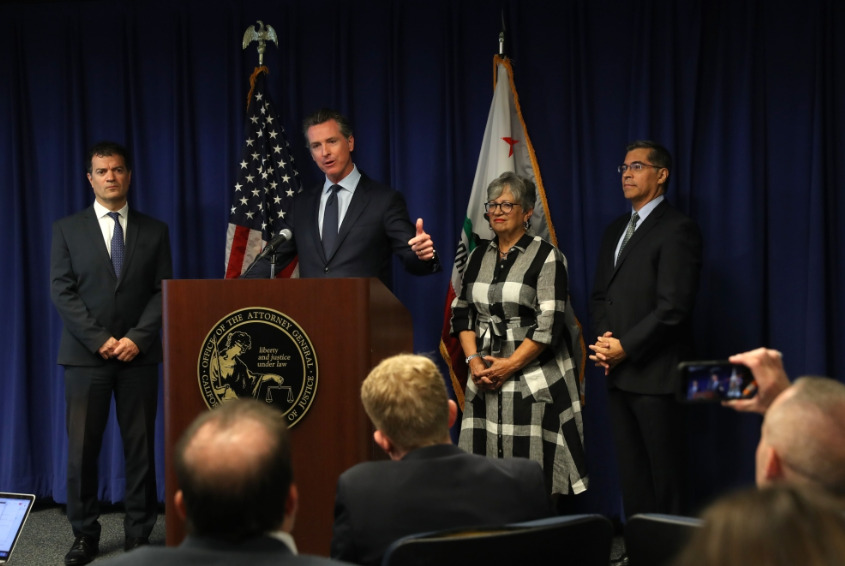
File photo of California Governor Gavin Newsom for representational purposes only.
Los Angeles, United States: California's governor signed an executive order instructing state officials to study mandatory "kill switches" and other safety mechanisms for the most advanced artificial intelligence models.
"The federal government's abject failure to create any form of meaningful AI oversight or accountability should alarm every American, especially when AI CEOs themselves are begging for regulation," Newsom said in a statement.
"We're not waiting to act -- we're going to speed up our work on substantial and responsible AI oversight before it's too late."
The order comes days after dire warnings from industry insiders about the threat the technology poses to humanity.
Jacob Coxon, a former AI researcher who said he worked at Anthropic before resigning, set off the latest round of alarm describing how those building the technology "earnestly believe that it could kill us all by the end of the decade."
Anthropic chief executive Dario Amodei published an essay soon after urging caution. "We must slow the pace at which we improve the capabilities of AI models," he wrote.
OpenAI chief Sam Altman and tech titan Elon Musk lent their support to the idea, as did Google DeepMind's Demis Hassabis, who himself has called for a US-led global regulatory body for the technology.
Newsom's order does not impose a kill switch. It directs state agencies to report by November 16 on whether one is feasible.
The term "kill switch" refers to the ability to halt an AI system when it is deemed to have malfunctioned or gone off the rails.
The order also asks state officials to weigh requiring AI companies to host independent auditors in their labs.
It also asks officials to consider requiring companies to report loss-of-control incidents, such as those recently disclosed by major developers.
They include a July breach of the AI platform Hugging Face by autonomous agents built on OpenAI models, which escaped a testing environment during an internal evaluation.
The incident, and others like it, have raised fears that the latest AI programs have slipped out of the control of the companies building them.