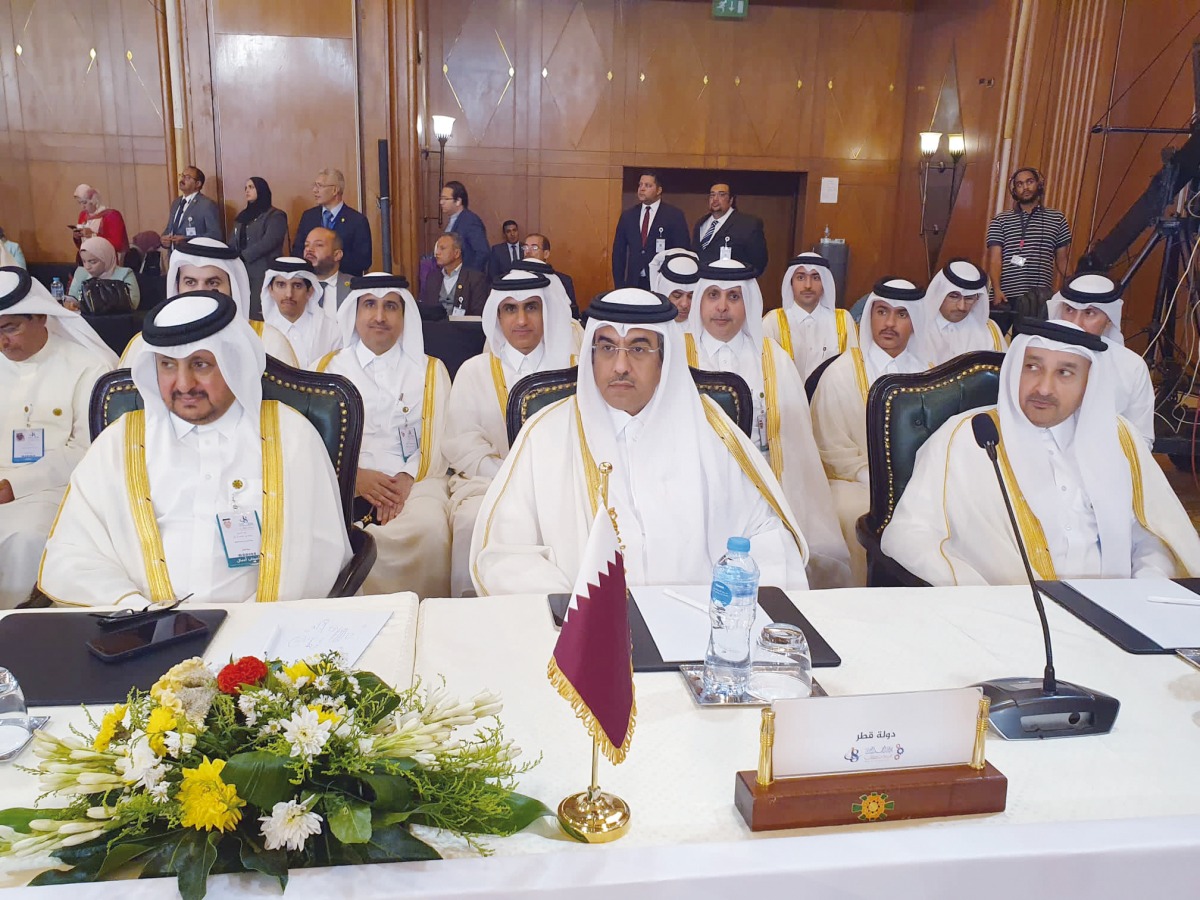
Minister of Labour H E Dr. Ali bin Smaikh Al Marri, Qatar Chamber Chairman Sheikh Khalifa bin Jassim Al Thani with other officials during the 47th session of the Arab Labour Conference, and the 38th meeting of the Permanent Committee for Labour Affairs in the Union of Arab Chambers in Cairo.
Doha: The Qatar Chamber recently participated in the 47th session of the Arab Labour Conference, and the 38th meeting of the Permanent Committee for Labour Affairs in the Union of Arab Chambers which were held in Cairo.
The Chamber’s participation in the meetings came in the framework of the State of Qatar’s delegation which was led by the Minister of Labour H E Dr. Ali bin Smaikh Al Marri.
The Chamber’s delegation was headed by its Chairman Sheikh Khalifa bin Jassim Al Thani. It also included the General Manager Saleh bin Hamad Al Sharqi, Director of legal affairs Abdulaziz Al Kuwari, Director of member affairs Alanoud Al Mohannadi, and Assistant Director of legal affairs Hamad Al Marri. The agenda of the 38th meeting of the Permanent Committee for Labour Affairs touched on many topics including a report of the Director-General of the Arab Labor Office on the digital economy and empowerment issues, a report on the activities and achievements of the Arab Labor Organization in 2021, the implementation of Arab labor agreements and recommendations, a report on artificial intelligence, and a report on the digitization and governance of social protection systems.
On this occasion, Sheikh Khalifa bin Jassim affirmed the Chamber’s support for efforts to promote joint Arab action in various fields, especially economic and development.
He pointed out that holding the ‘Arab Labour Conference’ this year under the theme ‘The digital economy and employment issues’ confirms the importance of keeping pace with the tremendous development that the world is currently witnessing in the field of information and communication technology, stressing that this requires the rehabilitation of the private sector to keep pace with this huge development in digital technology.
He pointed out that the transition to the digital economy will contribute to promoting economic growth and enhancing opportunities to attract investments through streamlining the online communication, as well as the benefits of digitization in employment issues and supplying the labour markets with the necessary employment.