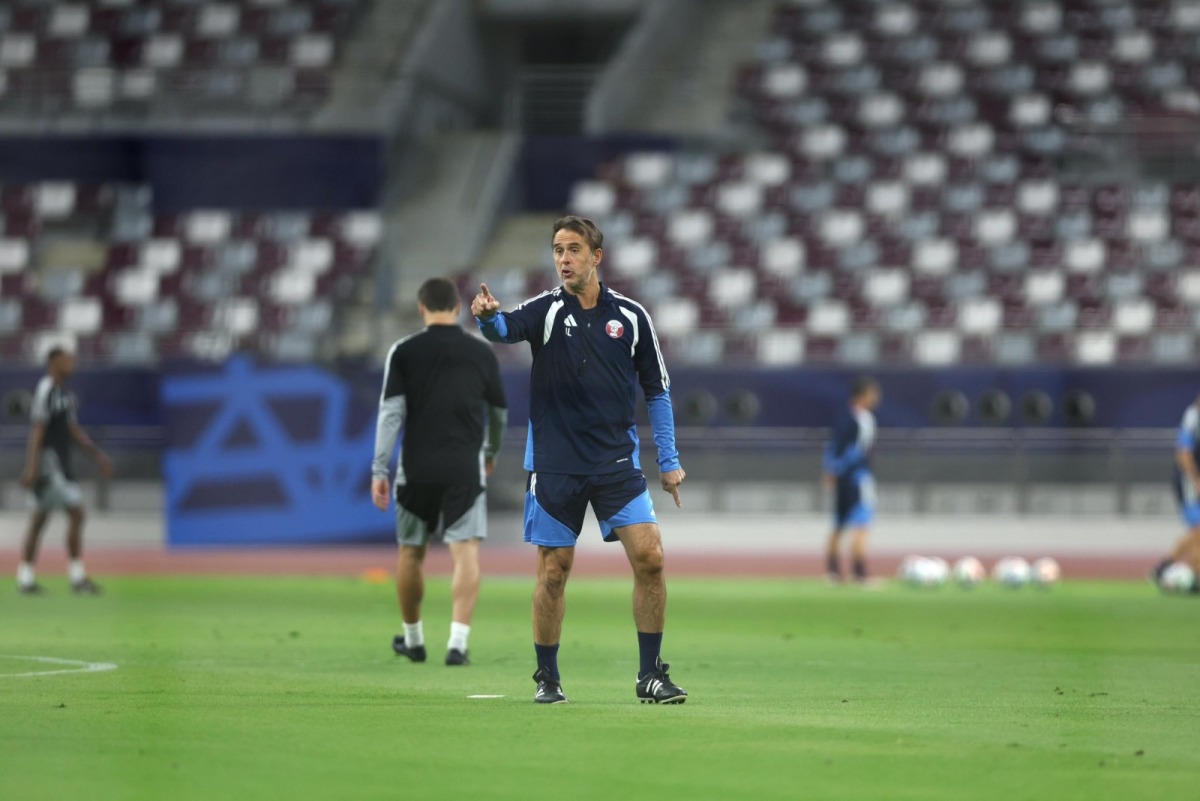
Doha, Qatar: Julen Lopetegui is not making lofty promises as he prepares Qatar for their historic participation in the FIFA World Cup 2026. Instead, the head coach says he “dreams” of seeing Al Annabi become competitive against some of the world’s strongest teams in football’s biggest stage.
The two-time Asian champions will head to North America for the June 11-July 19 showpiece, marking the first time Qatar have qualified for a World Cup through the qualifying process. Their debut appearance in 2022 came as hosts, but this time they earned their place after navigating a demanding Asian campaign, sealing qualification with a dramatic 2-1 win over the United Arab Emirates.
Having taken charge amid changes in the national team set-up during qualifying, Lopetegui now faces arguably the biggest challenge of his tenure. Qatar have been drawn in Group B alongside Switzerland, co-hosts Canada and Bosnia and Herzegovina, the opponents the Spaniard openly admits are stronger on paper.
Yet, speaking in an interview with QNA, the former Spain and Real Madrid coach made it clear that Qatar will not head into the tournament merely to make up the numbers.
“We have the ambition and the dream to be competitive in the World Cup because we won our right to be there,” Lopetegui said.
“No one gave us this opportunity. We earned it and now we have to be ready to do our best, being humble and understanding the level of our opponents.”
Lopetegui is realistic about the challenge awaiting Qatar. Switzerland, whom Al Annabi face in their opening match on June 13, are among Europe’s most consistent teams and have been a regular force in major tournaments.
“Switzerland are maybe one of the most balanced teams in Europe in the last eight years,” he said. “They have the same coach, very good players and footballers competing in the Champions League, Premier League, Serie A and La Liga.”
Canada, Qatar’s second opponents in Vancouver on June 19, also represent a stern test according to Lopetegui, who pointed to the quality of players competing at elite European clubs.
“You analyse Canada’s line-up and most of their players compete in the Champions League,” he said, adding that Bosnia and Herzegovina - Qatar’s final opponents on June 24 - pose a similarly difficult challenge.
But despite repeatedly acknowledging the gulf in experience and pedigree, Lopetegui believes Qatar must embrace the challenge rather than fear it.
“We know they are better than us, but now they have to beat us,” he said. “We cannot lie to ourselves about the reality, but we have the dream to compete and to be competitive.”
Preparation, according to the 59-year-old, will be central to Qatar’s hopes of making an impression.
Unlike domestic football schedules in Qatar, several World Cup matches in North America will take place earlier in the day, forcing players to adapt physically and mentally.
“Here you never play in the morning, usually you play at night,” Lopetegui explained. “We have to start working in the morning. We have to change many things in our bodies and minds to be ready.”
The coach stressed that the coming weeks will revolve around intense work, commitment and careful planning to ensure the team peak at the right moment.
“There is no switch on and switch off,” he said. “We have to work on effort, spirit and commitment to arrive stronger when June comes.”
Lopetegui also revealed that avoiding injuries remains one of his biggest concerns ahead of Qatar’s final preparations.
“The most important thing is to have as few injuries as possible,” he said. “We are crossing our fingers because there is no time to recover if players suffer injuries at this stage.”
With several senior players in the squad aged 35 or older, managing workloads has become crucial. Lopetegui said this was one of the reasons behind squad rotation during recent tournaments, including the Arab Cup, as Qatar attempt to strike a balance between experience and freshness.
“We have to take care of the players to arrive at the World Cup in the best possible condition,” he said. “Sometimes you have to make different choices because we want them ready for the big challenge in June.”
The Spaniard also addressed the cancellation of high-profile matches against Argentina and Serbia in March, a challenge he admitted would have been valuable tests for Qatar.
“It was not good for us because we lost the possibility to compete against very demanding teams,” Lopetegui said.
Lopetegui defended the decision to hold an ongoing training camp, citing the physical risk to players who had already spent extended time away from their clubs.
“It was a bad period and many players had already been out of their teams for around 15 days,” he said. “It was a big risk to force them to play these kinds of matches, so we adapted and focused on training.”
Even so, the coach insisted strong opponents are essential for Qatar’s development, pointing to last year’s defeat to Russia as an example of how difficult fixtures can sharpen the team before decisive matches.
“Sometimes these tough matches teach you a lot,” he said. “Against stronger teams you understand your real level and what you need to improve.”
On the player front, Lopetegui admitted fitness and match rhythm will heavily influence his final squad selection, particularly in the case of striker Almoez Ali, who endured an injury-hit campaign.
“In Ali’s case, unfortunately he only played around two matches this year because of injuries and surgery,” Lopetegui said, referring to Almoez Ali.
“For this level of competition, rhythm is very important. We hope he improves step by step because all players need minutes to be physically ready.”
Despite the challenges, Lopetegui urged Qatari fans to savour the moment, describing qualification itself as a historic achievement.
“Qatari people should be proud because we achieved something many countries could not,” he said.
“We achieved one dream of qualifying for the World Cup. Now we have another dream, to be competitive and to make the people proud of the team’s behaviour, spirit and fight.”