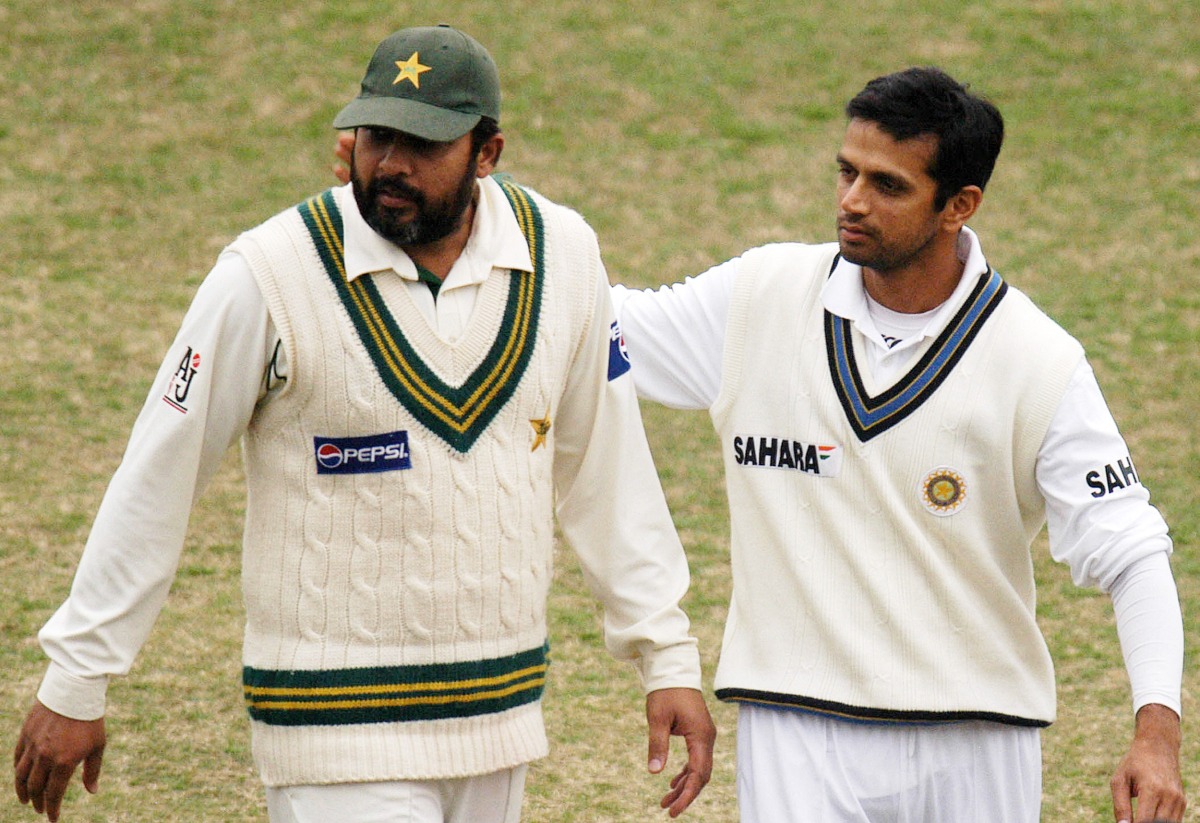
Pakistan's Inzamam-ul-Haq (left) and India's Rahul Dravid leave the ground at close of play on the last day of the first Test match in Lahore, in this January 17, 2006 file photo. AFP
Doha, Qatar: The soft-spoken giant, who once caressed the ball through the covers with effortless grace, still carries the calm of his batting days. Even in retirement, Inzamam-ul-Haq speaks in measured tones, choosing diplomacy over drama, but when the conversation turned to India and Pakistan cricket, conviction replaced caution.
While speaking to media in Doha during a private visit, one of Pakistan’s greatest batters leaned on nostalgia and possibility, imagining a rivalry restored to its full theatre.
“If Pakistan and India play a Test series, then the Ashes between England and Australia will be much less popular – there would be at least a 50 percent gap,” Inzamam said, his voice carrying the certainty of a man who experienced cricket’s fiercest rivalry from the middle.
“Politics should be kept aside. At least Pakistan and India must play in ICC [International Cricket Council] events in good spirit. There should even be bilateral series.”
For a generation, few embodied Pakistan’s batting resilience like Inzamam. Blessed with velvet timing rather than visible urgency, he often appeared untroubled even against the quickest bowlers. Where others fought pressure, Inzamam absorbed it. The languid drives, soft hands and ability to find gaps made him one of the most elegant middle-order batters of his era.
By the time he retired, he had piled up 8,830 runs in 120 Tests and 11,739 in 378 ODIs, numbers that placed him among Pakistan’s batting royalty. He struck 25 Test centuries and for years sat just behind mentor Javed Miandad among Pakistan’s leading Test run-scorers before later generations rewrote the record books.
Yet his legacy stretches beyond numbers. As a 21-year-old, Inzamam announced himself on the grandest stage, blasting a breathtaking 60 off 37 balls against New Zealand in the semi-final of the 1992 World Cup – an innings that changed Pakistan’s destiny and paved the way for their only ODI World Cup title.
But for Inzamam, cricket’s most magnetic rivalry has lost part of its soul. Political tensions have confined India and Pakistan to ICC and continental events, with no bilateral cricket since 2012-13.
The rivalry, however, remains unmatched in emotion and expectation. The recent Asia Cup handshake controversy and the trophy presentation row involving India’s captain Suryakumar Yadav and Asian Cricket Council President Mohsin Naqvi again highlighted how even routine moments between Pakistan and India are magnified beyond the field.
“Pakistan and India players shared cordial relations in the past. We used to visit each other’s rooms in the team hotel, but on the field we were rivals,” Inzamam recalled. “This is how it should be.”
Pakistan’s struggles against India in ICC tournaments, particularly at World Cups, have frustrated their supporters. Pakistan have lost all eight matches against India in the ODI World Cup and won only one match while losing eight in the T20 World Cup, but Inzamam dismissed theories of technical inferiority.
“It’s all about pressure. There is a lot of pressure on players when Pakistan and India are playing. Even when we play veterans cricket, there is pressure,” he said with a smile.
“We are waiting for the jinx to be broken, and it will end one day.”
The conversation soon shifted to Pakistan’s current troubles – a side searching for consistency after painful Test setbacks, including a recent defeat against Bangladesh.
Inzamam’s diagnosis was blunt as he said Pakistan are drifting away from the foundations that once made them formidable.
“We need to play four-day cricket. The more we play four-day cricket, the more we can improve our performances in Tests,” he said.
“It’s not that Pakistan do not have talent. The only reason is that they have not played enough four-day cricket.”
He urged young players to spend time in county cricket, arguing that experience cannot be manufactured in dressing rooms.
“No coach will teach what the ground teaches players,” he said.
For a country once blessed with the menace of Wasim Akram and Waqar Younis, the decline in bowling standards worries him.
“In our times, we had many quality bowlers and some had to sit out because there were so many,” he said.
“Unfortunately, we do not have those fast bowlers or even quality spinners now, but the Pakistan board is working on it.”
Asked to name the most influential cricketers of the last two decades, Inzamam quickly turned to modern greats.
“Virat Kohli inspired a generation,” he said, before also naming Steve Smith, Joe Root and James Anderson – players who, in different ways, redefined longevity and excellence.
Still, one unfinished chapter lingers in memory.
Inzamam ended his Test career agonisingly short of surpassing Miandad’s Pakistan record tally at the time – falling two runs shy of his mentor’s mark.
“I learnt a lot from Javed Miandad,” he said. “Even if I had broken his record, he would still remain a greater batsman,” he added.